For procurement officers, executive producers, and marketing directors, selecting a creative vendor is not just about reviewing a stunning portfolio. It is a rigorous exercise in risk management, resource allocation, and operational due diligence. Animation production is highly technical, capital-intensive, and operationally complex. A breakdown in communication, a sudden timeline slippage, or a misunderstanding regarding intellectual property (IP) rights can derail an entire product launch or campaign.
To safeguard your organization’s investment and ensure a seamless partnership, your team must conduct thorough vendor due diligence. Before signing any service level agreement (SLA) or statement of work (SOW), ask these critical questions across four foundational operational areas.
1. Ask Questions About Process
Creative alignment is only half the battle; process alignment is what guarantees successful delivery. When auditing a studio’s operational workflow, look for structured, predictable pipelines that minimize budget volatility and catch technical friction early.
Read More: How to Partner with an Animation Studio
Pipeline, Scope & Feedback Auditing Questions:
1. Can you detail your exact pipeline from pre-production through final rendering?
A professional 3D animation studio should walk you through a clearly segmented process: from storyboarding and animatic development, to asset creation (3D modeling, rigging, sculpting, texturing), and finally to production and post-production (animation, retopology, rendering).
2. How are revisions budgeted, and what is your policy on out-of-scope requests?
Scope creep is the leading cause of budget overruns. Look for studios that offer built-in buffers. For example, some elite studios allocate up to 20% of the initial scope for revisions, modifications, and new requests at no additional cost, protecting you from sudden surcharges.
3. How do you document and integrate client feedback at each milestone?
Ensure the studio has a formalized tracking system so that every note is systematically addressed without getting lost in email chains.
Straight from the Source: Real Partner Experiences
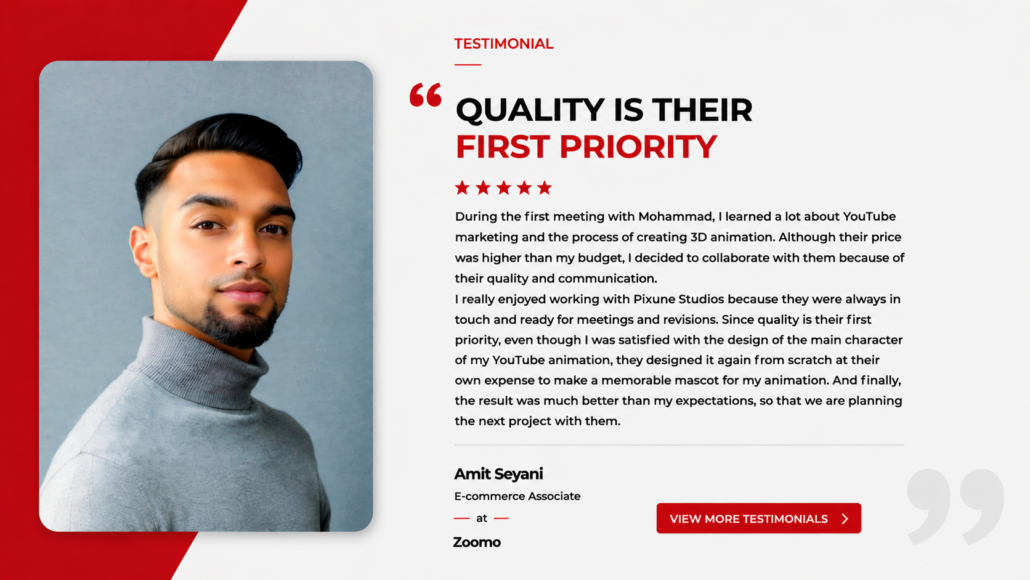
Based on what Amit Seyani (E-commerce Associate at Zoomo) has shared, a studio committed to quality will prioritize vendor alignment over strict contract boundaries. Seyani noted that even after approving a character design, Pixune chose to redesign the mascot from scratch at their own expense to deliver a superior, more memorable asset. This demonstrates the value of choosing a partner that treats quality as their first priority rather than nickel-and-diming for every minor iteration.
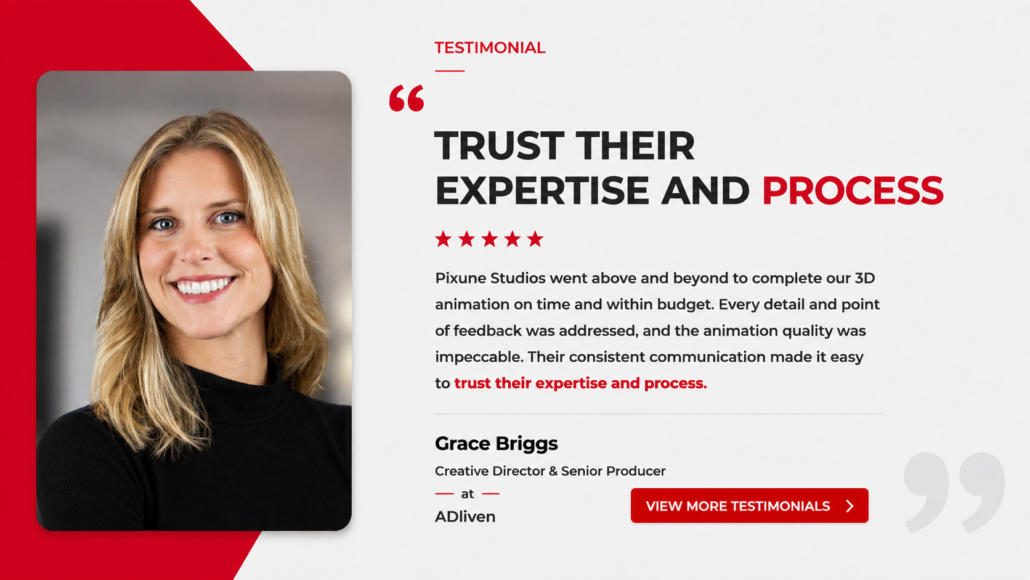
Based on what Grace Briggs (Creative Director & Senior Producer at ADliven) has told, a trustworthy partner must proactively ensure every feedback point is meticulously resolved within the agreed budget and timeline, keeping the quality of the final animation impeccable.
2. Ask Questions About Ownership & Rights
For corporate buyers and producers, protecting intellectual property and complying with data privacy regulations is paramount. You must establish clear legal boundaries before any design work begins.
IP, Asset Rights & Legal Compliance Questions:
1. Do we retain full ownership of all source files, character models, and rigging setups?
Verify that your contract guarantees complete IP transfer of all assets, including raw 3D models, textures, and rigs, not just the final rendered video. This allows your internal team to reuse the assets for future projects.
2. What are your data security and confidentiality protocols?
Ensure the studio has strict non-disclosure agreement (NDA) policies and secure file-sharing systems to protect your pre-launch brand secrets.
3. Are your forms and communication channels fully compliant with data privacy standards?
Ensure they adhere to modern legal frameworks, such as GDPR compliance for collecting and storing client information.
Straight from the Source: Real Partner Experiences
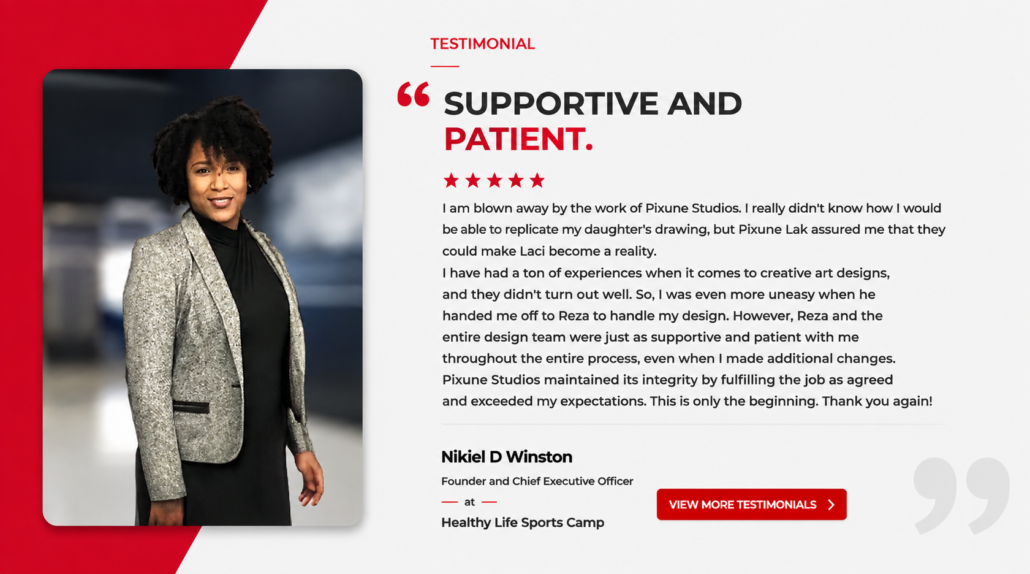
Based on what Nikiel D. Winston (Founder & CEO at Healthy Life Sports Camp) has shared, legal and operational security is rooted in the vendor’s integrity. Winston noted that despite previous negative experiences with creative designers who failed to deliver, partnering with a structured studio, Pixune Studios, that fully maintained its integrity by fulfilling the job exactly as agreed provided peace of mind and eliminated the anxiety of losing control.
3. Ask Questions About Timeline Accountability
An impressive reel means nothing if a studio cannot meet its shipping deadlines. Your due diligence must verify their capacity to handle pressure, absorb schedule shifts, and maintain delivery consistency.
SLA, Schedule & Risk Mitigation Questions:
1. What is your track record for on-time delivery across complex campaigns?
Look for a studio with a mature, high-volume track record, such as delivering over 300 minutes of polished animation to 40+ diverse clients.
2. How do you handle timeline recovery if a project falls behind?
Ask how they scale resources if internal delays or heavy feedback cycles threaten the launch date.
3. What measures do you take to prevent communication lag during tight turnarounds?
A studio’s responsiveness SLA is a strong indicator of timeline safety. Ensure they commit to rapid communication, such as responding to urgent inquiries within about 1 hour during working hours.
Straight from the Source: Real Partner Experiences
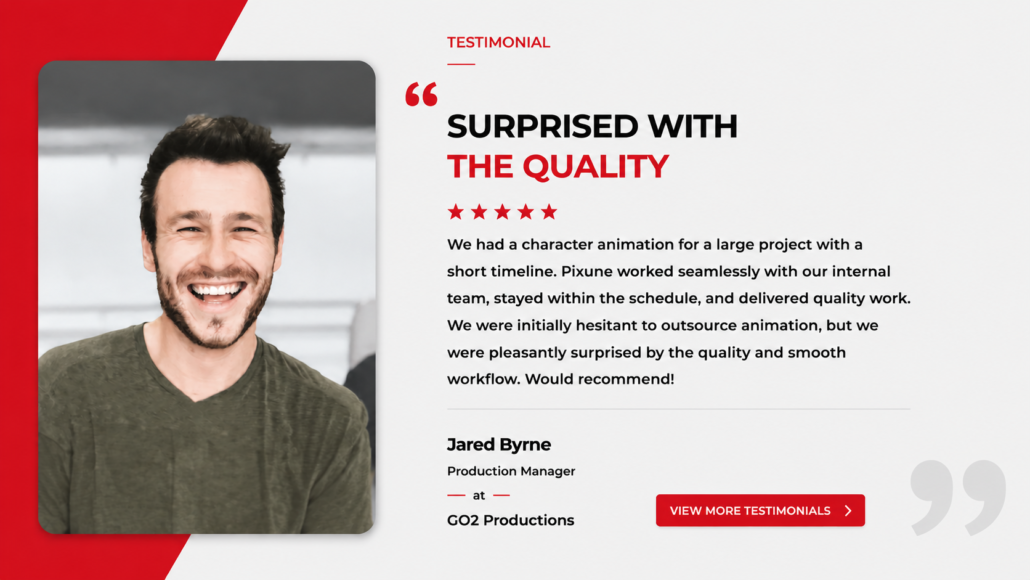
Based on what Jared Byrne (Production Manager at GO2 Productions) has shared, look for studios that can work seamlessly alongside your internal team. Byrne noted that even when managing large character animation projects on extremely short timelines, a professional studio’s ability to coordinate smoothly with existing in-house personnel keeps the schedule stable and eliminates the friction typically associated with outsourcing.
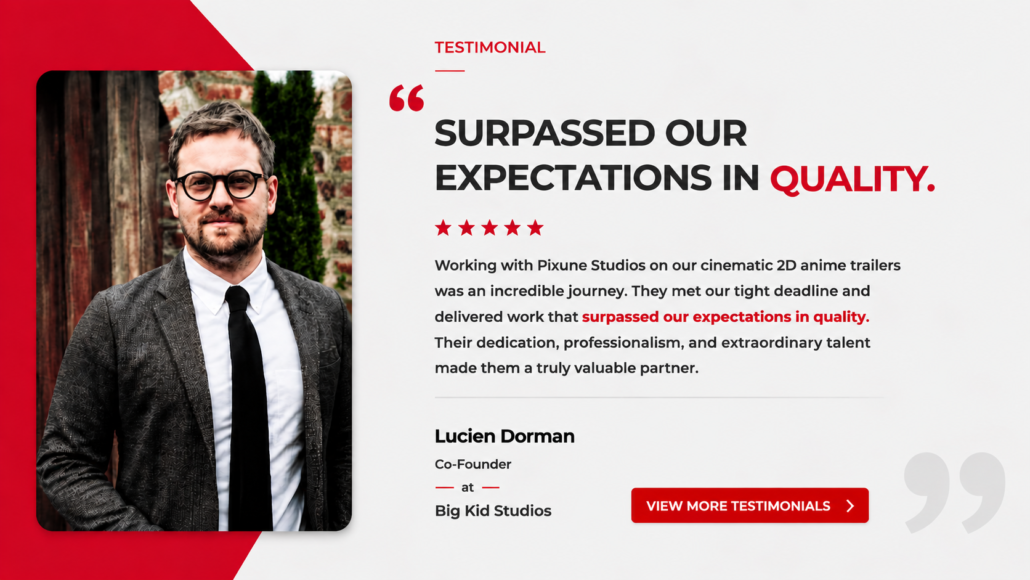
Based on what Lucien Dorman (Co-Founder at Big Kid Studios) has told, an experienced 2D animation agency has the talent and structural capacity to handle incredibly tight deadlines for complex, highly stylized assets, like cinematic 2D anime trailers, without letting the visual quality suffer.
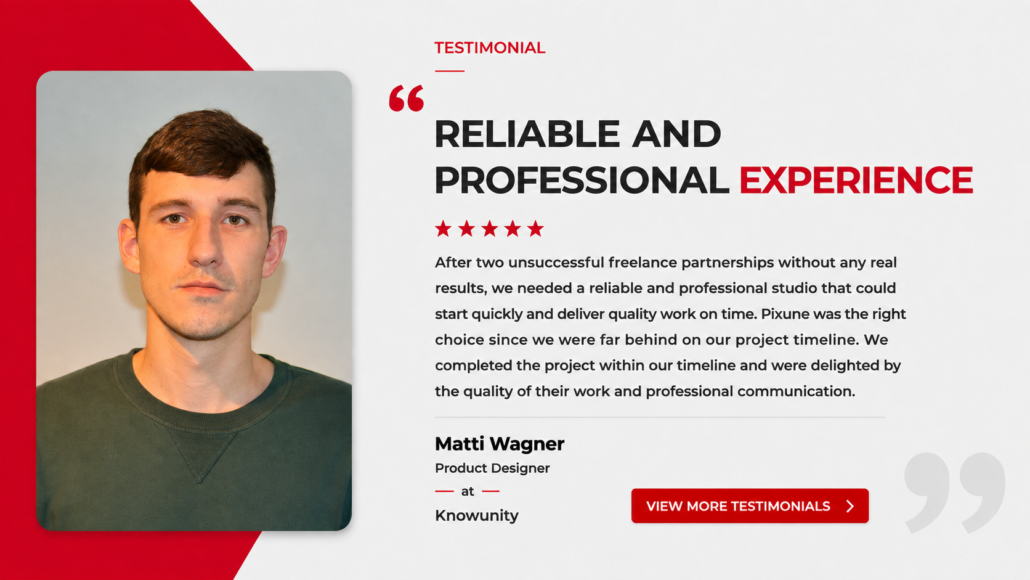
Based on what Matti Wagner (Product Designer at Knowunity) has shared, selecting a studio with a reliable and professional team is the ultimate insurance policy. Wagner noted that after two unsuccessful freelance partnerships failed to produce any results and left them far behind schedule, bringing in a reliable studio, Pixune Studios, allowed them to quickly restart and successfully complete the project on time.
4. Ask Questions About Team Structure
To ensure project continuity, you must understand who is actually working on the animation services. You need to know if your project is being handed off to unmanaged freelancers or if it is being executed by a dedicated, stable core team.
Team Composition, Stability & Management Questions:
1. Who will be our primary point of contact, and how is the project managed internally?
Verify if you will have a dedicated account representative and project coordinator to handle day-to-day updates and bridge the gap between you and the design team.
2. What is your core team’s retention rate and experience level?
A high client retention rate (such as 95%) often points to a highly stable, consistent internal team that keeps production quality uniform across long-term engagements.
3. Are the artists working on our project in-house staff or temporary contractors?
In-house teams offer far greater security, consistency of style, and resource availability than studios that rely entirely on ad-hoc networks.
Straight from the Source: Real Partner Experiences
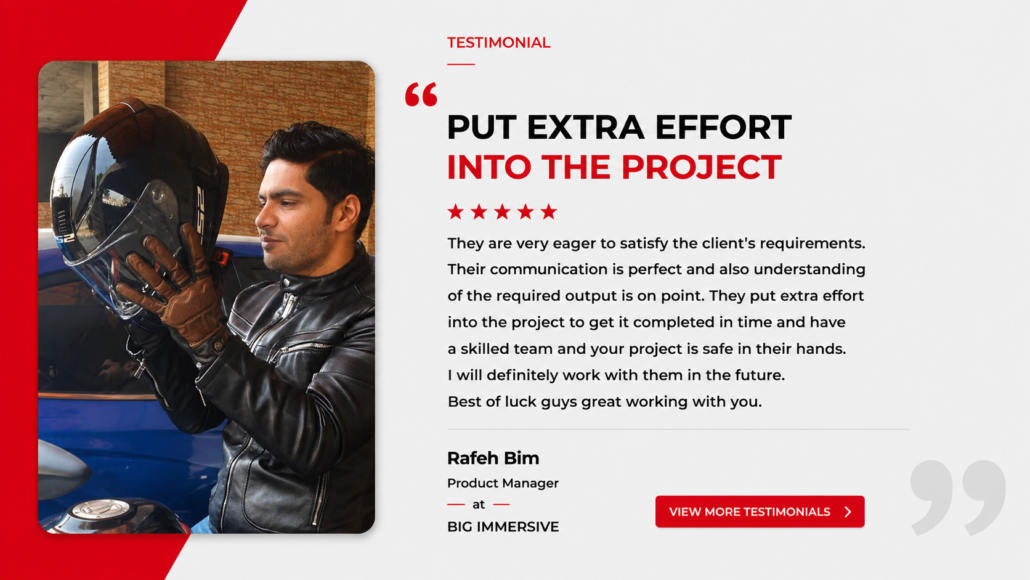
Based on what Rafeh Bim (Product Manager at BIG IMMERSIVE) has shared, your project is only as safe as the hands of the team managing it. Bim emphasized that a studio with a highly skilled, dedicated team that actively puts extra effort into the project to guarantee timely delivery offers a level of safety and reliability that disjointed freelance setups simply cannot match.
Conducting rigorous vendor due diligence is not about placing bureaucratic boundaries around creative output. Instead, it is about establishing the structural and operational safety nets that allow bold creative concepts to thrive. While a studio’s aesthetic portfolio proves their artistic capability, their answers to these structural questions reveal their operational integrity.
By thoroughly vetting a potential animation partner’s production pipeline, intellectual property boundaries, timeline protections, and team composition, procurement teams can transform high-stakes creative outsourcing from a high-risk gamble into a highly predictable, repeatable asset-generation pipeline. A studio that answers these due diligence questions with absolute transparency, backed by a proven track record of on-time, on-budget, and high-retention delivery, represents a partner you can trust to build long-term value for your brand.