
The gaming business is growing very quickly. We’re talking about $300 billion by 2025, which is more than the combined value of movies and music. Meanwhile, hundreds of new games come out every week for PCs, consoles, and mobile devices. But most players don’t think about what makes these games work.
There is a team of testers behind every smooth gaming experience that you never see. They’re the ones who play levels 50 times in a row, crash systems on purpose, and write down bugs in minute detail. Without them, your favorite games would be broken when they first came out.
Here we will explain what game testing is, why it’s so important, and how the whole process works from the idea stage to after the game is released. If you’re interested in the industry or thinking about a career in QA, learning about testing will change the way you think about games.
What Exactly is Game Testing? (The Real Definition)
Testing games sounds like a dream job, but it’s not like playing games for fun. Well, game testing is a systematic quality control process in which experts check every part of a video game to find bugs before players do.
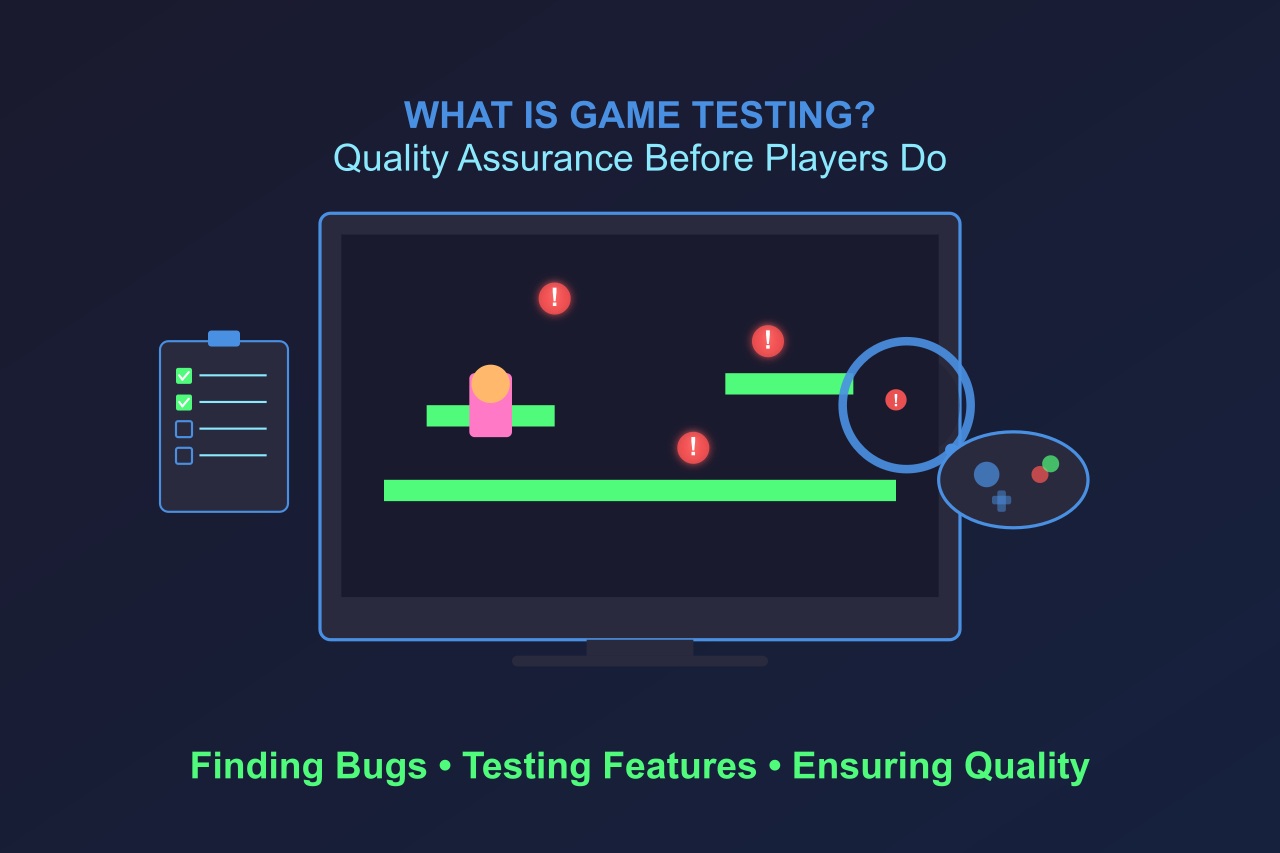
These professionals do quality assurance so that the game’s end result meets certain standards, such as smooth gameplay, no game-breaking bugs, good performance on all platforms, and adjusting platform requirements like PlayStation’s TRC or Xbox’s Requirements.
There is a clear difference between you who play the game for fun with a game teater who digs into the details:
- Playing for fun: You can explore as much as you want, enjoy the story, and stop when you’re bored.
- Professional game testing: You play the same level 50 times, write down every crash, and follow strict rules even when they make you want to scream.
In fact, testers don’t just say, “The game crashed.” Instead, they document exactly what happened, how to make it happen again, what hardware was used, and also record video evidence. So it’s a methodical job that needs a lot of focus.
What Do Game Testers Actually Do?
If you think that game testing is just playing the game, then we shall say you are wrong deeply.
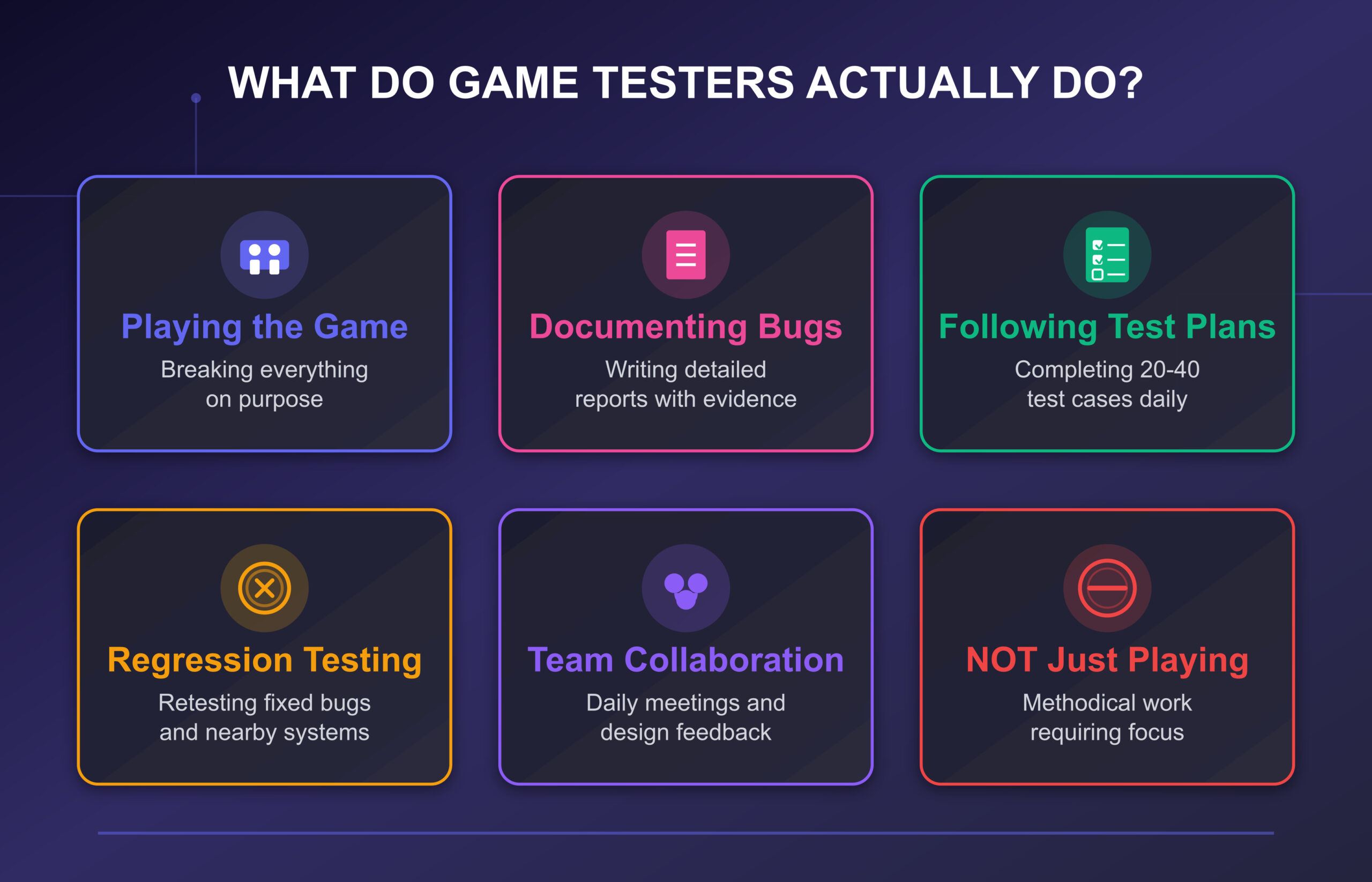
1. Playing the Game (But Not for Fun)
Game testers spend their days playing through builds, but the catch here is that they are, in fact, trying to break everything on purpose. For example:
- They’ll jump against the same wall 100 times to see if the characters go through it.
- They’ll quickly pause and unpause to look for memory leaks.
- They’ll attack NPCs in ways that are totally unexpected.
However, there is a reason for every action. When testers find a bug, they have to make it happen over and over again, usually 5 to 10 times, to show that it’s a real problem and not just a one-time glitch.
That’s how you tell the difference between real problems and random events.
2. Write Down Bugs in Painful Detail
Finding bugs is only part of the fight. Writing detailed reports is where the real work is. Game testers keep track of every problem with tracking systems like Jira, Bugzilla, or Trello.
A good bug report has the following details:
- How to do the problem step by step
- What kind of hardware and software is being used
- Screenshots or video proof of the problem
- Severity rating, like a major crash vs. a minor visual glitch
3. Follow Checklists and Test Plans
Testing becomes more organized as games move toward alpha and beta. Testers get detailed test plans, which tell them exactly what they need to check.
You could try out all the shop menus today, but tomorrow, you must check to see if the save files work in all situations.
In general, most studios want testers to finish 20 to 40 test cases every day, depending on how hard they are.
4. Test Fixed Bugs Again and Again
Professional game testers run tests to make sure that the fix works after developers fix a bug. This is known as regression testing.
But where it gets tricky is that fixing one bug often makes new ones appear in other places.
Therefore, testers also check nearby areas to make sure the fix didn’t break anything else.
5. Go to Meetings and Giving Feedback
Testing isn’t something you do by yourself because game testers should absolutely go to daily stand-ups, talk to developers about which bugs are most important, and sometimes give feedback on how the game should be designed.
Plus, lead testers spend a lot of time guaranteeing that the QA and development teams are working together.
For example, if 15 testers all say that a boss fight is too hard, that feedback goes straight to the game designers so they can make it easier.
Who’s Involved in Game Testing?
You might think that there’s just one game thest involved. Right? But there is a team, in fact.
1. Game Studios and Publishers
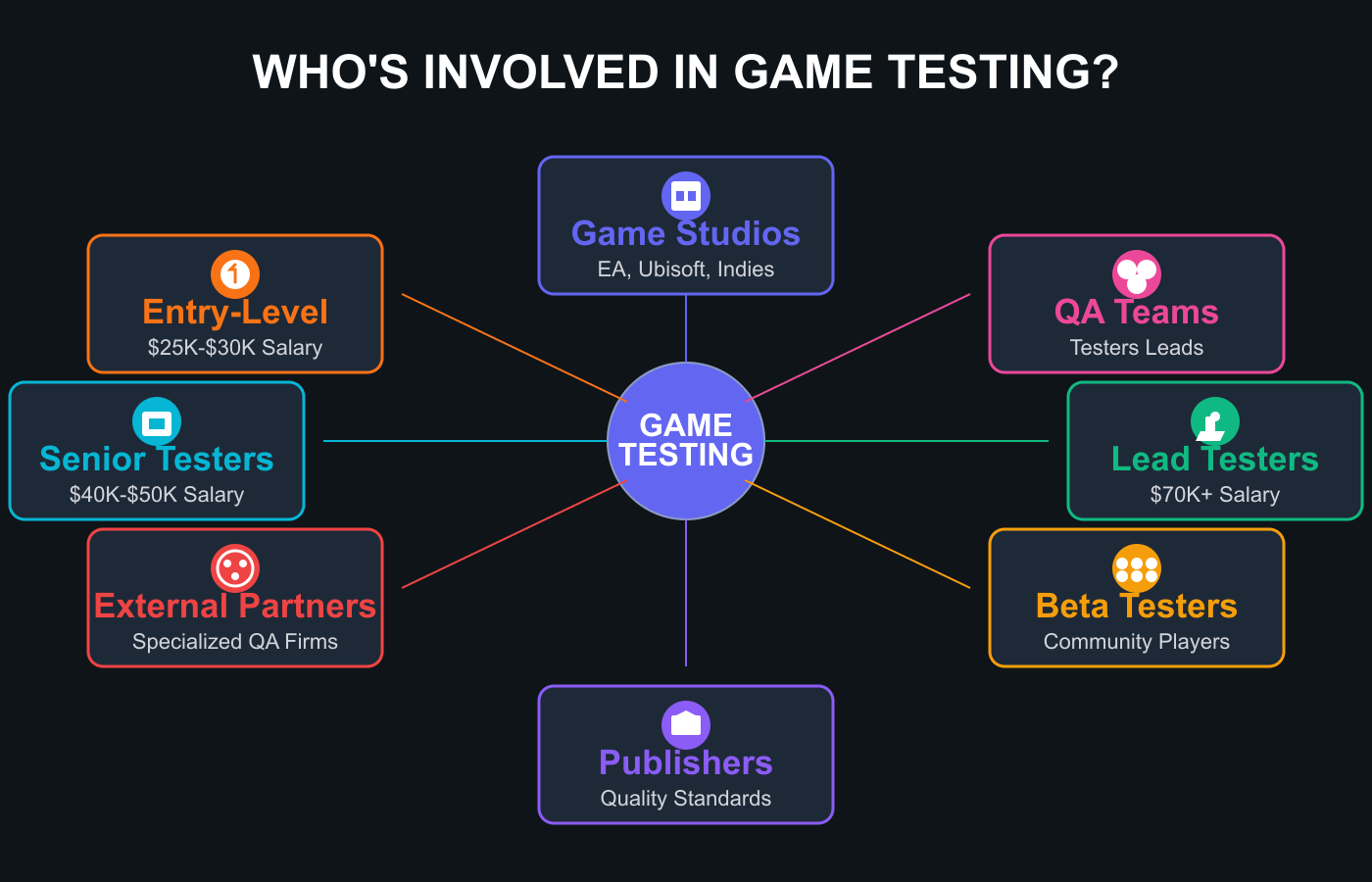
EA, Activision, and Ubisoft are just a few of the publishers that hire hundreds of testers to work on many projects at once. These teams start early, sometimes testing rough prototypes that don’t look much like real games yet.
Most of the time, big studios even put QA staff right in with the development teams. So while programmers write code, testers are right next to them, giving feedback quickly.
Such close integration finds problems quickly, sometimes in hours instead of weeks.
However, smaller indie studios do things differently. A development team with 5 to 10 people might only be able to hire one full-time tester, or the developers might have to do the testing themselves at first.
Indie QA often depends more on outside partners and community beta testers because they don’t have a lot of money.
Read More: Game Development Timelines
2. QA Teams and Lead Testers
There are clear hierarchies in testing teams. Entry-level testers, who are usually recent graduates or passionate gamers, do test cases and write down bugs. They usually make between $25,000 and $30,000 a year, which isn’t much for the amount of work they do.
On the other hand, the middle tier is made up of senior testers who can handle complicated testing situations and often focus on one area after 3 to 5 years of experience.
Ideally, they work on problems with multiplayer networking or testing for Japanese markets, and their pay goes up to $40,000 to $50,000.
And the last one is the lead tester, who is in charge of all QA work and sits at the top. They mostly work with producers, give team members tasks, track bug databases, and finally decide when builds are ready to be sent out.
Leads often work more than 60 hours a week during busy times, and their experience earns them salaries of $70,000 or more.
3. Beta Testers and External Testing Partners
Not everything happens inside the company. Companies often hire specialized QA firms to do work for them, especially when it comes to big compatibility tests.
Do you need your game to work on 200 different Android devices? Well, external partners like Pingle Studio do just that.
They send experienced engineers to test complicated systems without needing months of training inside the company.
There are two levels to beta testing.
- In closed betas, a small group of players who have signed an NDA give feedback on specific features.
- Open betas are not the same at all. Thousands or even millions of players come in at once, put servers to the test and find problems that internal teams would never have found.
Call of Duty gets free large-scale load testing and a lot of marketing buzz when they run an open beta. Players are excited to get early access, and developers get useful information about how servers work when they are under a lot of stress. And in the end, everyone wins.
Why Does Game Testing Actually Matter?
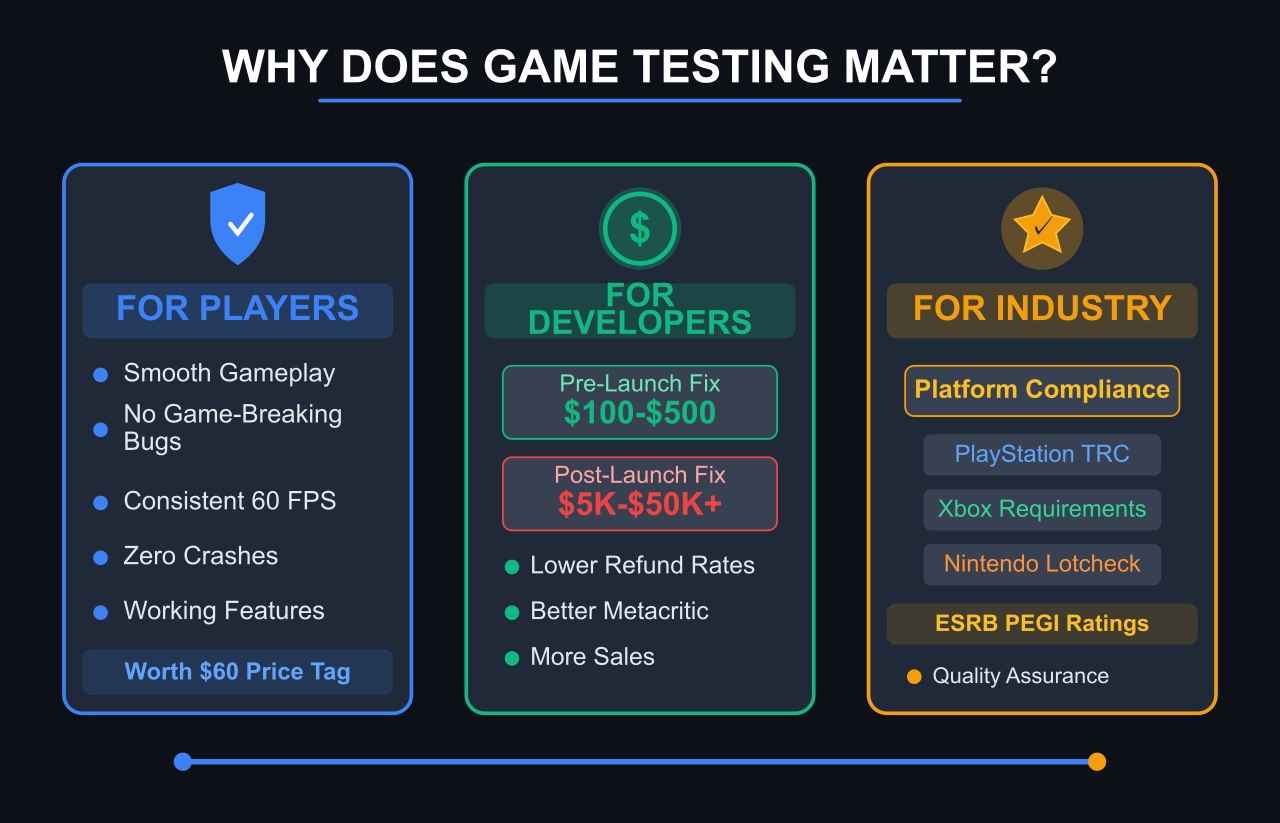
Game testing is beneficial for 3 groups of people and they are players, developers and the industry.
For Players
When you drop $60 on a game, you expect it to work. That’s the baseline, right?
Proper testing delivers exactly that, something like smooth gameplay without crashes, glitches, or frustrating bugs.
What players actually need:
- Consistent performance: 60 FPS minimum on their hardware
- Working features: Saves don’t corrupt, quests complete properly
- Responsive controls: Zero input lag or button delays
- Stability: No crashes, erasing hours of progress
Real-world examples prove this. Cyberpunk 2077 launched in December 2020 with massive console bugs. Crashes every hour, broken AI, visual disasters everywhere.
But then, Sony pulled it from the PlayStation Store entirely. Compare that to God of War (2018), and it was then launched perfectly smooth after thorough testing.
For Developers
Fixing bugs before launch costs way less than fixing them after.
A bug caught during alpha? Maybe 2 hours of developer time, but the same bug found post-launch? It definitely needs emergency patches, server downtime, customer support, and potential refunds.
The numbers don’t lie:
- Pre-launch fix: $100-$500 per bug
- Post-launch emergency: $5,000-$50,000+ per issue
- Refund damage: 5% of 1 million players at $60 = $3 million lost
- Review impact: Sub-70 Metacritic scores = 30-50% fewer sales
For the Industry
Platform holders really ask for strict compliance. For example, Sony’s Technical Requirements Checklist has over 100 requirements, Xbox Requirements are equally thorough, and Nintendo’s Lotcheck process is famously rigorous. And of course, those games failing these checks get rejected and also burn money.
What platforms actually check:
- Proper save data management
- Every button works correctly
- Standardized system error formats
- Required frame rates and load speeds
Meanwhile, ESRB and PEGI ratings affect who can buy your game. Testers flag content that might push ratings higher than intended.
But what is your game is targeting Teen (13+) but has excessive blood? Either remove it or accept a Mature (17+) rating, which cuts your potential audience significantly.
Read More: The Future of Gaming Industry
When Does Game Testing Happen?
Game testing isn’t just for when the game is completed. No. The game surly needs testing in other phases too.
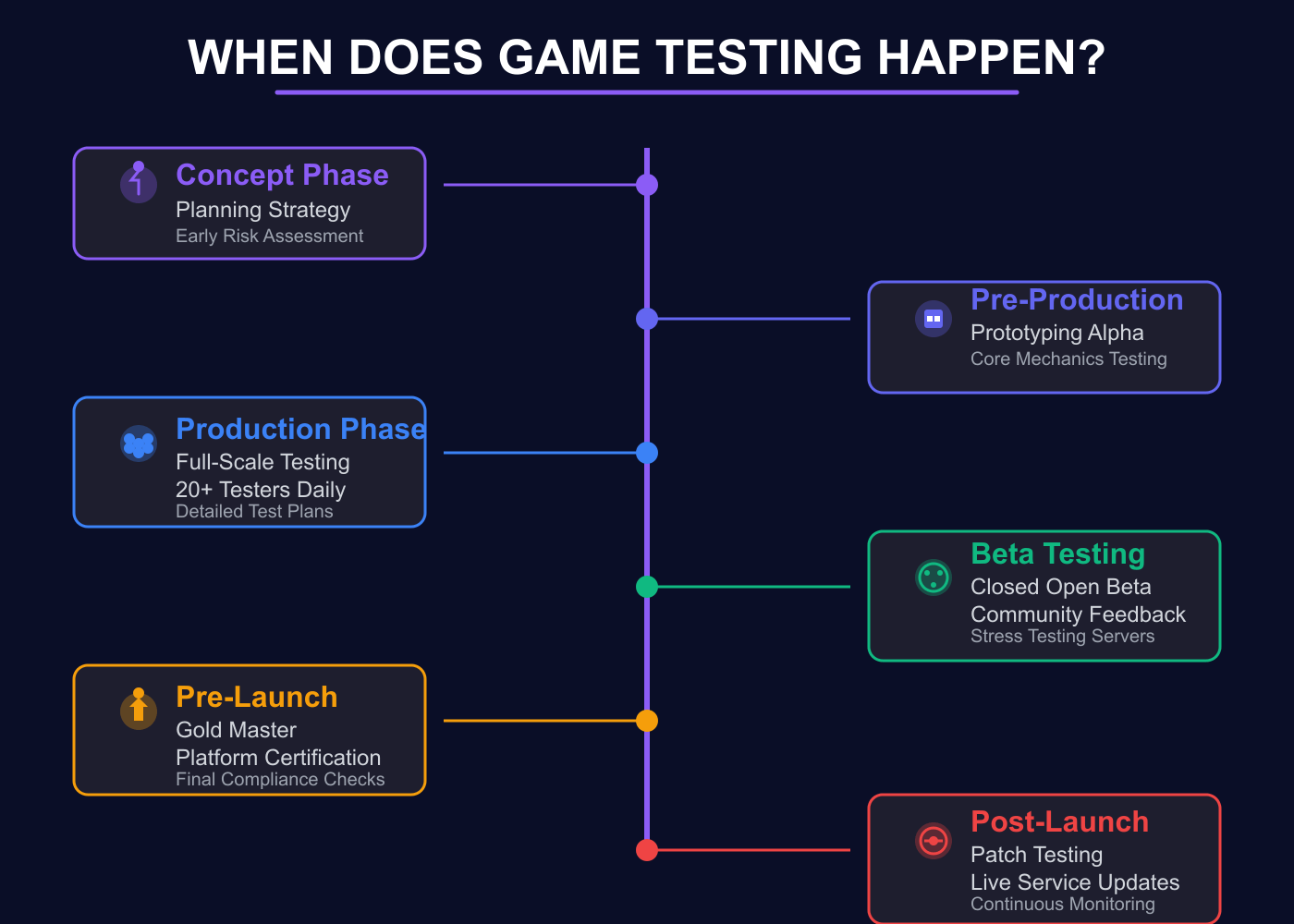
Concept Phase
Most people don’t know that testing starts a lot earlier than they think. In fact, teams start planning their whole testing strategy even before there is a playable game.
In the concept phase, the game is just ideas and documents, like character designs, story outlines, and gameplay ideas. Still, testers are already involved and are figuring out what risks might come up.
They ask important questions like, “Will this multiplayer system be able to handle 10,000 players at once?” Can these graphics work on mobile devices? What platform requirements could cause problems later on?
Pre-Production and Prototyping
Alpha testing officially starts when developers finish a working prototype. At this point, we’re talking about rough builds, like just one level or a few basic mechanics.
As a result, testers concentrate on making sure those core mechanics work, like does the fighting feel like it works? Are the laws of physics working right? Can players easily find their way around the menus? These early tests find basic problems when they’re still pretty easy to fix.
For example, if jumping feels floaty or shooting doesn’t feel powerful, that gets flagged right away.
The Production Phase
This is where testing really gets going. All of a sudden, full teams of testers work every day, and the operation gets very organized.
When full-scale testing is going on, more than 20 testers could be working on the same game at the same time. Each tester has a specific job to do.
One tests the combat systems, another checks the logic of the quests, and a third only looks at performance. Everything is guided by detailed test plans, which make sure that all systems are thoroughly tested.
Beta testing rollout, on the other hand, lets people outside of the company test as well. At first, closed betas only let a few players in under an NDA to give focused feedback.
Open betas, subsequently, invite everyone, sometimes millions of players, to stress-test servers and find edge cases that internal teams would never find.
Pre-Launch and Gold Master
It’s time to get serious. In the end, the game needs to get final approval before discs can be made or uploaded to digital stores.
This is where the last checks for certification and compliance take place. Sony, Microsoft, and Nintendo all have strict rules for their platforms.
PlayStation’s TRC has more than 100 checkpoints, and if you don’t meet all the requirements, your game will be turned down, which could push back the launch by weeks.
Post-Launch
As developers fix bugs that players report, patch testing is still going on. Before a patch is released, it needs to be thoroughly tested to make sure that the fixes don’t cause other problems.
This regression testing stops the “fix one bug, create three more” problem that makes players go crazy.
Also, for games with live services, monitoring is always going on. Every day, new things come out for games like Fortnite, Destiny 2, and Call of Duty: Warzone.
So, before each season, update, or event, everything needs to be fully tested. Dedicated QA teams work all year to make sure that new content doesn’t crash servers or create exploits that break the game.
What Are the Different Types of Game Testing? (The Complete Breakdown)
There are basically 6 types of game testing in which testers check different aspects of a game.

1. Functional Testing
This is the testing you do every day. In short, does this stuff really work?
Testers look at the main parts of the game, like shooting, jumping, managing your inventory, and getting around the menus.
They even check that UI elements work as they should and make sure that features work as they should.
Problems that often come up in this type of game testing include:
- Crashes when accessing specific menus
- Button presses that don’t work
- Things that don’t work at all, like broken quests and items that can’t be used
- UI elements with visual bugs
2. Performance Testing
One important question that performance testing answers is, “Does this game run smoothly?”
Testers check the frame rates in different scenes and monitor how long it takes to load between levels. They also keep an eye on how much CPU, GPU, and RAM are being used. Some ways to test are:
- Stress testing: Spawning 100 enemies at once to see if the frame rates stay steady
- Benchmarking: Using standardized scenarios to see how well things work
- Memory profiling: Looking for memory leaks when you play for a long time
For example, Elden Ring had a lot of performance problems when it came out on PC, as even high-end systems had trouble keeping up with 60 FPS. However, eventually, FromSoftware fixed it, but the first reviews were very bad.
3. Compatibility Testing
Games should work in all the places where people might play them. That’s basically what compatibility testing is, but it’s a lot more complicated than it sounds.
Platform coverage includes:
- PC: Windows 10/11, a range of graphics cards (NVIDIA, AMD), and a range of CPU setups
- Mobile: iOS 15–17, Android 11–14, and hundreds of other models
- Consoles: PlayStation 4/5, Xbox One/Series X|S, Nintendo Switch
- Cloud gaming: GeForce Now, Xbox Cloud Gaming, PlayStation Plus Premium
A game that works perfectly on an NVIDIA RTX 4090 might crash on Intel graphics that are built into the computer.
So, testers make sure the game works on systems that meet the minimum and recommended requirements, not just the best ones.
4. Multiplayer / Network Testing
The success or failure of online games depends on how well they work with other players. So in multiplayer and network testing, a tester checks to see if the server stays stable when it’s busy.
They look into the details to see if matchmaking connects players quickly and check for lag and latency compensation.
Additionally, they search for synchronization, which means that all players see the same game state at the same time. Without the right sync, multiplayer is just a mess.
While in beta, Call of Duty games do significant network testing. Because of this, their starts usually go smoothly with millions of players. On the other hand, games that skip this step often have terrible server problems on launch day.
5. Localization Testing
Your game will be available in 30 countries and 15 languages, and localization testing makes that big goal possible.
Testers check that translations are correct not only in terms of word-for-word meaning, but also in terms of cultural appropriateness.
Their main task is to check the layout of the UI because German text is usually 30% longer than English text, which could break the designs of the interface. Lastly, they say that voice-over synchronization matches the lip movements of the characters in all languages.
Take a look at Persona 5, which took more than a year to translate into English. Testers went through thousands of lines of dialogue, made sure that the text fit in menus, and made sure that cultural references made sense for people in the West.
And finally, the final product clearly shows that you paid close attention to every detail.
6. Regression Testing
Regression testing asks a very important question every time developers fix a bug, and the question is this: Did that fix break something else?
After updates, testers check to see if features that used to work still do and also take steps to ensure that old bugs stay fixed. At the same time, they look for new problems that have come up in nearby systems because of recent changes.
Manual Testing vs. Automated Testing
Automated testing uses software and tools to check performance without any help from a person, while manual testing involves people playing the game and finding bugs through direct contact.

As a matter of fact, smart companies use both approaches together since it’s not possible for either method to cover everything.
| Testing Type | Manual | Automated | Why? |
| Regression | ❌ | ✅ | Too repetitive for humans |
| Playtesting | ✅ | ❌ | Needs human judgment |
| Performance | ✅ | ✅ | Both add value |
| Exploratory | ✅ | ❌ | Requires creativity |
| UI functionality | ❌ | ✅ | Highly repetitive |
What Testing Tools and Technologies Do Testers Use?
Bug tracking systems, automation tools, and performance analyzers are the three main types of tools that modern QA uses. Because each one solves a different problem, most studios use a mix of all three.
Bug Tracking and Management Tools
Bug tracking systems help you stay organized, and as soon as a tester sees a crash, they write it down. Then the system automatically sends it to the right developer.
| Tool | Cost | Best For | Key Feature |
| Jira | Paid | Large studios | Deep integration |
| Bugzilla | Free | Budget teams | Highly customizable |
| Trello | Freemium | Small teams | Visual boards |
Testing Automation Tools
Automation takes care of the boring, repeated tasks. These tools can do the same tests over and over again and not get tired or make mistakes.
Selenium tests web browsers automatically, which is great for HTML5 games. But Appium is for testing on mobile devices and works with both iOS and Android.
| Tool | Platform | Primary Use |
| Selenium | Web | Browser-based games |
| Appium | Mobile | iOS/Android automation |
| Unity Test Framework | Unity | Logic testing |
Performance and Analytics Tools
Performance tools show what players really feel. For example, real-time frame rate monitors like FRAPS show exactly when performance drops by tracking FPS, and memory trackers find memory leaks before they cause crashes when you play for a long time.
Last but not least, network simulators test online features when the connection is very bad.
| Tool Type | Purpose | Example |
| Frame monitors | Track performance | FRAPS, MSI Afterburner |
| Memory trackers | Find leaks | Unity Profiler |
| Network tools | Simulate lag | Clumsy |
Final Thoughts
Game testers are the real heroes of the gaming world, and that’s because they work long hours, do the same things over and over, and find bugs that most players will never know about. Testing guarantees that games start up without any problems, keep players’ trust, and meet the quality standards we expect.
The best technological steps here are that testers are using AI-driven testing, cloud-based solutions, and automated systems to do their jobs in new ways.
But human judgment is still necessary. You still need people to judge how fun something is, how easy it is to use, and those little things that algorithms miss.