
Egyptian players would notice if something didn’t look right, so Assassin’s Creed Origins didn’t just make towers that looked good; they also looked into real Egyptian colors, clothing, and building styles.
These cultural details helped the game sell millions of copies around the world and gave players the impression that the creators cared about their culture.
Cross-cultural game art is just making sure that the graphics in your game feel real and appropriate for players from various cultures and backgrounds.
If you get this right, your game will be a worldwide hit. But if you get it wrong, it will upset whole markets and kill your sales. That’s why working with a game art studio experienced in cultural research can make a big difference.
Cross-cultural Influences in Character Design
When you make models for different countries, you can’t just use one face everywhere. In Japan, beauty means something very different from what it means in the US or Egypt. That’s where game art localization becomes essential, ensuring that your characters and visuals resonate with each region’s cultural expectations.
Face and Body Looks
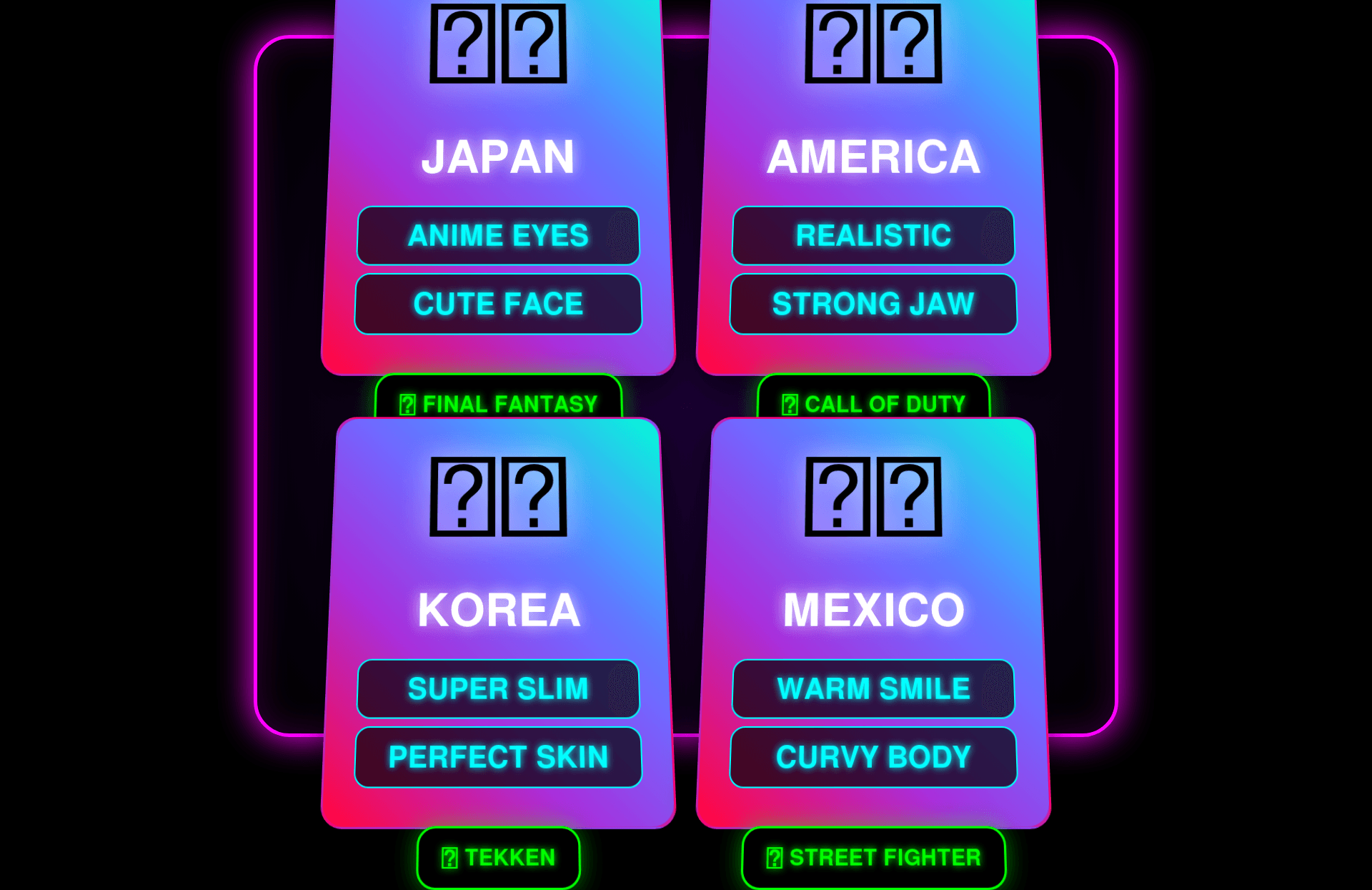
Different countries have different faces:
- Japan: Small faces, huge eyes, very pale skin (think anime girls)
- America: Strong jaw, realistic features, different skin colors
- Korea: Super skinny, soft baby faces, perfect skin
- Mexico: Warm smiles, curvy bodies, expressive eyes
Game Examples That Got It Right:
| Game | Character | Cultural Design | Why It Works |
| Street Fighter | Chun-Li | Chinese hair buns, qipao dress, graceful moves | Shows real Chinese martial arts style and traditional clothing |
| Tekken | Hwoarang | Korean street fashion, modern hairstyle | Captures actual Korean youth culture and fighting style |
| Overwatch | Pharah | Egyptian armor design, traditional patterns | Blends ancient Egyptian symbols with futuristic technology |
| Mortal Kombat | Scorpion | Japanese ninja outfit, traditional weapons | Authentic Japanese martial arts clothing and fighting methods |
Clothes That Matter
What characters wear is their culture:
- Kimonos in Japanese games have real meaning (colors, patterns, how you wear them)
- Hijabs need to look right for Muslim players
- Tribal clothes from Africa can’t just be random patterns
- Modern clothes – what’s cool in Tokyo looks weird in Dubai
Jin’s school outfit in Tekjen represents Japanese student culture, and Hwoarang’s clothing shows Korean fashion trends. Every piece of clothing on these fighters shows you where they are from.
Hand Moves and Body Language
This part trips up most game makers:
- Thumbs up = offensive in Middle Eastern countries
- Pointing = super rude in Asia (use open hand instead)
- Peace sign backwards = really bad in England
- Touching the head = big no-no in Buddhist countries
When Genji (Japanese) says hello in Overwatch, he bows, but Soldier 76 (American) just waves.
| Country Style | Face Type | Body Build | Hair/Makeup | Clothes |
| Japanese | Small, cute | Super thin | Colorful, anime style | Traditional + modern mix |
| American | Realistic, strong | Muscular/athletic | Natural colors | Casual, practical |
| Arab | Modest, covered | Loose-fitting clothes | Simple, clean | Traditional robes |
| Brazilian | Warm, happy | Curvy, athletic | Bright, fun | Colorful, festive |
When you look at Final Fantasy (Japanese) and Call of Duty (American), the difference is very clear. The people in Final Fantasy have those big cartoon eyes and beautiful skin.
But players in Call of Duty have scars and real-looking faces that make them look like real fighters.
Cross-cultural Influences in Environmental Art
The places in your game need to feel like real places where real people live, and every culture builds differently because of weather, history, and what they think looks good.
Buildings and Architecture
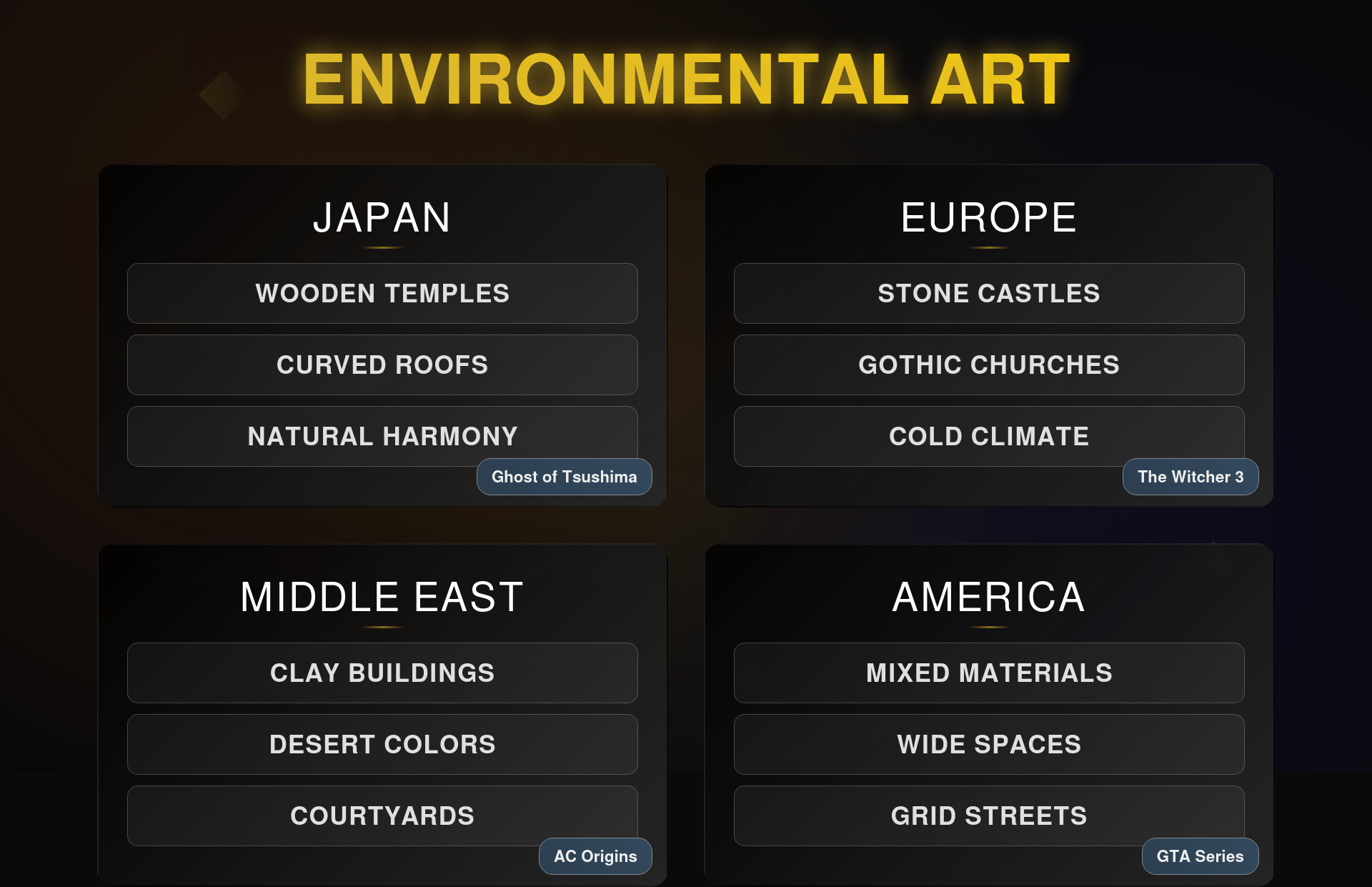
Why buildings look different everywhere:
- Japan: Wooden houses with curved roofs (earthquakes + nature harmony)
- Europe: Stone castles and churches (cold weather + showing power)
- Middle East: Clay buildings with courtyards (hot sun + privacy)
- America: Mixed materials, wide spaces (new country + lots of land)
Environment Examples in Games:
| Game | Location | Cultural Elements | What Makes It Authentic |
| Ghost of Tsushima | Medieval Japan | Wooden temples, natural gardens, seasonal changes | Understands Japanese harmony with nature philosophy |
| Assassin’s Creed Origins | Ancient Egypt | Massive pyramids, desert colors, and Nile River cities | Historically accurate architecture and building materials |
| Sleeping Dogs | Hong Kong | Neon signs, narrow streets, dense apartments | Captures real modern Asian city planning and lifestyle |
| The Witcher 3 | Northern Europe | Stone walls, wooden houses, muddy roads | Shows actual medieval European building styles and climate needs |
Colors Everywhere
Colors mean things. Natural wood browns and temple reds are used in Ghost of Tsushima because that’s how real Japanese buildings look.
God of War, on the other hand, has gray stones and dark wood that look great in harsh Norse settings.
- China: Red and gold everywhere (luck and money)
- Greece: White and blue houses (reflect the sun’s heat)
- India: Bright colors like orange, pink, yellow (festivals and joy)
- Scandinavia: Dark colors, earth tones (long winters, practical)
How Cities Work
Different cultures organize cities differently. For example, Grand Theft Auto: Vice City uses art deco structures and palm trees to replicate Miami’s beach atmosphere.
Plus, while Sleeping Dogs shows Hong Kong’s density through tall lighting signs and busy markets, it also shows very different urban experiences.
- Medieval Europe: Winding roads around a church (community first)
- America: Straight grid roads (cars and efficiency)
- Asia: Dense, mixed areas (walking and trains)
- Arab: Walled sections with markets (protection and trade)
| Region | Building Style | Main Colors | City Layout | Famous Example |
| Japanese | Wood, curved roofs | Brown, red, natural | Dense, walkable | Ghost of Tsushima |
| European | Stone, tall buildings | Gray, brown, regional | Historic centers | Assassin’s Creed |
| Arab | Clay, geometric patterns | Sand colors, blue | Walled quarters | Prince of Persia |
| American | Mixed modern | Bright, varied | Grid streets | GTA series |
The wooden homes, stone walls, and wet roads in The Witcher 3 are perfect examples of medieval Europe. That’s how Northern Europe really was, so everything looks cold and useful.
Meanwhile, Horizon Zero Dawn shows what America might be like in the future, but it still has that American feeling of big open spaces.
Cross-cultural Influences In Symbols and Icons
Some pictures mean totally different things to different people. A symbol that seems innocent to you might be super offensive or sacred to someone else.
Religious Stuff
Religious symbols are serious business:
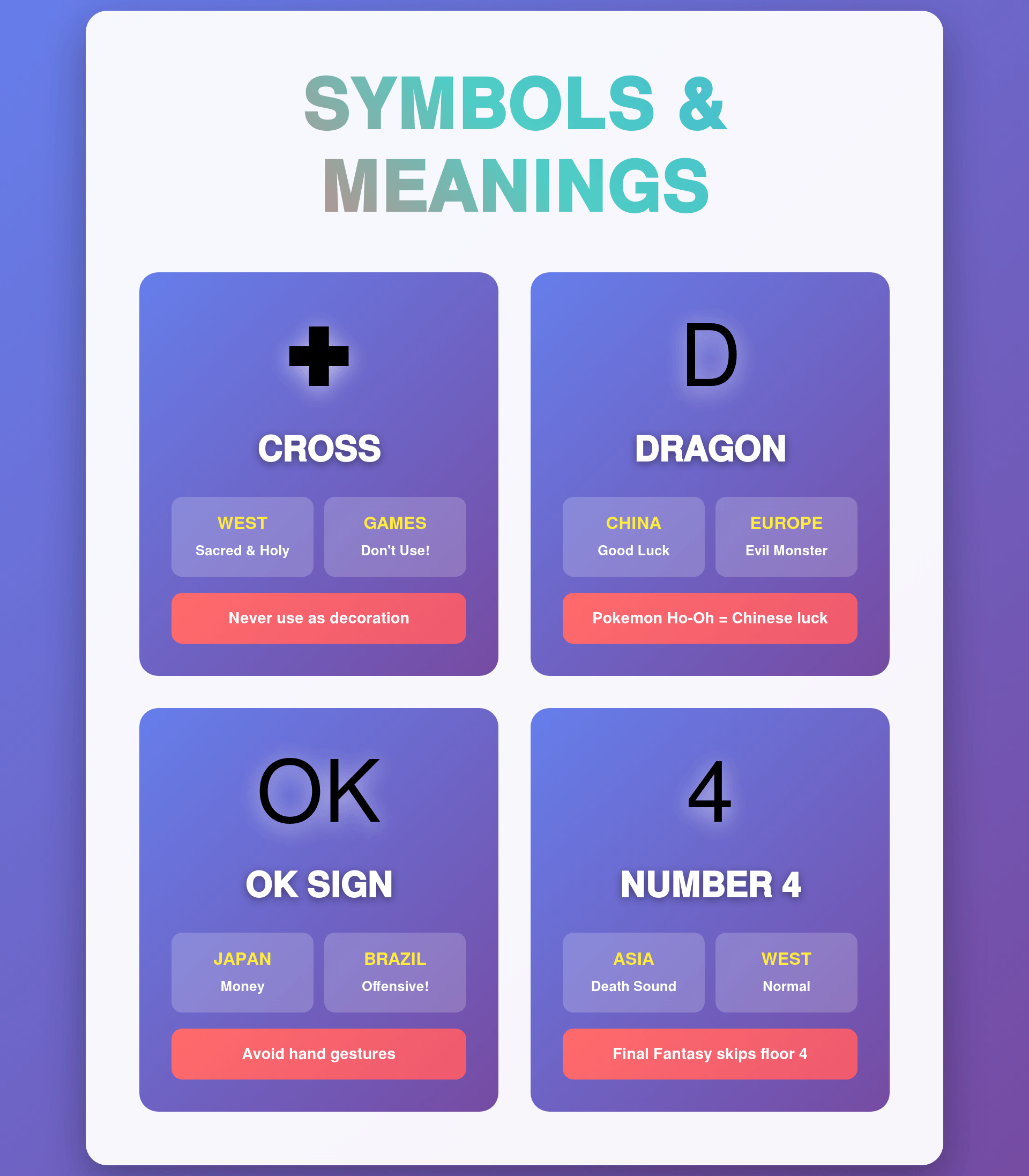
- Christian cross = sacred, don’t use for decoration
- Islamic crescent = holy symbol, be respectful
- Buddhist wheel = deep spiritual meaning
- Jewish star = important religious symbol
Symbol Examples That Work:
| Game | Cultural Symbol | Original Meaning | How Game Uses It |
| Pokemon | Ho-Oh (Chinese Phoenix) | Rebirth and good fortune | A legendary bird that brings happiness to trainers |
| Overwatch | Mei’s Ice Symbols | Chinese winter elements | Character abilities connected to her cultural background |
| Little Big Planet | Quran Music Issue | Sacred religious text | The game was delayed to remove offensive content |
| Mortal Kombat | Scorpion’s Kunai | Traditional Japanese weapon | An authentic ninja tool used in fighting moves |
Animals Mean Different Things
Same animal, totally different meanings:
- Dragons: Good luck in China, evil monsters in Europe
- Owls: Wise in America, death signs in Native cultures
- Cats: Sacred in Egypt, unlucky in some European places
- Crows: Bad omens in the West, messengers in other cultures
The Ho-Oh in Pokemon comes from a Chinese legend, where the phoenix is a bird of rebirth and happiness.
It’s common for Western games to use phoenixes as cool fire creatures without knowing their cultural meaning.
Hand Signs and Numbers
Japanese RPGs like Final Fantasy often skip floor 4 in their building designs because the number sounds like “death” in Japanese. However, Western players never notice this detail, but Japanese players immediately recognize the cultural sensitivity.
- OK sign (👌): Means “money” in Japan, “zero/worthless” in France, and is offensive in Brazil
- Number 4: Super unlucky in Asia (sounds like “death”)
- Number 13: Unlucky in the West, normal everywhere else
- Peace sign: Different meanings depending on which way your palm faces
| Symbol | Western Meaning | Asian Meaning | Other Places |
| Dragon | Evil monster | Lucky, wise | Water spirit |
| Number 4 | Normal | Very unlucky | Sometimes lucky |
| Owl | Smart, wise | Death, bad luck | Spirit messenger |
| Red color | Danger/love | Money, luck | Pure/holy |
| White color | Pure, clean | Death, ghosts | Peace |
Cross-Cultural Influences In Game Color And Pattern
Not only are colors pretty, but they also have very different meanings for people from different places.
What satisfies Chinese players might scare American players, and what appears classy in Europe might look like the end of the world in Asia.
Red Color Meanings
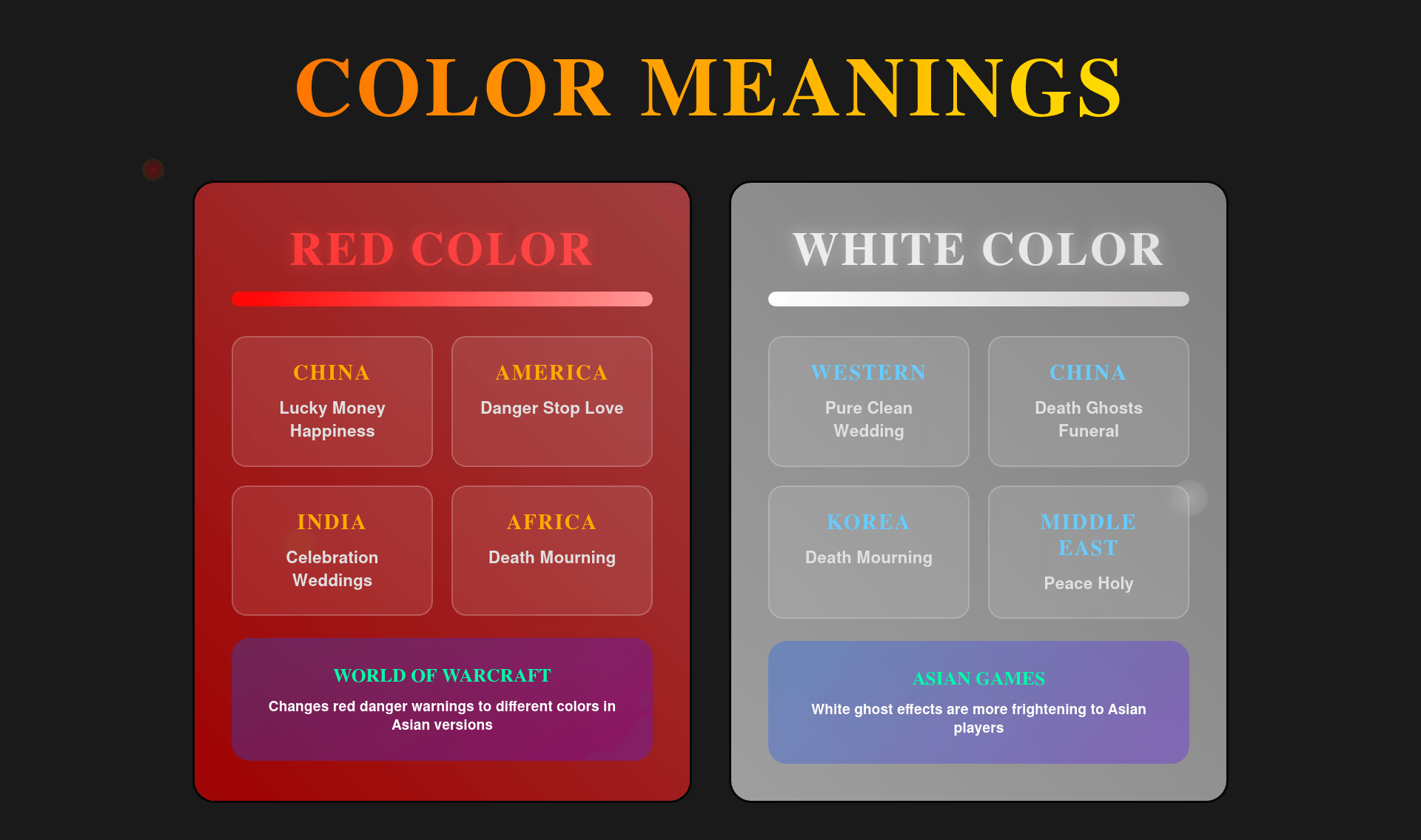
Red is probably the trickiest color to get right:
- China: Super lucky color, means money and happiness
- America: Danger, stop signs, or love (like Valentine’s Day)
- India: Celebration time, weddings, festivals
- Some African cultures: Death and mourning
White Color Problems
White seems safe, but it really isn’t:
- Western countries: Clean, pure, wedding dresses
- China and Korea: Death, ghosts, funerals
- India: Sometimes pure, sometimes mourning
- Middle East: Often means peace and holy things
Other Colors That Change
- Black: Fancy in the West, evil or mourning elsewhere
- Green: Nature to Americans, money to others, a holy color in Islam
- Blue: Calm in most places, but can mean cold or sad
- Yellow: Happy in the West, sometimes means sickness in other places
World of Warcraft changes its interface colors for different countries. The red “danger” warnings that work in America get changed to different colors in Asian versions because red means good luck there.
Color Examples in Games
| Game | Color Choice | Western Meaning | Asian Meaning | Why It Matters |
| Street Fighter | Red health bars | Danger, low health | Good luck, power | Had to use different warning colors |
| World of Warcraft | White ghost effects | Spooky, supernatural | Death is very scary | More frightening to Asian players |
| FIFA | Green soccer fields | Natural, fresh | Money, growth | Works well everywhere |
| Call of Duty | Black military gear | Professional, tough | Death, darkness | Creates different feelings |
Games with wedding scenes do a great job of showing this. Many Asian games use red dresses and flowers because that’s a good color for weddings. There are also different color patterns for racing games. What looks fast and fun in one culture might look risky or bad in another.
Cross-Cultural Influences In Art Styles
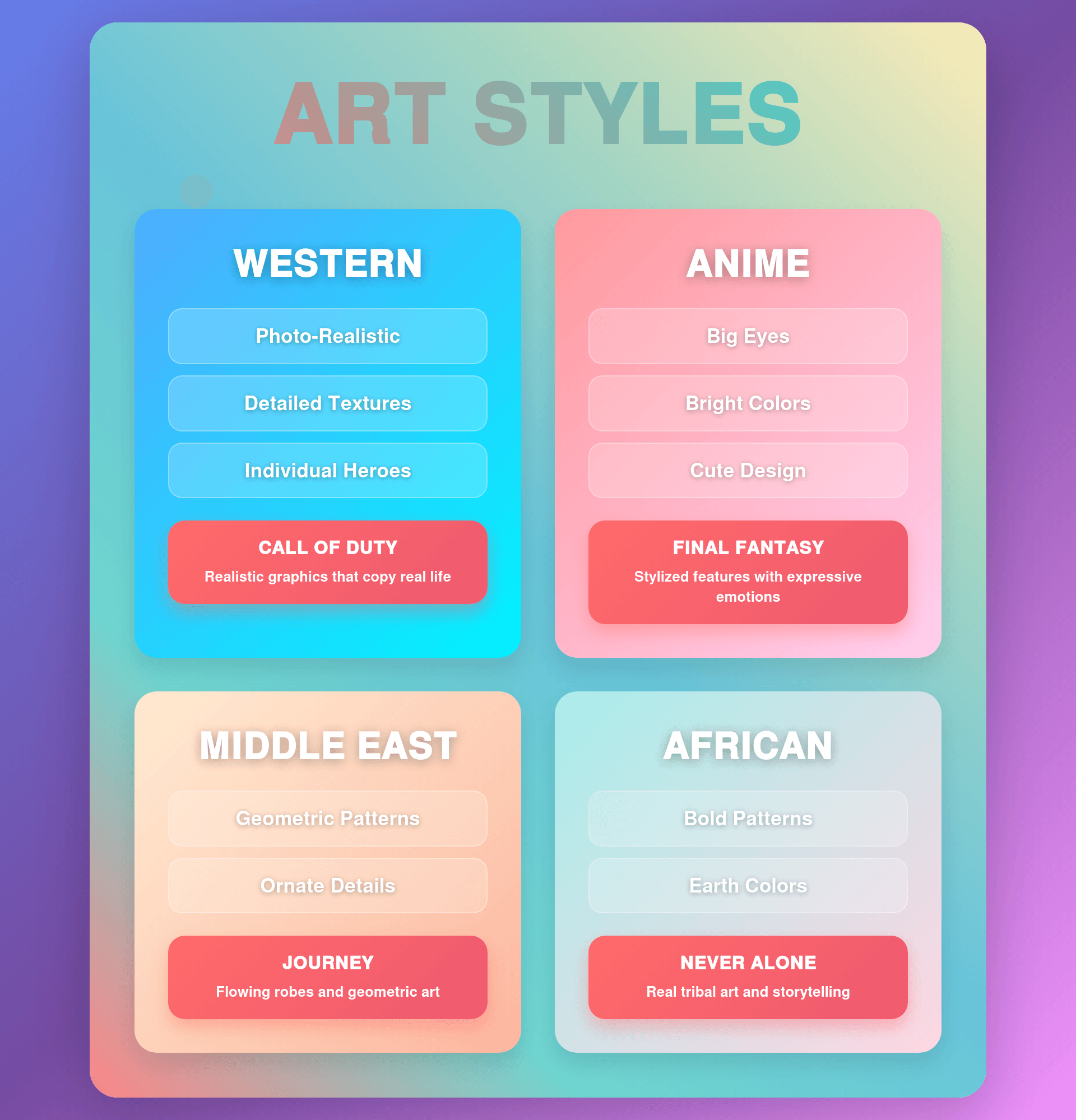
Every culture has its own way of making art that looks “right” to them. Japanese people love anime style, Americans prefer realistic graphics, and Middle Eastern cultures have their own beautiful patterns and designs.
Western Realistic Style
This is what most American and European games use:
- Photo-realistic faces that look like real people
- Detailed textures on everything (skin, clothes, buildings)
- Individual heroes who stand out from the crowd
- 3D graphics that try to copy real life
Anime and Manga Style
Japanese games have their own special look:
- Big expressive eyes that show lots of emotion
- Stylized features that are not realistic but super cute
- Bright colors and fun designs
- Exaggerated expressions for comedy and drama
Middle Eastern Patterns
These games use traditional Islamic art:
- Geometric shapes instead of realistic pictures
- Beautiful calligraphy as decoration
- Ornate details with lots of fancy patterns
- No human faces in religious contexts
African and Indigenous Styles
Nino No Kuni combines cartoon characters from Japan with scenes from European fairy tales.
The characters have big anime eyes, but their homes look like they belong in a Disney movie. This is an example of how two different types of art can work together.
- Bold tribal patterns with deep meanings
- Earth tone colors like brown, orange, and red
- Symbolic animals and natural elements
- Traditional storytelling through pictures
Art Style Examples That Work
Never Alone is amazing because it was made with real Alaskan Native people. The art style comes from their actual traditional drawings and carvings, not just what outsiders think looks “Native American.”
| Game | Art Style | Cultural Origin | What Makes It Special |
| Okami | Japanese brush painting | Traditional Japanese art | Looks like ancient scrolls come to life |
| Never Alone | Indigenous Alaskan | Native American traditions | Uses actual tribal art and storytelling |
| Journey | Middle Eastern inspired | Desert and Islamic culture | Geometric patterns and flowing robes |
| Cuphead | 1930s Western animation | American cartoon style | Hand-drawn like old Disney cartoons |
Cross-cultural Influences In Music and Sound
Location changes how people react to sounds and music. Classical instruments, languages, and even sound effects can either make the players feel right at home or totally lost.
Traditional Instruments
Every culture has its own special instruments:
- Japanese: Shamisen (guitar-like), taiko drums, flutes
- Middle Eastern: Oud (like a guitar), tabla drums, sitars
- African: Djembe drums, kalimba (thumb piano), horns
- European: Violins, piano, church organs
Different Musical Patterns
Music rhythms change everything:
- Western music: 4/4 beat, major and minor scales
- Asian music: Different scales, sometimes sound “off” to Western ears
- Middle Eastern: Complex rhythms, quarter-tones
- African: Polyrhythms (multiple beats at once)
Voice Acting and Languages
How characters talk matters a lot:
- Accents need to sound right for each character’s background
- Language choice – subtitles vs dubbing preferences vary by country
- Speaking speed and tone change between cultures
- Emotional expressions sound different in different languages
When you play Ghost of Tsushima, you can choose between Japanese sounds and English subtitles. The Japanese voice acting does a much better job of capturing the culture of the samurai than the English translation ever could.
Sound Examples Done Right
The coolest thing is that the same letter can sound very different in English and Japanese. Japanese has more ways to show how someone feels through their voice tone, so when an anime studio creates characters, they often sound a lot more emotional when they speak it.
| Game | Music Style | Cultural Elements | Why It Works |
| Ghost of Tsushima | Traditional Japanese | Shamisen, flutes, taiko drums | Feels like authentic samurai movies |
| Black Panther | African rhythms | Tribal drums, traditional chants | Connects to Wakanda’s African roots |
| Assassin’s Creed Origins | Ancient Egyptian | Period instruments, desert sounds | Transports you to ancient times |
| The Witcher 3 | Slavic folk music | Eastern European instruments | Matches the fantasy Polish setting |
Cross-Cultural Influences In User Interface
The menus and buttons in your game need to work the way different cultures expect them to.
Some people read right-to-left, others prefer group menus instead of individual choices, and button layouts can feel totally wrong if you don’t consider cultural habits.
Reading Direction Changes
Not everyone reads the same way:
- English, European languages: Left to right, top to bottom
- Arabic, Hebrew: Right to left, changes the whole menu layout
- Chinese, Japanese: Can be top to bottom, right to left
- Mixed languages: Some games need to flip everything
Menu Organization Styles
Different cultures organize information differently:
- Western style: Individual options, personal choices first
- Asian style: Group harmony, family/team options together
- Middle Eastern: Hierarchical, respect for authority
- Scandinavian: Minimal, clean, simple choices
Button Placement Logic
Where you put buttons matters:
- Confirm/Cancel buttons: Switch positions in different countries
- Navigation flows: Some cultures prefer circular menus
- Color coding: Green “go” doesn’t work everywhere
- Icon meanings: Thumbs up, checkmarks can mean different things
Mobile games in Middle Eastern countries completely flip their interfaces to work with right-to-left reading. Everything from menu positions to button layouts gets mirrored.
UI Examples That Adapt Well
It’s normal for Japanese people to see a lot of information at once, which makes Japanese game settings feel busier to Western players. Some Western choices are cleaner and have more room between items, so that they don’t look too crowded.
| Game Type | Western Layout | Asian Layout | Middle Eastern Layout | Key Differences |
| Mobile RPGs | Individual character focus | Team/guild emphasis | Hierarchical respect | Priority order changes |
| Racing Games | Left-side mini-maps | Right-side preferred | Mirrored completely | Reading direction affects placement |
| Strategy Games | Grid-based menus | Flowing, organic layouts | Geometric patterns | Cultural design preferences |
| Social Games | Personal achievements | Group accomplishments | Family/community focus | Social value differences |
Conclusion
Most mistakes in cultural sensitivity happen because coders don’t know what they don’t know. Which is totally fine, because no one can be an expert on every culture in the world. There are, however, ways to avoid costly mistakes and make your game more popular by doing some study and talking to the right people. In addition to avoiding problems, companies that get this right make games that make people from different countries feel truly seen and appreciated.