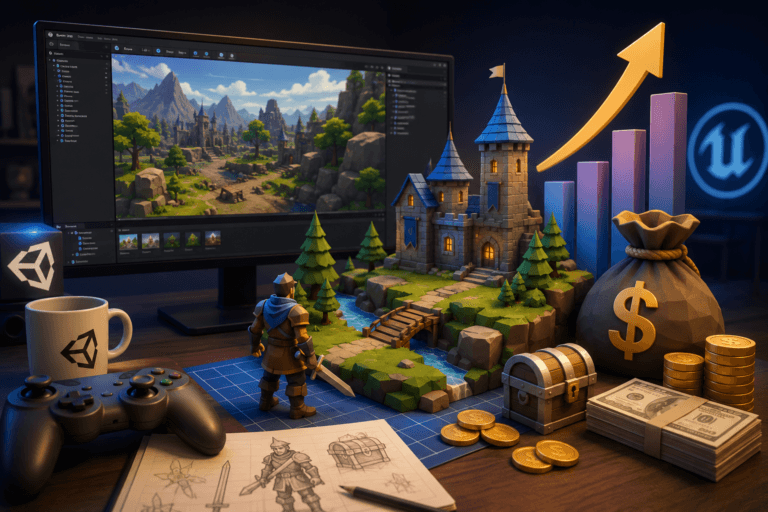

Crafting a video game is one of the most demanding creative and technical undertakings in digital entertainment, and in any game art studio. The financial outlay can range from a few thousand dollars for a basic indie project to hundreds of millions for AAA game development.
The final production budget is heavily influenced by factors such as the project’s scope, chosen technology, desired game art outsourcing style, and the development pipeline’s team structure.
In this guide, we will discuss every component, from initial game design to post-launch marketing costs, to offer a transparent view of the true game development cost and strategies for effective budget management.
DISCLAIMER: All the prices which are listed in this article are approximate and take them with a grain of salt. No absolute number can be given for any of the listed fields and it’s impossible to make a definitive price list for game projects, but I have tried to estimate them as real as they could be. All the listed prices are in US Dollars.
What Factors Affect the Cost of Making a Game?
Every game has its own unique cost structure. Factors such as game genre (RPG, shooter, puzzle), target platforms (mobile, console, PC, cross-platform games), and level of visual fidelity all play a major role in determining the overall budget.
For example, a 2D casual mobile game can cost anywhere from $20,000 to $150,000, while large-scale 3D AAA game development projects can exceed $100 million, depending on scope, team size, and production complexity.
The team’s geographic location is also critical; developers based in North America typically command higher salaries than those in Eastern Europe or Asia.
The chosen game engine (Unity or Unreal Engine) and the total production timeline further compound expenses. Early understanding of these variables helps indie studios and publishers set realistic budgets and avoid subsequent financial overruns.
Read More: How Much Does It Cost to Make a 3D Game?
What Are the Main Costs in Game Development?
Developing a video game is an intricate process that demands a dedicated investment across multiple specialized disciplines. The total production budget is a mosaic of expenses, primarily driven by human capital.
Let’s break down the primary financial pillars that underpin every successful game development cost, from the initial creative blueprints to the final touches of audio and quality assurance:
Game Design
Game design defines the core mechanics, narrative flow, and player engagement strategies. Costs typically range from $5,000 for early-stage prototypes to $100,000+ for complex projects involving dedicated narrative designers, UX specialists, and system design experts.
This phase includes concept documentation, gameplay balancing, and prototyping using tools like Figma or Miro. A well-defined design foundation helps minimize costly revisions later in development.
Programming and Code Development
Programming often accounts for 30–50% of the total development budget. Simple games built in engines like Unity may cost $30,000–$100,000, while large-scale or custom-engine AAA development can exceed $1 million+.
Developers handle gameplay systems, networking, AI, and performance game art optimization. Efficient practices such as code reuse and modular asset architecture can significantly reduce long-term maintenance costs.
Game Art and Animation
Visuals are a defining element of a game’s identity. 2D game art (including pixel art or stylized assets) typically ranges from $10,000–$50,000, while large-scale 3D art production and cinematic asset pipelines can exceed $500,000+, depending on style, quality, and asset volume.
Additional elements such as animation, UI/UX design, and character modeling further contribute to overall costs. Outsourcing art production to specialized teams can often reduce costs by 30–40% while maintaining high-quality output.
Sound and Music
Sound design—including sound effects, ambient audio, and original music can range from $5,000 for smaller projects to $200,000+ for AAA-level orchestral scores.
High-quality audio significantly enhances immersion and emotional impact, often playing a key role in player retention and overall experience.
Testing, Marketing, and Distribution
Quality assurance (QA) and game testing typically account for 10–15% of an indie game’s budget. Marketing, however, can match or even exceed development costs, with AAA titles often allocating $20–80 million to promotional campaigns.
Additional expenses such as platform fees, distribution costs, localization, and post-launch support also contribute to the total budget. Proper planning in these areas is essential for long-term success and profitability.
What Are the Downsides of Hiring Full-Time Staff?
While building an in-house team offers stability and deep institutional knowledge, it also comes with several limitations that can directly affect the production budget:
Financial Overhead
Full-time employees come with ongoing costs, including salaries, benefits, equipment, and overhead—even during periods of reduced production activity.
For example, a five-person in-house art team can cost $300,000+ annually, while outsourcing the same workload on a project-by-project basis may range between $100,000 and $150,000, depending on scope and production needs.
Creative and Operational Limits
Maintaining a fixed staff restricts flexibility. Studios may find they lack a crucial, specialized skill, such as advanced rigging or cinematic animation, exactly when it’s most needed.
Game art outsourcing provides immediate access to a wider pool of global talent without the heavy, ongoing financial commitment.
How Can You Make a Game on a Budget?
Successfully creating a game with a restrained indie game budget requires not only talent but a high degree of strategic discipline and financial forethought.
The following strategies detail how to maintain high quality while significantly reducing overall game development costs:
Prioritize Core Design and Features
Concentrate on the gameplay loop that makes your title unique. Cutting non-essential mechanics saves time and money while keeping the development pipeline focused.
Reuse or Adapt Successful Game Frameworks
Analyze and build upon successful established designs, such as match-three puzzles or idle clickers, and then innovate. Reinventing the wheel needlessly depletes both time and financial resources.
Use Ready-Made Assets and Code Templates
Marketplaces like the Unity Asset Store or Unreal Marketplace offer affordable plug-ins, shaders, and environments. Many successful indie game budget hits started with pre-made game-ready assets that were later customized to add originality.
Reduce Art and Sound Costs with Stock Libraries
Royalty-free libraries such as ArtStation Marketplace, Envato, and Freesound provide affordable, legal assets. Small customization efforts can make these assets feel unique.
Partner with Specialized Outsourcing Teams
Professional outsourcing partners deliver high-quality game art and programming without the internal overhead. Experienced vendors can quickly scale up resources as required, ensuring predictable costs.
How Much Does It Cost to Make Different Types of Games?
The question of game development costs is almost impossible to answer with a single number, because the final budget is fundamentally tied to the game’s genre (for instance, indie vs. AAA games) and the expected level of polish.
Here is a breakdown of the typical financial ranges and key drivers for the three most common segments: Indie, AAA, and Mobile game costs.
Indie Game Development Costs
Most indie game projects typically have budgets ranging from $10,000 to $500,000, depending on the team size, scope, and level of production quality. Engines like Unity and Godot, both among the best game engines, lower the entry barrier, and many indie studios rely on revenue sharing or small-game publishing deals.
AAA Game Development Cost
AAA game development budgets frequently exceed $80–200 million, often including substantial marketing costs. These high figures are driven by large-scale teams (typically 100–500+ developers), complex production pipelines, custom or heavily modified game engines, and the demand for high-fidelity, photorealistic assets.
Notable examples include Red Dead Redemption 2, with an estimated budget of around $170 million+, and Cyberpunk 2077, which reportedly exceeded $150 million+ in development costs.
Mobile Game Development Cost
Mobile game development is generally more accessible, with budgets ranging from $20,000 for simple 2D casual games to $500,000+ for advanced 3D or multiplayer experiences, depending on scope and technical complexity.
Game monetization models, such as in-app purchases, mobile game ads, and subscriptions can help offset initial development costs, especially when supported by strong user acquisition and retention strategies.
What Are Alternative Ways to Create a Game on a Minimal Budget?
When traditional routes to securing publisher funding or large capital investments are unavailable, developers must get creative to minimize game development costs.
These alternative approaches are essential for turning ambitious projects into reality within the constraints of a strict indie game budget.
Start Small and Scale Later (MVP)
Begin with a Minimal Viable Product (MVP) for game design. If the core game gains market traction, gradually expand the content. This strategy significantly reduces upfront risk and allows for early testing of market fit.
Build Partnerships and Revenue Shares
Collaborate with programmers, artists, or musicians who are willing to work in exchange for future royalties. Clear legal contracts protect all parties and align long-term motivation.
Can You Make a Game for Free?
While a truly “free” game is nearly impossible, costs can be drastically minimized using free engines (like Godot or Unreal), open-source assets, and volunteer/hobby teams. However, be prepared for trade-offs in final polish and development speed.
Pixune Studios: A Smart Choice for Outsourcing!
Pixune Studios effectively combines top-tier artistic expertise with highly cost-efficient production pipelines. From stylized art to full in-game asset design, Pixune Studios offers a level of quality competitive with larger AAA studios, without the high overhead.
For studios seeking the optimal balance between creative ambition and a controlled production budget, Pixune provides the ideal blend of artistry and resource scalability.
Final Words
The ultimate game development cost can vary widely, but success is achievable through strategic planning, judicious outsourcing, and clear creative direction.
Whether your goal is a modest indie gem or a major, large-scale production, a firm grasp of how your money is allocated is critical for ensuring both high quality and long-term financial sustainability.