
Explaining medicine is hard. A doctor may need to explain a surgery in five minutes. A biotech startup may need investors to understand a process that happens inside a cell. A pharmaceutical company may need to show how a drug interacts with receptors, pathways, and tissues. A medical device company may need to explain a product that works inside the body, where cameras cannot go.
Text can help. Static diagrams can help. But some medical ideas need movement.
That is the real value of medical animation. It gives people a way to see what is usually hidden: organs working, molecules binding, devices moving, procedures unfolding, and treatments taking effect.
For healthcare brands, it is not just a “nice video.” It is a communication tool. It can help patients understand their treatment, help doctors explain complex procedures, help medical students learn faster, and help companies present scientific products with more confidence.
Pixune’s experience in 3D animation services, technical animation, and explainer videos shows one clear thing: when a subject is complex, animation can make it easier to follow without removing its depth.
Why Medical Animation Works
| Communication problem | What medical animation does | Why it matters |
| The subject happens inside the body | Shows anatomy, cells, tissues, devices, and procedures visually | The viewer no longer has to imagine everything |
| The process is too complex for text | Breaks it into clear steps | The message becomes easier to follow |
| The audience is not medically trained | Uses controlled visuals, labels, pacing, and narration | Patients and non-specialists understand faster |
| The product cannot be filmed | Recreates it in 2D or 3D | Pharma, biotech, and device companies can explain invisible processes |
| The training needs consistency | Shows the same sequence every time | Students and teams learn from a reliable visual reference |
What is Medical Animation?
Definition and Purpose
Medical animation is a specialized type of animation used to explain medical, anatomical, biological, or healthcare-related subjects through moving visuals.
It can show:
- How a disease affects the body
- How a surgery is performed
- How a drug works at the molecular level
- How a medical device functions
- How organs, tissues, and cells interact
- How patients should understand a treatment or procedure
The purpose is not only to make medical content look more polished. The main purpose is to make difficult information easier to understand.
A good medical animation should answer the viewer’s silent questions:
- What is happening?
- Where is it happening?
- Why does it matter?
- What changes after treatment?
- What should I remember?
Medical animation sits at the intersection of science, storytelling, design, and production. It uses the same foundation as professional 3D animation, but it needs a much stronger focus on research, accuracy, and review.
The Association of Medical Illustrators describes medical illustrators and animators as visual communication specialists who combine life science knowledge with artistic and technical skill.
Medical Animation vs Scientific Animation
Medical animation and scientific animation are closely related, but they are not always the same.
Medical animation usually focuses on healthcare communication. It is often made for patients, doctors, medical schools, hospitals, pharmaceutical companies, biotech brands, and medical device companies.
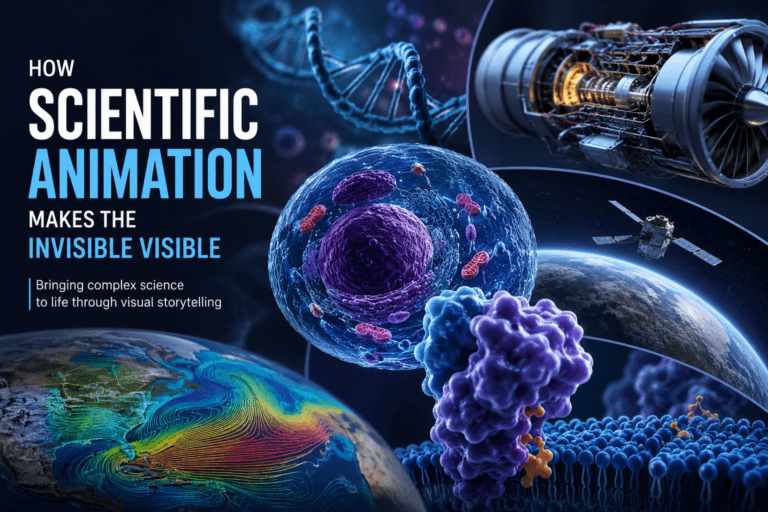
Scientific animation is broader. It may explain biology, chemistry, physics, engineering, environmental systems, or laboratory processes. In biomedical projects, scientific animation often visualizes molecular and cellular activity, such as proteins, receptors, DNA, or cell signaling.
The overlap is large. A mechanism of action video for a drug is both medical and scientific. It supports healthcare communication, but it also visualizes molecular science.
| Field | Main focus | Common audience |
| Medical animation | Healthcare, anatomy, procedures, drugs, devices, patient education | Patients, doctors, hospitals, pharma, medtech, universities |
| Scientific animation | Scientific concepts, experiments, molecules, cells, technical systems | Researchers, students, labs, biotech teams, investors |
| General 3D animation | Entertainment, marketing, products, stories, games | Consumers, players, brands, general audiences |
The difference is not only the subject. It is also the responsibility. Medical animation must be clear, accurate, and careful with what it visually implies.
Types of Medical Animation
Medical animation is not one fixed format. The right type depends on the message, audience, and level of detail.
Anatomy and Physiology Animation
Anatomy animation shows the structure of the body. Physiology animation shows how the body works.
Together, they help viewers understand systems such as the heart, lungs, brain, muscles, bones, nerves, digestive organs, or blood vessels.
This is especially useful when the viewer needs more than a labeled diagram. A still image can show the heart. Animation can show blood flow, valve movement, pressure changes, and what goes wrong during disease.
Common uses include:
- Medical school lessons
- Patient education videos
- Anatomy explainers
- Disease awareness content
- Hospital website visuals
- Healthcare training modules
The benefit is simple: structure and function become easier to connect.
Surgical Procedure Animation
Surgery is difficult to explain with words alone.
A patient may hear the name of a procedure but still not understand what will happen. A trainee may study the steps but struggle to picture the sequence. A hospital may need a consistent way to explain the same operation to many patients.
Surgical animation solves this by showing the procedure step by step.
It can show:
- Where the incision is made
- Which organs or tissues are involved
- How instruments move
- How an implant is placed
- What the surgeon is trying to correct
- What the expected result looks like
The level of detail depends on the audience. A patient-facing video should be calm, clean, and easy to follow. A training video for professionals may need more anatomical precision and procedural detail.
This is where the production pipeline matters. A proper 3D animation pipeline helps the team plan the message before jumping into modeling and rendering.
Mechanism of Action (MoA) Animation
Mechanism of Action animation, or MoA animation, explains how a drug or treatment works inside the body.
This is one of the most important uses of medical animation in the pharmaceutical and biotech industries. Drug mechanisms often happen at a microscopic scale. A camera cannot film a molecule binding to a receptor or a pathway being blocked inside a cell.
Animation makes that invisible process visible.
An MoA animation may show:
- A drug entering the bloodstream
- A molecule reaching a target cell
- A receptor interaction
- A biological pathway being activated or blocked
- A cellular response
- The final therapeutic effect
For pharma teams, MoA animation helps turn dense science into a clear story. For healthcare professionals, it can make the drug’s logic easier to follow. For investors or non-specialists, it can explain the value of a product without requiring them to read a technical paper first.
But there is an important warning: MoA animation must be reviewed carefully. A beautiful animation can still be a problem if it exaggerates results or visually suggests claims that are not supported.
Medical Device Animation
Medical device animation explains how a device works, how it is used, and how it interacts with the body.
This is useful for surgical tools, implants, diagnostic machines, wearable devices, robotic systems, treatment equipment, and healthcare technology products.
A strong device animation can show what a live camera cannot:
- Internal components
- Mechanical movement
- Cutaway views
- Exploded views
- Product assembly
- Device-body interaction
- Safety features
- Usage steps
For medical device companies, this type of animation is valuable in sales presentations, product launches, training, trade shows, investor meetings, and website explainers.
It is closely related to technical animation services, where the goal is to explain complex systems through accurate and controlled visuals.
Patient Education Animation
Patient education animation explains health conditions, treatments, procedures, and care instructions in a simple visual format.
This matters because patients often receive complex information at stressful moments. They may not understand medical terms. They may forget part of what was explained. They may feel overwhelmed.
Animation helps by turning the explanation into a guided visual story.
For example, a patient education animation can explain:
- What a diagnosis means
- How a disease develops
- Why a treatment is needed
- How a procedure works
- How medication should be taken
- What recovery may involve
- What follow-up care matters
The point is not to replace the doctor. The point is to support the conversation.
A systematic review indexed in PubMed found that most included studies reported statistically significant improvements in health information recall when animation videos were used. PubMed
How Medical Animation Is Created
Medical animation needs a disciplined process. The visuals may look smooth in the final video, but behind that result there is research, writing, design, technical production, and review.
Medical Research and Script Development
Every medical animation should start with the question: “What exactly should the viewer understand after watching this?”
That answer shapes the whole project.
The team studies the subject, reviews references, collects medical or technical material, and defines the core message. Then the script is written.
The script is not just narration. It is the blueprint of the video. It decides:
- What information stays
- What gets simplified
- What order the viewer sees things in
- What terms need explanation
- What visual moments need emphasis
- What claims must be reviewed
A patient education video should usually use plain language. A pharmaceutical MoA video may need more technical terminology. A medical device video may need a mix of engineering detail and healthcare context.
Good scripting prevents the biggest problem in medical animation: showing too much and explaining too little.
Storyboarding and Visualization
The storyboard turns the script into a visual plan.
This is where the team decides how the viewer will move through the information. What appears first? When does the camera zoom in? Where should labels appear? Which parts need close-ups? Which details should be hidden to keep the scene clean?
For medical animation, storyboarding is not optional. It protects clarity.
A storyboard helps avoid problems such as:
- Too many visual elements at once
- Confusing camera movement
- Unclear sequence of events
- Missing medical steps
- Overly dramatic visuals
- Weak connection between narration and image
Many projects also use an animatic, which is a timed version of the storyboard. It helps test pacing before the team invests in full 3D production.
This stage is very similar to the planning process used in Pixune’s animation production pipeline.
3D Modeling, Rigging, and Animation
After the plan is approved, the 3D work begins.
3D artists create the digital assets: organs, bones, tissues, cells, molecules, medical tools, devices, environments, or characters. The complexity depends on the goal.
A patient video may need simplified anatomy. A surgical training video may need more precise body structures. A pharma MoA video may need detailed cells, receptors, and microscopic environments.
The process often includes:
| Stage | What happens | Why it matters |
| 3D modeling | Building organs, devices, cells, tools, or characters | Creates the visual foundation |
| Texturing | Adding surface detail, color, and material feel | Makes the subject readable and believable |
| Rigging | Creating controls for movement | Allows organs, devices, or characters to move correctly |
| Animation | Defining motion, timing, and camera movement | Turns the explanation into a clear sequence |
| Simulation | Creating fluids, particles, tissues, or physical effects | Adds realism when needed |
| Rendering | Processing the 3D scene into final images | Creates the polished final look |
| Compositing | Combining layers, labels, effects, and color correction | Makes the final video clean and understandable |
This is where 3D tools such as Maya, Blender, Cinema 4D, ZBrush, and Unreal Engine may enter the workflow.
Review by Medical Experts
Review is not a final “check.” It should happen throughout the project.
Medical animation can easily create the wrong impression if a detail is inaccurate. A model may look good but show the wrong anatomy. A motion may feel smooth but imply the wrong biological process. A visual metaphor may be clear but scientifically misleading.
Expert review helps catch these problems early.
A review team may include:
- Doctors
- Scientists
- Medical advisors
- Device engineers
- Regulatory reviewers
- Certified medical illustrators
- Client-side subject-matter experts
They may review the script, storyboard, models, animation, labels, claims, and final edit.
This process protects both the viewer and the brand. In medical communication, trust is part of the product.
Applications of Medical Animation
Pharmaceutical Marketing
Pharmaceutical companies use medical animation to explain drug mechanisms, disease pathways, treatment benefits, and scientific positioning.
The most common format is the MoA video. It helps healthcare professionals, investors, sales teams, and internal stakeholders understand what the treatment does and why it matters.
Medical animation is useful in pharma because it can show:
- Molecular interactions
- Receptor binding
- Cell signaling
- Immune response
- Disease progression
- Drug delivery
- Treatment pathways
For marketing teams, the benefit is not only visual appeal. It is speed of understanding. A clear animation can communicate complex science faster than a slide deck full of dense diagrams.
Still, pharma animation must be handled carefully. Claims, visuals, risk information, and product benefits must stay aligned with approved data.
Healthcare and Hospital Education
Hospitals and healthcare providers use animation to make communication clearer.
A doctor may explain a procedure in person, but animation gives patients a second way to understand it. This can be especially useful before surgery, during treatment planning, or after diagnosis.
Healthcare animation can support:
- Pre-surgery education
- Condition explainers
- Treatment walkthroughs
- Recovery instructions
- Public health campaigns
- Waiting room videos
- Hospital website content
- Patient portal resources
The benefit is consistency. Every patient can receive the same clear explanation, while doctors and nurses can use the animation as a visual support tool.
Medical Schools and Universities
Medical education depends on understanding systems, not just memorizing terms.
Animation helps students see how body parts work together over time. This is useful for anatomy, physiology, pathology, pharmacology, surgery, and biomedical science.
For example, animation can show:
- How the heart contracts
- How neurons transmit signals
- How muscles move
- How disease changes tissue
- How drugs affect cells
- How surgical steps unfold
A static diagram can show “what it is.” Animation can show “what it does.”
That difference is why medical animation is so useful in classrooms, e-learning platforms, lectures, simulations, and digital training libraries.
Clinical Training
Clinical training often needs repeatable, step-by-step instruction.
Animation gives instructors a way to show a procedure or workflow from angles that may not be possible in live footage. It can slow down important moments, remove visual distractions, highlight critical details, and replay the sequence as many times as needed.
Clinical training animation may cover:
- Surgical procedures
- Emergency workflows
- Device usage
- Patient handling
- Diagnostic steps
- Treatment protocols
- Safety instructions
The benefit is control. The trainer decides exactly what the learner sees.
Biotechnology and Life Sciences
Biotech companies often need to explain things that are technically impressive but hard to describe.
A platform may involve cell therapy, gene editing, AI-driven drug discovery, molecular diagnostics, or a new laboratory workflow. These subjects can be too abstract for a general audience.
Animation helps turn the science into a story.
For biotech startups, this is useful in:
- Investor presentations
- Website explainers
- Product launches
- Conference videos
- Pitch decks
- Scientific outreach
- Partner education
A strong animation can make a biotech product feel more understandable, credible, and ready for discussion.
Benefits of Medical Animation
Explaining Complex Medical Concepts
This is the main reason medical animation exists.
Some subjects become clearer the moment they move. Blood flow, organ function, surgical steps, molecular binding, and device mechanisms are all easier to understand when the viewer can follow the action.
Medical animation helps by using:
- Controlled pacing
- Clear camera movement
- Visual hierarchy
- Labels and callouts
- Color coding
- Step-by-step sequencing
- Simplified environments
- Focused storytelling
This is the same advantage seen in professional technical animation: complex systems become easier to explain when they are broken into visual steps.
Improving Patient Understanding
Patients do not need to become medical experts. They need to understand enough to make sense of their situation, ask better questions, and follow instructions more confidently.
Medical animation can help because it reduces the gap between medical language and patient understanding.
Instead of saying, “The artery is blocked,” an animation can show the blockage. Instead of describing a procedure verbally, it can show the steps. Instead of explaining a drug pathway with abstract terms, it can show the treatment moving through the body.
For patient-facing videos, the best style is usually:
- Calm
- Clear
- Slow enough to follow
- Visually clean
- Not overly graphic
- Not overloaded with labels
- Written in plain language
The benefit is not decoration. It is comprehension.
Enhancing Medical Training and Communication
Medical animation also helps teams communicate internally.
A medical device company can use one animation across sales, training, investor meetings, and website content. A hospital can use one procedure video across multiple departments. A university can reuse anatomy animations in lectures, online modules, and exam preparation.
This makes animation a reusable asset, not just a one-time video.
| Benefit | Who gains from it? | Example |
| Faster understanding | Patients, investors, students | A short video explains a procedure before a consultation |
| Better consistency | Hospitals, trainers, sales teams | Every viewer receives the same explanation |
| Stronger product communication | Pharma, biotech, medtech | A device or drug mechanism becomes visible |
| Easier learning | Students, clinicians | Complex systems are shown step by step |
| More flexible content | Marketing and education teams | One 3D asset can support videos, stills, slides, and short clips |
This is where medical animation becomes strategic. It is not only content. It is a communication asset that can support multiple teams.
Challenges in Medical Animation
Scientific Accuracy
The biggest challenge is accuracy.
A medical animation can look impressive and still be wrong. A vessel may be placed incorrectly. A device may move in a way that does not match real use. A drug animation may imply a result that has not been proven.
In healthcare, small visual mistakes can create large trust problems.
That is why medical animation needs research, references, and expert review. The team must know what needs to be anatomically precise, what can be simplified, and what should not be shown at all.
The goal is not to show every detail. The goal is to show the right details accurately.
Regulatory and Ethical Considerations
Medical animation can influence how people understand treatments, devices, and healthcare decisions. That creates responsibility.
For pharmaceutical and medical device marketing, animation must avoid unsupported or misleading claims. The visuals should not exaggerate benefits, hide risks, or make a product seem more effective than approved data allows.
In the United States, the FDA’s Office of Prescription Drug Promotion works to ensure prescription drug promotion is truthful, balanced, and accurately communicated. FDA
This matters because animation can imply meaning without saying it directly. A fast visual cure, a glowing organ, or a disappearing disease can all suggest claims. If those claims are not supported, the animation may become a regulatory problem.
Good medical animation needs creative control and compliance awareness.
Balancing Detail with Clarity
Medical subjects are dense. The temptation is to show everything.
That usually makes the video worse.
Too many labels, too many structures, too much motion, or too much scientific detail can overload the viewer. A good animation guides attention. It shows the viewer what matters now, then moves to the next idea.
A useful rule is this:
Show enough to be accurate. Remove enough to be clear.
That balance is what separates a helpful medical animation from a confusing one.
Software Used for Medical Animation
Medical animation can be created with different software depending on the project style, budget, and technical needs.
Autodesk Maya
Autodesk Maya is widely used in professional 3D animation pipelines. It is strong for modeling, rigging, animation, simulation, and complex production workflows.
In medical animation, Maya can be used to animate anatomy, surgical tools, devices, characters, and microscopic environments.
Read More: Maya vs Blender
Blender
Blender is a free, open-source 3D creation suite. It supports modeling, sculpting, rigging, animation, simulation, rendering, compositing, and editing.
It is useful for medical explainers, anatomy animation, device visuals, and educational content. Pixune covers Blender and other tools in its guide to 3D animation software.
Cinema 4D
Cinema 4D is often used for motion graphics, clean design, and commercial animation.
For medical animation, it can be useful for explainers, diagrams, product visuals, labels, transitions, and stylized healthcare videos.
ZBrush
ZBrush is used for digital sculpting and high-detail organic modeling.
In medical animation, it can help create detailed muscles, organs, tissue surfaces, bones, and biological forms. It is especially useful when the model needs to feel rich and anatomical.
Unreal Engine
Unreal Engine is a real-time 3D engine used for games, virtual production, interactive content, VR & AR, and real-time visualization.
In medical animation, Unreal Engine can be useful for interactive training, real-time anatomy tools, virtual procedures, and immersive healthcare education.
How Much Does Medical Animation Cost?
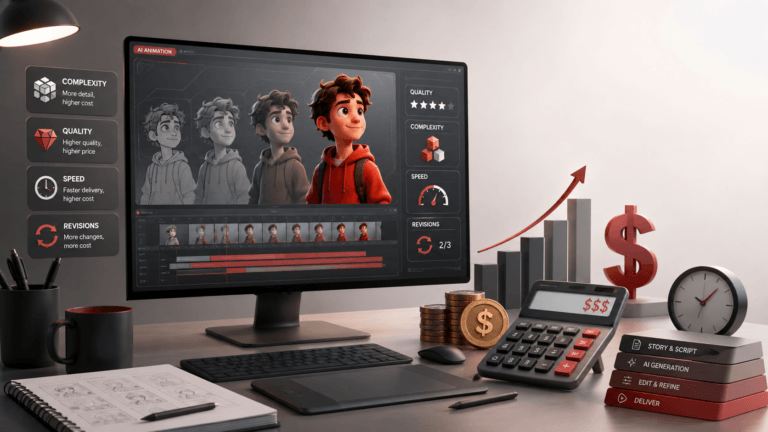
Factors That Affect Pricing
Medical animation costs vary because projects vary heavily.
A simple patient explainer is very different from a cinematic MoA video. A 2D healthcare animation is different from a 3D surgical training module. A medical device product video is different from a biotech investor animation.
The main cost factors are:
- Duration
- 2D or 3D animation style
- Level of realism
- Medical complexity
- Custom anatomy or device modeling
- MoA or molecular detail
- Simulation needs
- Voiceover and sound design
- Expert review
- Regulatory review
- Revision rounds
- Timeline urgency
Pixune’s guide on how much 3D animation costs explains how production quality, modeling, animation, rendering, and scope affect budget.
Typical Budget Ranges
Medical animation pricing should always be estimated based on the actual brief. Still, rough ranges can help with early planning.
| Project type | Typical scope | Budget expectation |
| Simple 2D medical explainer | Basic visuals, short narration, limited motion | Lower budget |
| Basic 3D anatomy animation | Simple organ or body-system visualization | Moderate budget |
| Professional 3D medical animation | Custom models, polished visuals, expert review | Higher budget |
| MoA or biotech animation | Molecular/cellular environments, advanced storytelling | High budget |
| Surgical or medical device animation | Technical accuracy, detailed modeling, product/body interaction | High budget |
| Premium pharma or campaign-level animation | Cinematic quality, complex scenes, regulatory review, many revisions | Highest budget |
As a general rule, professional medical animation can range from a few thousand dollars for simpler work to tens of thousands of dollars per minute for custom, high-quality 3D animation.
The safest way to price a medical animation is to answer these questions first:
- Who is the viewer?
- What should they understand after watching?
- Is the subject anatomical, surgical, molecular, or device-based?
- Does the project need medical expert review?
- How realistic should it look?
- How many scenes are needed?
- Will the animation be used for education, marketing, training, or investor communication?
A clear brief prevents wasted production time and reduces expensive late-stage changes.
Final Thoughts
Medical animation is valuable because medicine is often invisible, complex, and difficult to explain quickly.
It helps patients understand what is happening inside their bodies. It helps doctors and hospitals communicate more clearly. It helps students learn dynamic systems. It helps pharmaceutical and biotech teams explain science that cannot be filmed. It helps medical device companies show how their products work in context.
The best medical animation does three things at once:
- It respects the science.
- It guides the viewer.
- It makes the message easier to remember.
That is why medical animation should not be treated as decoration. It is a practical communication tool for healthcare, pharma, biotech, training, and education.
For teams that need to explain medical, scientific, or technical subjects, Pixune’s technical animation services, 3D animation studio, and full animation services can help turn complex information into clear, polished, and useful visual content.

![1405,02,10 SnpLE[Cover HD] 1](https://pixune.com/wp-content/uploads/2026/08/14050210-SnpLECover-HD-1-768x431.jpg)