
Some parts of science are almost impossible to explain with words alone.
How do you show a molecule attaching to a receptor? How do you explain a virus entering a cell, an ocean current changing over several decades, or energy moving through components hidden inside a machine?
These processes are real, but they are not always visible. Some are too small to film. Others are too large, too fast, too slow, or buried inside systems that a camera cannot reach.
Scientific animation gives us a way to see them.
By combining scientific research with animation and visual storytelling, complex processes can be transformed into clear sequences that audiences can follow. Instead of only explaining what something is, scientific animation can reveal how it behaves, what causes it to change, and why the process matters.
At Pixune, scientific and technical animation is used to communicate difficult systems, products, mechanisms, and ideas through structured visual storytelling. The objective is not simply to make science look impressive. The animation must help the audience understand the subject more clearly.
Scientific animation is closely connected to medical animation, although its scope is wider. Medical animation generally focuses on anatomy, diseases, surgery, treatments, pharmaceutical products, and medical devices. Scientific animation can cover those topics while also extending into biology, chemistry, physics, engineering, environmental science, biotechnology, and astronomy.
In simple terms, scientific animation makes complex or invisible science easier to see, understand, and remember.
What Is Scientific Animation?
Scientific animation is the use of moving visual media to explain scientific concepts, research findings, technical systems, data, or natural processes.
It may be created through different types of animation, including 2D animation, 3D animation, motion graphics, simulation, real-time visualization, or interactive technology. The best format depends on what is being explained and who needs to understand it.
A school lesson about photosynthesis may only require simple 2D animation. A pharmaceutical video may need detailed 3D molecular visualization services. An engineering presentation may use exploded views and transparent materials to reveal the inner workings of a machine. Climate researchers may rely on data-driven animation to show how a system changes over time.
The style can change dramatically, but the central purpose remains the same: to help the viewer build an accurate mental model of something difficult.
A successful scientific animation usually balances the following elements:
| Element | Its Role in Scientific Animation |
| Accuracy | Keeps the visuals aligned with scientific evidence |
| Clarity | Makes the subject understandable for the intended audience |
| Engagement | Maintains attention and supports memory |
| Structure | Reveals information in a logical sequence |
| Validation | Allows experts to review the scientific content |
Accuracy alone is not enough. An animation can be scientifically correct and still confuse the viewer. At the same time, an attractive animation loses credibility if it presents the science incorrectly.
The strongest work sits between those extremes. It respects the evidence while communicating it in a way people can actually follow.
Scientific Animation vs. Medical Animation
Scientific and medical animation often overlap. Drug mechanisms, cellular processes, medical devices, and disease pathways can belong to both categories. The distinction is mainly one of scope.
Medical animation concentrates on healthcare. It may show how a surgical procedure works, how a disease affects the body, how a treatment is performed, or how a medical device should be used.
Scientific animation includes these subjects but also covers a much broader range of disciplines.
| Medical Animation | Scientific Animation |
| Usually focuses on healthcare and the human body | Covers medicine as well as biology, chemistry, physics, engineering, climate, and space |
| Often created for patients, doctors, hospitals, pharma companies, and medical educators | Used by researchers, universities, biotech firms, engineers, investors, museums, and media companies |
| May show anatomy, surgery, disease, treatment, or devices | May show protein folding, ocean currents, machine systems, chemical reactions, or planetary motion |
An animation showing how insulin affects the body could be considered both medical and scientific. An animation of protein folding, a rocket trajectory, or ocean circulation would usually be classified more broadly as scientific animation.
This broader scope makes scientific animation useful anywhere a complicated process needs to become easier to understand.
Why Scientific Animation Works Better Than Static Visuals
Static diagrams are useful for showing structure. They can identify the parts of a cell, the components of a machine, or the measurements within a dataset. Their weakness is time.
Many scientific ideas depend on sequence, interaction, and change. A molecule binds to another structure. A signal activates a pathway. A machine transfers force. A current changes direction. A field expands or weakens.
A still image can show the beginning or the end of such a process, but the viewer must mentally fill in everything that happens between those moments.
Animation removes much of that guesswork.
A resource from Bitesize Bio explains that static figures often require audiences to infer timing and causality. Scientific animation can make those relationships visible by showing what happens, where it happens, and in what order.
This is the key difference:
| Static Visual | Scientific Animation |
| Shows an object or structure | Shows how the object behaves |
| Captures one moment | Reveals change over time |
| Leaves the sequence open to interpretation | Guides the viewer through the sequence |
| Presents data points | Can reveal patterns and relationships |
| Requires the viewer to imagine movement | Displays the movement directly |
That is why animation is especially effective when the behavior of a system matters more than its appearance.
The receptor matters, but the binding process matters more.
The machine component matters, but the transfer of force matters more.
The climate dataset matters, but the pattern of change matters more.
Main Types of Scientific Animation
Scientific animation is not a single style or production format. It changes depending on the field, the audience, and the type of information being communicated.
The following overview shows how different forms of scientific animation are commonly used:
| Type | What It Can Visualize | Common Uses |
| Biological and cellular animation | Cells, DNA, proteins, viruses, immune responses | Education, biotech, research communication |
| Molecular and chemistry animation | Drug binding, chemical reactions, protein folding | Pharma, biotech, publications, investor presentations |
| Physics and engineering animation | Forces, machines, internal systems, fluid behavior | Product demos, training, technical communication |
| Environmental and climate animation | Atmosphere, oceans, ecosystems, carbon movement | Education, public outreach, documentaries |
| Astronomy and space visualization | Planetary motion, space missions, solar activity | Museums, research, broadcast media |
| Medical animation | Anatomy, disease, surgery, treatment, devices | Hospitals, pharma, medtech, patient education |
Biological and Cellular Animation
Biological and cellular animation focuses on processes happening inside living systems.
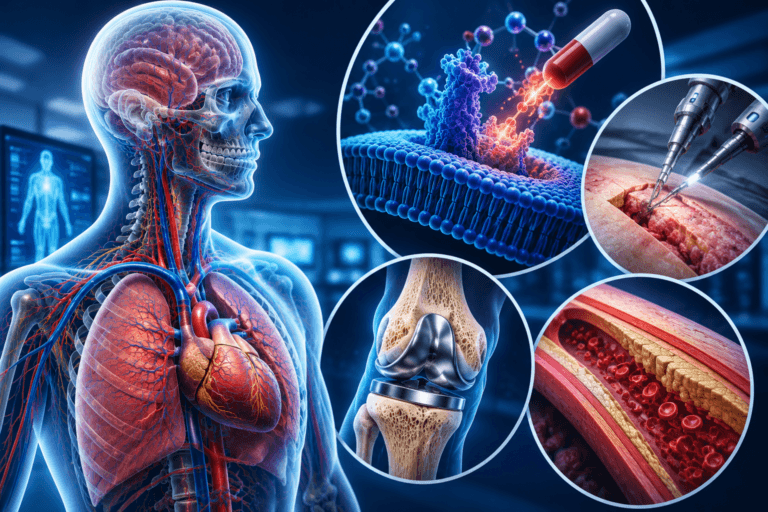
It can show DNA, proteins, enzymes, receptors, viruses, immune responses, organelles, and signaling pathways. These subjects are especially suitable for animation because they are microscopic and dynamic.
A traditional diagram may identify the components of a cellular pathway. Animation can show which molecule arrives first, how a receptor changes shape, what activates the next stage, and how the overall biological response develops.
For students, this can make biology more understandable. For researchers, it can help communicate a complex hypothesis. For a biotechnology company, it can turn an invisible platform or discovery into a clear explanation for investors and partners.
The subject is not only easier to see. It becomes easier to follow.
Molecular and Chemistry Animation
Molecular animation visualizes atoms, proteins, ligands, receptors, membranes, enzymes, bonds, and chemical interactions.
This is particularly valuable in pharmaceutical and biotechnology communication because molecular behavior cannot be recorded in the same way as a physical product or human action.
Consider a drug binding to a receptor. A written description may explain the interaction accurately, but the reader still needs to imagine scale, position, shape, motion, and the resulting biological effect.
A guided 3D sequence can present all of those relationships together.
A peer-reviewed article available through PubMed Central describes 3D animation as a useful tool for exploring dynamic molecular mechanisms that are difficult to represent through static 2D illustrations.
This reveals a deeper use for scientific animation. It does not only communicate research after the work is complete. The production process itself can encourage researchers to compare interpretations, examine assumptions, and notice gaps in existing knowledge.
Physics and Engineering Animation
Physics and engineering animation explains subjects such as force, movement, heat, fluid behavior, electrical flow, energy transfer, and internal mechanical systems.
It is closely connected to Pixune’s technical animation services, where complex machines, products, and mechanisms are translated into understandable visual sequences.
A camera may show the exterior of a turbine, industrial product, or technical device. It cannot always reveal what is happening inside.
Animation can use transparent materials, cutaway views, controlled camera movement, and exploded diagrams to expose hidden functions. It can also slow down rapid processes, isolate specific components, or remove distracting information.
This makes technical animation useful for:
- product demonstrations,
- engineering presentations,
- safety and training videos,
- industrial marketing,
- maintenance instructions,
- and investor communication.
In these situations, the animation is not decoration. It provides access to information that ordinary video cannot capture, and there are many benefits of 3D modeling in engineering.
Environmental and Climate Animation
Climate and environmental systems are difficult to communicate because they operate across enormous distances and long periods of time.
Ocean currents, atmospheric movement, carbon circulation, melting ice, pollution, and ecosystem changes cannot always be understood from numbers or isolated footage.
Animation can combine scientific data with time compression and spatial visualization. This allows audiences to see where change is happening, how different systems influence one another, and why the resulting pattern matters.
NASA’s Scientific Visualization Studio provides some of the strongest examples of this approach. Its work transforms Earth and space science data into animations used in education, museums, scientific presentations, documentaries, and public communication.
A strong climate animation does more than state that a change is taking place. It shows the behavior of the system behind that change.
Astronomy and Space Visualization
Space science has many of the same challenges, only on an even larger scale.
A single camera cannot clearly capture the movement of planets, the development of a solar storm, a spacecraft’s complete trajectory, or the behavior of a black hole.
Scientific visualization can reconstruct these subjects using research, simulation, and observational data.
NASA’s Scientific Visualization Studio works across astronomy, planetary science, climate, cartography, and 3D modeling. Its visualizations help translate scientific information into experiences that are easier for both specialists and the public to understand.
For museums and documentaries, this makes invisible or distant events accessible. For researchers and educators, it creates a bridge between data and explanation.
How Scientific Animation Is Created
A finished scientific animation may look effortless, but its production is usually research-heavy.
The work begins before modeling or animation software is opened. The team must first understand the subject. Depending on the project, that may involve journal articles, technical documents, CAD files, molecular data, diagrams, reference videos, product specifications, or interviews with researchers.
The audience must also be defined early.
An animation for school students requires a different level of detail than a conference presentation. A biotech investor video must communicate commercial value without losing scientific credibility. An engineering demonstration must reveal how the system works without overwhelming the viewer with unnecessary complexity.
Once the message is clear, the science is translated into a visual sequence.
| Production Stage | Main Purpose |
| Research and briefing | Establish the science, audience, goals, and available references |
| Script development | Turn the subject into a clear explanation |
| Storyboarding | Plan what the viewer sees at each stage |
| Animatic | Test timing, pacing, narration, and scene progression |
| Asset creation | Build models, diagrams, environments, and simulations |
| Animation | Show movement, interaction, transformation, and cause-and-effect |
| Expert review | Check the work for scientific and technical accuracy |
| Final production | Complete rendering, compositing, sound, captions, and delivery |
Studios such as XVIVO use a comparable structure, moving from research and scriptwriting through storyboarding, animatics, rough animation, and final production.
At Pixune, this type of preparation is essential because seemingly small creative decisions can change the meaning of the science. Scale, color, timing, labels, camera position, and movement all influence how the audience interprets the process.
Why Storyboarding Matters
Storyboarding has a more critical role in scientific animation than it does in many other types of video production.
It allows the team to align the science before time is spent on complex models, simulations, and renders.
At this stage, the animators and subject matter experts can decide:
- which details are scientifically confirmed,
- which parts must be simplified,
- which elements remain hypothetical,
- where labels or explanations are required,
- and whether any visual choice could create a false impression.
Animation can make an idea feel more certain than it actually is. A hypothetical molecular pathway should not look like a direct recording of reality. A simplified climate model should not imply that every variable has been included.
Storyboarding allows these problems to be identified while they are still easy to correct.
Where Scientific Animation Is Used
Scientific animation is used anywhere difficult information needs to become clearer.
Education and E-Learning
In education, animation helps students move beyond memorizing diagrams.
A student may remember the parts of a cell from a textbook, but animation can show how those parts communicate and respond over time. This makes it useful for school lessons, university lectures, online courses, laboratory preparation, and technical training.
The value comes from showing relationships rather than only listing information.
Scientific Research and Publications
Researchers can use animation in conference presentations, journal supplements, graphical abstracts, grant proposals, laboratory websites, and internal discussions.
The article on 3D animation for dynamic molecular mechanisms explains how animation can combine structural and temporal data into a visual model.
This can help researchers explain a hypothesis, compare possible mechanisms, and make complex findings more accessible to people from other disciplines.
Pharmaceutical and Biotechnology Communication
Biotechnology companies often face a communication problem: the innovation may be valuable, but its value is difficult to explain.
Scientific animation can visualize drug delivery, gene editing, cell therapy, diagnostic platforms, protein interactions, mechanisms of action, and mechanisms of disease.
For investors and partners, this shortens the time needed to understand the technology. For internal teams, it can create a shared explanation of how the product or platform works.
The result is not only better marketing. It is clearer business communication.
Museums, Exhibitions, and Public Outreach
Museums and science centers need to explain complicated subjects to people with very different levels of knowledge.
Visitors may only spend a few minutes at an exhibit. A well-designed animation can guide them through a concept more efficiently than a dense wall of text.
Scientific animations are also suitable for large displays, interactive exhibits, conference screens, and public awareness campaigns.
Documentaries and Broadcast Media
Scientific documentaries frequently depend on animation because much of their subject matter cannot be filmed directly.
Viruses, ancient environments, nuclear reactions, black holes, ocean circulation, brain activity, and planetary events all require some form of reconstruction or visualization.
Animation gives filmmakers a way to show the parts of the story that cameras cannot capture.
The Benefits of Scientific Animation
The value of scientific animation goes far beyond visual appeal.
It simplifies complex information by introducing it in a controlled sequence. Instead of presenting every component at once, the animation can guide the viewer from the basic structure to the more difficult interactions.
It also reveals cause-and-effect. The viewer can see what happens first, what activates the next stage, and what result follows.
Because the sequence is controlled, animation can reduce misinterpretation. Five people looking at the same static diagram may imagine five slightly different processes. An animation provides a more consistent explanation.
Scientific animation can also improve memory. A carefully designed visual sequence is often easier to recall than a paragraph filled with unfamiliar terminology.
Finally, it can help teams align internally. When researchers, engineers, or product teams create an animation, they must agree on what is known, what is uncertain, and how the process should be explained. That discussion can reveal gaps long before the animation reaches an external audience.
Scientific animation is particularly effective when:
- the subject cannot be filmed directly;
- the process depends on time or sequence;
- the audience needs to understand cause-and-effect;
- the concept is highly abstract;
- several disciplines need a shared explanation;
- or the information must be communicated quickly to non-specialists.
The Challenges Behind Scientific Animation
Scientific animation must balance several competing demands.
Accuracy is the most obvious challenge. A beautiful animation can still fail if it misrepresents the science. Dramatic visuals may exaggerate an effect, while excessive simplification can remove important meaning.
At the same time, too much detail can overwhelm the audience. A scientific model may contain hundreds of components, but only a few may be necessary for the explanation.
Collaboration presents another challenge. Researchers and artists do not always approach information in the same way. Scientists tend to focus on evidence, terminology, uncertainty, and precision. Animation teams focus on pacing, hierarchy, composition, and viewer comprehension.
Neither perspective is enough on its own. The finished work needs both.
Another difficulty appears when the process has never been directly observed. Molecular interactions, ancient events, theoretical physics, and some cellular mechanisms may be based on simulations, models, or current hypotheses. The animation must communicate these subjects without presenting interpretation as unquestionable fact.
The final challenge is production cost. Scientific animation may require research, custom models, simulation, expert review, rendering, voiceover, sound design, and several rounds of correction.
Pixune’s guide to medical animation explains that duration, visual style, realism, scientific complexity, simulation requirements, and review rounds can all affect the final budget.
Good planning solves many of these problems. Aligning the script and storyboard before full production reduces the risk of expensive corrections later.
Software Used for Scientific Animation
There is no single best program for scientific animation. Each tool has different strengths.
| Software | Common Scientific Uses |
| Blender | Modeling, animation, rendering, scripting, and affordable scientific visualization |
| Autodesk Maya | High-end modeling, rigging, animation, and large production pipelines |
| Cinema 4D | Motion graphics, polished explainers, and design-focused visuals |
| Houdini | Procedural systems, particles, fluids, simulations, and data-driven animation |
| Unity | Real-time applications, interactive training, VR, and educational simulations |
| Unreal Engine | High-quality real-time visualization and immersive environments |
| After Effects | Compositing, labels, diagrams, interface graphics, and final polish |
Blender is widely used because it is open-source and supports modeling, animation, rendering, and scripting. A University of Illinois session on 3D Scientific Visualization with Blender describes how the software can be used to display data, generate models, create animation, and control virtual cameras.
Autodesk Maya is common in professional 3D pipelines. Oregon State University’s article on Molecular Maya demonstrates how Maya can be extended to work with protein structures and molecular visualization.
Cinema 4D is especially useful for motion graphics and polished scientific explainers. Maxon’s article on the art of medical animation shows how Cinema 4D, Redshift, ZBrush, X-Particles, and After Effects can be combined within a scientific production workflow.
Houdini is suited to projects involving physical simulation, procedural systems, fluid movement, particles, or large datasets. The University of Illinois resource on scientific visualization in Houdini describes the software as a bridge between visual effects and research physics.
Unity and Unreal Engine become useful when the experience needs to be interactive, immersive, or delivered in real time. They can support virtual laboratories, museum installations, training applications, and research visualization.
The software is important, but it does not determine the quality of the result. Scientific understanding, communication design, and expert review matter more than the choice of program.
How Much Does Scientific Animation Cost?
Scientific animation does not have a fixed price because project requirements vary considerably.
A short 2D educational video is very different from a high-end 3D mechanism-of-action animation with custom molecular models, simulation, voiceover, and scientific review.
The main cost factors include:
| Cost Factor | Why It Matters |
| Duration | Longer videos require more scenes, assets, and animation |
| 2D or 3D format | 3D often requires modeling, materials, lighting, cameras, and rendering |
| Scientific complexity | Difficult subjects demand more research and specialist input |
| Custom assets | Molecules, cells, organs, machines, and devices may need to be built from scratch |
| Simulation | Fluids, particles, forces, or physical systems increase production time |
| Realism | More detailed visuals require additional modeling and rendering work |
| Expert review | Scientific content may pass through several validation rounds |
| Delivery format | Websites, exhibitions, VR systems, and large displays have different requirements |
The intended use also influences the budget.
A short animation for a landing page may only need a focused visual explanation. A museum installation may require large-format rendering. A biotech investor film may need premium 3D production and extensive validation. An interactive training application may require real-time development in Unity or Unreal Engine.
The best estimate begins with a clear brief. The production team should know:
- who the audience is,
- what they must understand,
- how scientifically detailed the animation should be,
- whether subject matter experts will review it,
- how realistic the visual style needs to be,
- and where the final animation will be displayed.
A clear brief reduces uncertainty and prevents expensive revisions later in the process.
What Makes a Good Scientific Animation?
A good scientific animation is not necessarily the most realistic one.
A simplified model may explain a process more effectively than a highly detailed render. The correct level of detail depends on the audience and the purpose.
A video made for school students should not feel like a specialist conference presentation. An investor animation should not feel like a children’s lesson. A medical device demonstration should not hide essential technical information simply to look cinematic.
Strong scientific animation usually has:
- a clear communication objective;
- reliable scientific references;
- pacing that matches the audience;
- a clear visual hierarchy;
- carefully controlled simplification;
- expert validation where necessary;
- and professional production quality.
A strong animation team does more than create attractive images. It decides what the viewer should see, when they should see it, and how much information they need at each stage.
That is where an experienced studio adds value.
Pixune’s technical animation services combine research, visual planning, 2D or 3D production, and final delivery to help scientific and technical organizations communicate subjects that would otherwise remain difficult to explain.
The goal is not decoration. The goal is understanding.
Final Thoughts
Scientific animation matters because science is often difficult to see.
It can reveal microscopic interactions, hidden machine systems, environmental patterns, and events taking place far beyond the reach of an ordinary camera.
It helps students learn, researchers communicate, biotechnology companies explain innovation, engineers demonstrate systems, museums educate visitors, and filmmakers visualize the unseen.
The best scientific animation does not replace science. It supports it.
It respects the evidence, simplifies without misleading, and turns complexity into a sequence that people can follow.
Whether the subject is a molecular mechanism, an engineering process, scientific data, or a technical product, Pixune’s technical animation services and medical animation experience can help transform difficult information into clear and engaging visual communication.

![1405,02,10 SnpLE[Cover HD] 1](https://pixune.com/wp-content/uploads/2026/08/14050210-SnpLECover-HD-1-768x431.jpg)