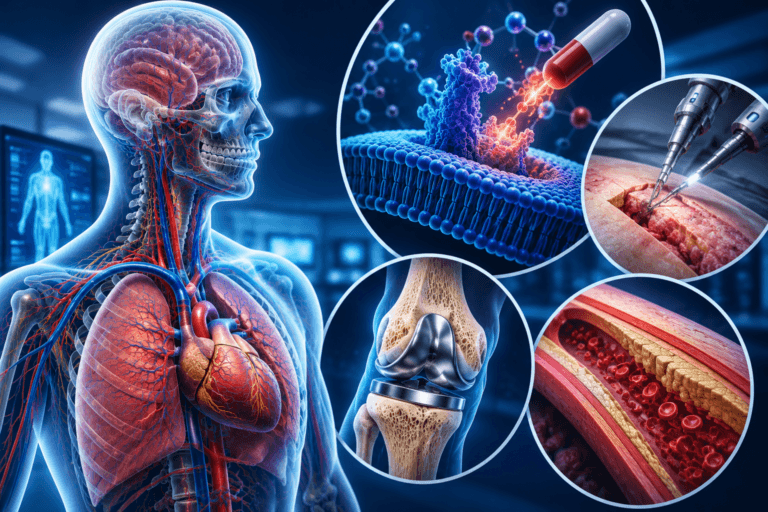
Some scientific ideas are easy to describe but difficult to visualize. You can explain how a drug interacts with a cell. You can describe how a machine transfers energy from one component to another. You can talk about how a planet moves through space or how a chemical reaction takes place at a molecular level. The problem is that we cannot always see these things happening. Some processes are too small to observe. Others happen too quickly or slowly for a camera to capture. Some take place inside the human body or inside complex machines where direct observation is impossible.
Scientific animation makes these processes visible.
By combining scientific research with animation and visual storytelling, complex subjects can be turned into visual sequences that are easier to understand. A well-made scientific animation does more than make a concept look impressive. It helps the viewer understand what is happening, why it happens, and how different parts of a system are connected.
Scientific animation is used across medicine, biology, chemistry, physics, engineering, environmental science, astronomy, and many other fields. The style can range from a simple 2D educational video to a highly detailed 3D simulation.
At Pixune, scientific and technical animation is used to communicate complex systems, products, mechanisms, and ideas through visual storytelling. The goal is always the same: make difficult information easier to understand without losing the accuracy behind it.
What Is Scientific Animation?
Scientific animation is the use of animation and visual effects to explain scientific concepts, processes, systems, research, or data. It can take many forms. A short 2D animation might explain how photosynthesis works. A 3D animation could show how a drug molecule interacts with a receptor. An engineering animation might cut through a machine to reveal what happens inside it while it is operating.
Scientific animation can also be used to visualize things that are difficult to observe directly. This includes molecular interactions, cellular processes, astronomical events, geological changes, and simulations based on scientific data.
The type of 3D animation depends on the subject and the audience. A university lecture may require a different visual approach from a public science documentary. A pharmaceutical company explaining a treatment to investors has different needs from an engineer demonstrating a machine to a technical team. That is why scientific animation is not defined by one particular art style. It is defined by its purpose: using moving visuals to make scientific information clearer.
Why Is Scientific Animation Important?
Science often deals with processes rather than static objects. Knowing what a cell looks like is useful. Understanding how the cell responds to a stimulus is much more difficult to communicate with a single image. The same applies to engineering. A diagram can show the parts of an engine, but it may not clearly show how those parts interact while the engine operates.
Animation gives the viewer something that a static image cannot: time. The audience can see one event happen and then see what it causes. A molecule moves toward a receptor. A signal travels through a system. A mechanical component moves and transfers force. A geological process develops over thousands of years.
This makes animation particularly useful when understanding the sequence is as important as understanding the individual components. It also gives creators control over what the viewer sees. A complex system can be introduced one part at a time instead of showing everything simultaneously. That makes difficult subjects easier to follow without necessarily simplifying the science itself.
Scientific Animation vs. Medical Animation
Scientific animation and medical animation are closely related. In some projects, the terms can even overlap. The main difference is the scope. Medical animation focuses primarily on healthcare and the human body. It can explain anatomy, diseases, surgical procedures, treatments, pharmaceuticals, and medical devices. Scientific animation has a broader scope. It can cover medicine and biology but can also move into chemistry, physics, engineering, astronomy, environmental science, and other scientific fields.
For example, an animation showing how a surgical implant works would generally be considered medical animation. An animation explaining how a new material behaves under extreme pressure would be scientific or technical animation. The two fields also share many production techniques. Both may require detailed 3D models, simulations, scientific references, expert review, and careful visual storytelling. The important question is not always which label applies. It is what needs to be explained and who needs to understand it.
Types of Scientific Animation
There is no single format that works for every scientific subject. The visual approach should reflect the information being communicated.
1. Biological and Cellular Animation
Biological animation can reveal processes that happen at scales far beyond normal human vision. A video might show DNA replication, cell division, protein interactions, immune responses, or the behavior of a virus inside a cell. These animations often use 3D models because three-dimensional space makes it easier to show relationships between structures. However, the models are usually simplified. Scientific visualization is not always about reproducing every detail. It is about showing the details that matter to the explanation.
2. Molecular and Chemical Animation
Molecular animation is useful when the subject involves structures and interactions that cannot be filmed directly. For example, a pharmaceutical company might need to demonstrate how a molecule binds to a target protein. A chemistry lesson might show how atoms rearrange during a reaction. These projects can use detailed 3D models and simulation-based animation to give viewers a visual representation of an otherwise invisible process.
Pixune’s 3D visualization services can be used for this type of scientific communication.
3. Physics Animation
Physics involves many processes that are difficult to observe in a classroom or laboratory. Animation can visualize forces, energy, waves, motion, gravity, electromagnetism, fluid behavior, and other concepts.
For example, instead of simply showing an equation describing a wave, an animation can demonstrate how the wave moves through a medium and how changing different variables affects its behavior. This can make abstract concepts more intuitive.
4. Engineering and Technical Animation
Scientific animation also overlaps heavily with technical visualization. A complex machine may contain components that are hidden once everything is assembled. An animation can separate those components, reveal internal mechanisms, and show how the system operates.
This is particularly useful for products, machinery, industrial systems, and technology. For more specialized projects, technical animation services can combine 3D modeling, animation, simulations, and explanatory graphics to show how a system works.
5. Environmental and Earth Science Animation
Some scientific processes happen on a scale that makes them difficult to observe directly. Climate patterns, ocean currents, erosion, volcanic activity, tectonic movement, and changes in ecosystems can take place over enormous distances or very long periods. Animation can compress that information into a sequence that the viewer can understand in minutes. Data-driven visualization can be especially useful here because the animation can represent real measurements rather than simply creating an artistic interpretation.
6. Astronomy and Space Animation
Space is another area where animation becomes particularly useful. A camera cannot simply travel alongside a planet or move inside a star to show what is happening. Scientists and educators therefore rely heavily on visualization to represent astronomical concepts.
Scientific animation can illustrate planetary systems, spacecraft trajectories, stellar processes, black holes, galaxies, and other phenomena. The visuals may be based on scientific data, mathematical models, observations, or established theories. The animation should make clear when something is a visualization rather than a literal recording.
What Is Scientific Animation Used For?
Scientific animation is used whenever a visual explanation can communicate something more effectively than text or a static image.
1. Education
Education is one of the most obvious applications. Students often encounter scientific concepts that are difficult to imagine from textbooks alone. Animation can turn an abstract explanation into something that unfolds in front of them.
A biology lesson can show how a cell divides. A physics class can visualize forces acting on an object. A chemistry course can show how molecules interact. This does not mean animation replaces traditional teaching. It gives educators another way to explain difficult concepts.
2. Research Communication
Researchers need to communicate with audiences who may not share their specialist knowledge. A scientist presenting at a conference may understand a complex dataset immediately. An investor, journalist, policymaker, or researcher from another field may not.
A carefully designed animation can bridge that gap. It can turn research findings into a visual story without removing the underlying evidence.
3. Pharmaceutical and Biotechnology Communication
Pharmaceutical and biotechnology companies often work with processes that are impossible to see directly. A scientific animation can show how a drug behaves inside the body, how a biological mechanism works, or how a new treatment is intended to affect a particular process.
These visuals can be useful in presentations, educational content, investor communications, websites, conferences, and marketing. Because scientific accuracy is particularly important in this area, the animation usually needs careful review from subject matter experts.
4. Engineering and Product Demonstrations
Technical products can also benefit from animation. A manufacturer might need to demonstrate how a machine works without physically disassembling it. A technology company may need to explain what happens inside a device. An engineering firm may want to demonstrate a new process before the final system has even been built.
A 3D animation can reveal the parts that customers would normally never see. This is one reason 3D technical animation can be valuable for products and complex systems.
5. Museums and Science Communication
Scientific animation is also common in museums, exhibitions, documentaries, and public science communication. The audience in these settings can range from specialists to people with no technical background.
The challenge is to remain accurate while making the subject accessible. A good animation does not assume that viewers already understand the terminology. It introduces the concept visually and builds the explanation as the video progresses.
Examples of Scientific Animation
The best way to understand scientific animation is to look at the kinds of problems it can solve.
Showing How a Drug Works
Imagine a new drug that targets a specific receptor. A written explanation might describe the molecular interaction in technical language. A scientific animation can show the drug moving through the environment, reaching its target, binding to the receptor, and triggering the intended response. The viewer does not need to see the real molecular interaction to understand the mechanism.
Visualizing Cell Division
Cell division is a process that happens at a microscopic scale. An animation can take the viewer inside the cell and show chromosomes, the nucleus, and other structures changing over time. The level of detail can be adjusted depending on whether the audience is school students, medical students, researchers, or the general public.
Explaining a Machine
Consider a machine with dozens of internal components. A normal product video may show the machine from the outside. A scientific or technical animation can make the housing transparent, separate components, zoom into specific mechanisms, and show how energy or force moves through the system. The result is much closer to a visual explanation than a traditional product showcase.
Showing Climate Change Over Time
A single map may show temperature or sea-level data at one point in time. An animation can show how that data changes across decades. Patterns that are difficult to notice in a static image can become much more obvious when the viewer sees them develop.
Visualizing a Space Mission
A space mission can involve distances and time scales that are difficult to communicate through conventional footage. Animation can show the spacecraft’s trajectory, its relationship to planets, and important stages of the mission. Because the animation controls the camera, the viewer can see the journey from perspectives that would be impossible in reality.
How Is Scientific Animation Created?
Scientific animation starts with research rather than 3D animation software. Before an artist creates a model or a scene, the team needs to understand what is being represented. This may involve scientific papers, technical documents, diagrams, datasets, CAD files, reference images, or discussions with subject matter experts.
The next step is deciding what the audience actually needs to understand. This is important because scientific subjects can contain far more information than a short video can communicate. Trying to show everything often makes an animation harder to understand.
Once the message has been defined, the team develops a script and storyboard. The storyboard establishes the visual sequence. It determines what the viewer sees first, what information is introduced later, and where the important interactions take place.
After the storyboard is approved, the production team creates the necessary assets. Depending on the project, this could involve 2D illustrations, 3D models, molecular structures, environments, machinery, or simulated effects.
The animation is then produced and refined. Rendering, compositing, sound design, narration, captions, and graphics are added during the later stages. Scientific review is an important part of the process. Subject matter experts can identify inaccuracies or misleading visual choices before the final animation is delivered.
Why Scientific Accuracy Matters
Scientific animation has a responsibility that ordinary entertainment animation does not always have. A viewer may assume that what they see represents reality. If the animation presents an inaccurate process with confidence, it can create a false understanding. That does not mean every scientific animation must be completely photorealistic.
In fact, simplification is often necessary. A molecular animation may enlarge structures so they can be seen. A cell may be shown with simplified shapes. An engineering animation may remove components that are irrelevant to the explanation. The important thing is that the simplification should not change the meaning. This is where collaboration between artists and subject matter experts becomes valuable. Scientists can verify the content while artists determine how to communicate it clearly.
2D vs. 3D Scientific Animation
Both 2D and 3D animation can be effective for scientific communication.
When to Use 2D Animation
2D animation is often a good choice when the concept can be explained through diagrams, icons, illustrations, charts, or simplified motion. It can be particularly effective for educational content because information can be introduced gradually without requiring complex 3D assets. A 2D approach can also make abstract ideas easier to simplify.
When to Use 3D Animation
3D becomes particularly useful when spatial relationships matter. If the viewer needs to understand the structure of an object, move around a machine, look inside a cell, or observe a process from different angles, 3D can provide much greater freedom. It is also useful when the project requires realistic materials, lighting, simulations, or detailed product visualization.
Pixune’s 3D animation services can be applied to scientific subjects that benefit from this level of visual detail.
Combining 2D and 3D
The choice does not always have to be one or the other. A scientific video can use 3D models for the main subject and 2D graphics for labels, diagrams, data, and explanations. This hybrid approach can provide the depth of 3D without making every part of the video unnecessarily complex.
What Makes a Good Scientific Animation?
Scientific animation needs to solve two problems at the same time. It must be accurate enough to be trusted and clear enough to be understood.
A scientifically perfect model is not useful if the viewer cannot tell what they are looking at. On the other hand, an attractive animation loses its value if it communicates the wrong information. The strongest scientific animations therefore make deliberate decisions about detail.
They show the information that matters. They remove distractions. They use camera movement to guide attention. They introduce complicated systems gradually rather than presenting everything at once.
The visual style should also match the audience. A video for researchers can use terminology and detail that would overwhelm a general audience. A public-facing science video may need more visual explanation and less technical language. Good scientific animation is ultimately a communication exercise.
How Much Does Scientific Animation Cost?
There is no standard price for scientific animation because the scope can vary enormously. A short 2D educational animation may be relatively straightforward. A five-minute 3D visualization of a biological process may require detailed modeling, simulations, custom materials, lighting, rendering, narration, and scientific review.
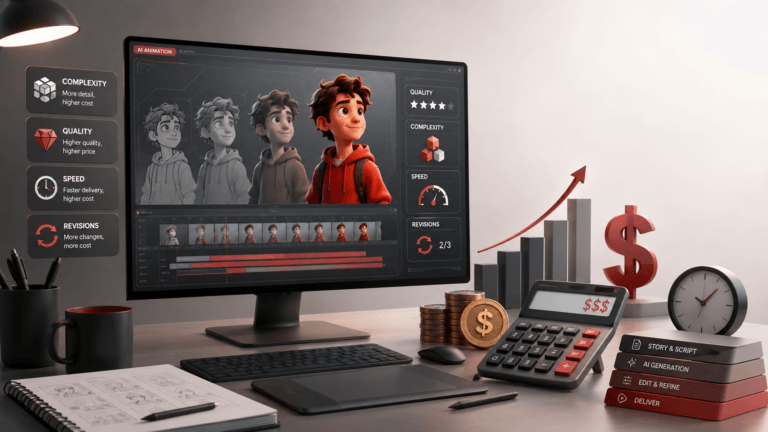
The biggest factors affecting the cost are usually the complexity of the subject, the chosen visual style, the duration, the number of custom assets, the amount of simulation involved, and the number of review and revision rounds.
A project also becomes more involved when the animation needs to represent a product or scientific mechanism with a high degree of accuracy. For this reason, the most useful way to estimate a project is to define the communication goal first. Once the production team understands what needs to be shown and who needs to understand it, it becomes much easier to determine the appropriate level of production.
Scientific Animation vs. Scientific Visualization
The terms “scientific animation” and “scientific visualization” are sometimes used interchangeably, but they can describe slightly different approaches. Scientific visualization generally refers to representing scientific data or complex information visually. This may involve charts, simulations, interactive graphics, 3D models, or data-driven imagery.
Scientific animation focuses more specifically on using movement and sequencing to explain a concept or process. The two often overlap.
For example, a climate visualization might use real datasets to create an animated representation of temperature changes over time. That could reasonably be described as both scientific visualization and scientific animation. The distinction matters less than choosing the right visual method for the information being communicated.
Read More: Advantages of 3D Visualization
Who Uses Scientific Animation?
Scientific animation is used by a wide range of organizations. Universities use it for teaching and research communication. Pharmaceutical and biotechnology companies use it to explain treatments and biological mechanisms. Engineering companies use it to demonstrate complex systems.
Museums and science centers use animation to make difficult concepts accessible to visitors. Media companies and documentary producers use it to visualize subjects that cannot be filmed directly. The common factor is not the industry. It is the need to explain something that is difficult to see or understand through conventional video.
The Future of Scientific Animation
Scientific animation is becoming increasingly sophisticated as animation technology improves. Real-time rendering allows complex scenes to be explored faster. Simulation tools make it possible to visualize increasingly detailed physical systems. Advances in AI can also assist with parts of the creative and production process.
However, better technology does not remove the need for careful scientific communication. The challenge will remain the same: deciding what should be shown, how it should be shown, and how much detail the audience actually needs. As scientific research becomes more complex, the ability to communicate that research clearly may become even more important.
Conclusion
Scientific animation gives us a way to see things that normally cannot be seen. It can take a microscopic biological process and bring it to the screen. It can reveal what happens inside a machine. It can compress decades of environmental change into a few minutes. It can take an abstract scientific idea and turn it into something the audience can actually follow.
The best scientific animation is not simply detailed or visually impressive. It is clear, accurate, purposeful, and built around the way people learn. When research and visual storytelling work together, animation becomes more than an illustration. It becomes a tool for understanding.