
Artificial intelligence is changing how advertising teams develop visual content. Generative AI can help create concepts, explore visual directions, generate assets, produce variations, and accelerate parts of the animation process.
For advertisers, this creates an important opportunity: campaigns that previously required significant time for concept development and production can now be explored much faster.
However, AI animation is not simply a matter of entering a prompt and receiving a finished commercial. Generative tools can produce impressive individual shots, but maintaining character consistency, controlling movement, following a precise storyboard, matching a brand identity, and delivering reliable commercial-quality footage still require creative and technical direction.
This is why the most effective approach to AI animation for advertising is often a combination of generative AI, traditional animation, compositing, editing, and human creative supervision.
In this guide, we explore how AI animation can be used in advertising, where it provides the most value, examples of advertising applications, its limitations, and how brands can build effective AI-assisted campaigns.
What Is AI Animation for Advertising?
AI animation for advertising refers to the use of artificial intelligence tools and workflows to create or assist with animated advertising content.
Depending on the project, AI can be involved in different stages of production. It may help generate initial visual concepts, create environments, animate images, produce character motion, develop visual effects, or generate multiple creative variations.
AI can therefore function as:
- A concept development tool
- A visual production assistant
- An animation tool
- A variation and localization tool
- A source of visual effects
- Part of a larger production pipeline
The important distinction is that AI-generated footage and AI-assisted animation services are not necessarily the same thing. A fully generated video may be created almost entirely by an AI model. An AI-assisted commercial may instead combine generated elements with professionally designed characters, 3D animation, compositing, editing, sound design, and conventional production techniques. For advertising, the second approach can provide considerably more control.
Why Are Brands Using AI Animation?
AI is transforming both animation and advertising. Marketing and advertising often requires a large amount of visual content under tight deadlines. Campaigns may need multiple versions for different platforms, audiences, products, languages, and aspect ratios. AI can reduce the time required to explore and produce some of these assets.
1. Faster Concept Development
Advertising teams can explore visual ideas before committing to a full production. Instead of spending days developing every concept to production quality, AI can help create rough visual directions quickly.
A creative team might test several concepts for the same product:
- A surreal environment
- A cinematic product reveal
- A humorous character scene
- A futuristic visual world
2. More Creative Exploration
Traditional production can make experimentation expensive. If every visual concept requires modelling, texturing, animation, and rendering, teams naturally limit the number of ideas they explore. Generative AI changes that equation. A creative team can test unusual environments, characters, compositions, and visual metaphors before deciding which direction deserves further development.
3. Faster Production of Variations
A single advertising concept may need multiple versions. AI can assist with some of these variations, although important brand elements often still require controlled post-production.
For example, a campaign could require:
- 16:9 video
- 9:16 vertical video
- 1:1 social content
- Different product versions
- Different languages
- Different calls to action
4. Supporting Short-Form Content
Social platforms have created demand for a constant stream of short videos. AI animation can help teams explore additional content around an existing campaign instead of producing every short video entirely from scratch.
This is particularly useful for:
- Social media ads
- Product teasers
- Promotional loops
- Short-form storytelling
- Trend-based content
AI Animation Use Cases in Advertising
1. Product Advertising
AI animation can help turn a product into the center of a visually unusual commercial. Instead of simply showing a product on a studio background, advertisers can place it in an impossible environment. For example, a smartphone could appear in a futuristic city while buildings transform around it. A cosmetic product could travel through a surreal world made from its ingredients. AI can be particularly useful during the concept stage, helping the creative team determine whether the visual idea is worth developing. For the final commercial, the product itself may need to be recreated or composited using controlled assets to preserve accurate branding, proportions, packaging, and typography.
2. Social Media Advertising
Short-form advertising is one of the most practical applications of AI-assisted animation. Brands can develop visually striking 6–15 second concepts for platforms such as Instagram, TikTok, and YouTube Shorts. For example, a product might transform into a character, a package could fall through an impossible environment, or an ordinary scene could suddenly become surreal. The short duration makes these formats particularly suitable for experimentation.
3. Character-Based Advertising
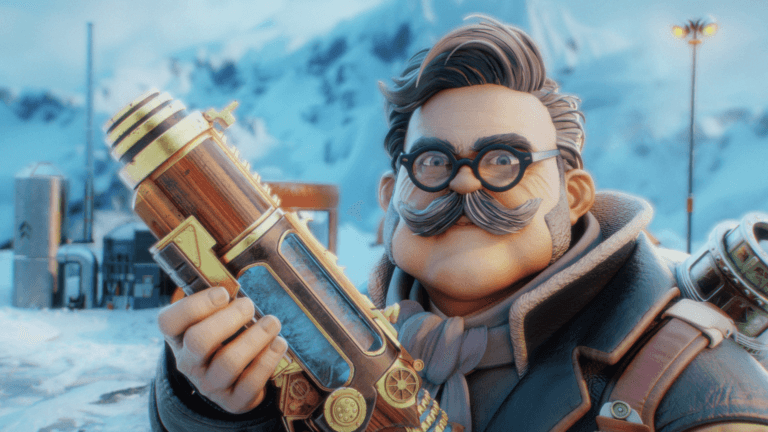
AI in animation can help bring branded characters and mascots into new situations.
A mascot could:
- Enter different environments
- Demonstrate a product
- React to an event
- Perform a short comedy scene
- Appear in multiple campaign variations
However, character consistency remains one of the biggest challenges in generative video.
If the character is an important long-term brand asset, it is often better to establish the character using controlled 2D or 3D production and then use AI selectively for environments, effects, ideation, or supplementary shots.
4. Explainer Advertising
Animated advertising can simplify complicated products and services.
AI can help visualize abstract ideas such as:
- Financial systems
- Software
- Artificial intelligence
- Healthcare technology
- Industrial processes
For example, an advertisement for cloud software could visualize data moving between different systems inside a futuristic environment. AI-generated imagery can provide an initial visual language, while conventional animation and compositing can be used where exact information must be communicated.
5. Cinematic Brand Advertising
Brands sometimes want advertisements that feel closer to film than traditional commercials. AI can help explore cinematic environments, unusual camera concepts, creatures, fantasy worlds, and atmospheric scenes. For example, a sports brand could create a cinematic sequence where an athlete runs through a constantly changing environment representing speed and endurance. The more complex the story becomes, however, the more important production control becomes.
6. Product Visualization
AI can help advertisers imagine products in environments that would be expensive or impossible to build physically.
A product could appear:
- Underwater
- In space
- Inside a miniature world
- In a futuristic city
- Inside a fantasy environment
This is particularly useful for concept development and visually driven campaigns. For highly accurate product advertising, the final product geometry, packaging, logo, and typography should generally be controlled rather than left entirely to generative models.
7. Seasonal Advertising
AI animation can help brands create visually distinctive campaigns around events and holidays.
Examples include:
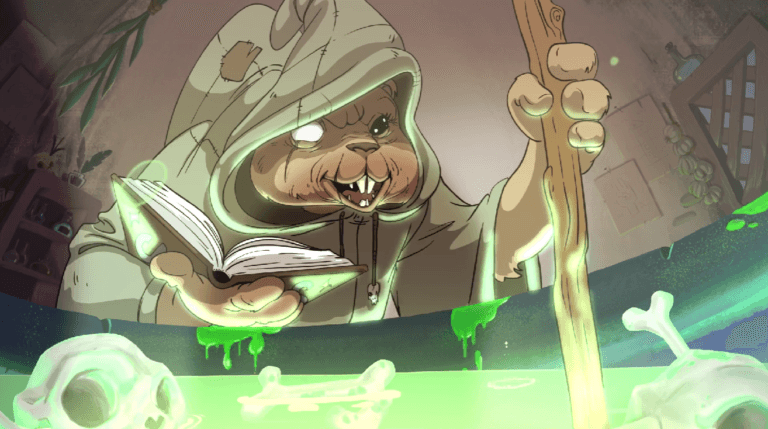
- Halloween
- Christmas
- Valentine’s Day
- New Year
- Sports events
- Product launches
A single brand character could be placed into different seasonal environments, allowing the campaign to evolve throughout the year.
8. Localization and Creative Variations
Advertising campaigns often need different versions for different markets. AI can assist with some visual and production variations, but localization should not simply mean translating text.
Different markets may require changes to:
- Characters
- Environments
- Cultural references
- Voiceover
- Products
- Calls to action
Human review remains important to ensure that the resulting content is culturally appropriate and consistent with the campaign.
Examples of AI Animation Concepts for Advertising
Rather than simply replacing conventional commercials, AI works particularly well when it enables concepts that would otherwise be difficult to produce.
A Product Falls Into an Impossible World
A product falls from a normal environment and passes through several surreal worlds before landing in the final product shot. This format can combine AI-generated environments with controlled product animation and compositing.
A Brand Mascot Enters Different Universes
The same mascot appears in several completely different worlds.
For example:
A mascot begins in a normal office, falls through a portal, enters a fantasy world, then arrives in a futuristic city where the product is revealed. This can create a visually memorable campaign while allowing the brand character to remain the consistent element.
The Product Comes Alive
A normal product suddenly becomes a character. A pair of shoes could start running on its own. A coffee machine could behave like a curious robot. A bottle could react to its environment. This concept works particularly well for short social advertisements.
Reality Starts Transforming
A normal environment gradually changes according to the product’s characteristics. For example, a skincare product could cause a dull environment to transform into a vibrant natural world. The transformation itself becomes the visual metaphor for the product benefit.
What AI Animation Does Well
AI animation is particularly useful when the production needs speed, experimentation, and visual variety.
It can be highly effective for:
1. Visual Ideation
Creative teams can explore dozens of possible directions before selecting one for production.
2. Surreal and Fantasy Visuals
AI is particularly good at generating unusual environments, creatures, and visual combinations that would require significant traditional production work.
3. Previsualization
AI-generated clips can help demonstrate what a potential commercial could look like before investing in full production.
4. Backgrounds and Supporting Shots
AI can provide supplementary environmental footage or visual material that does not require the same level of precision as the hero product or character.
5. Rapid Creative Testing
Multiple concepts can be produced quickly and evaluated before the campaign is fully developed.
Where AI Animation Still Has Limitations
Generative AI has improved rapidly, but it still has important limitations for professional advertising.
1. Character Consistency
A character may change appearance between shots.
Details such as:
- Face
- Clothing
- Proportions
- Hair
- Accessories
can change unexpectedly. This is a serious problem when a recognizable mascot or character needs to appear throughout an advertisement.
2. Precise Art Direction
Advertising often requires exact creative decisions. A director may need a character to look at a specific object, move at a precise moment, or interact with a product in a particular way. Generative models do not always provide the level of deterministic control required for these situations.
3. Product Accuracy
Logos, packaging, typography, interfaces, and product details can be distorted. This is particularly problematic when the product itself is the focus of the advertisement.
4. Complex Motion
AI video models can generate impressive movement, but complicated interactions can still produce artifacts or physically inconsistent motion.
Examples include:
- Hands interacting with objects
- Characters holding products
- Multiple characters touching each other
- Precise choreography
- Complex mechanical movement
5. Continuity
A commercial is not just a collection of attractive shots.
Shots need to connect through:
- Character position
- Lighting
- Environment
- Camera direction
- Motion
- Story
Maintaining this continuity can require substantial human supervision and post-production.
AI Animation vs. Traditional Animation
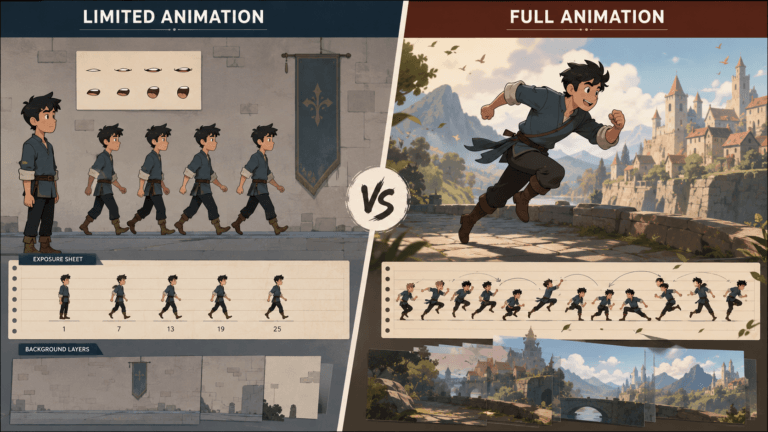
AI and traditional animation services should not necessarily be treated as competing approaches. They solve different problems. Traditional 2D and 3D animation provide greater control over characters, cameras, environments, timing, materials, and repeatability. AI provides speed and exploration. A professional workflow can combine the two. For example, a team could use AI to explore 20 visual concepts, select one, create controlled character and product assets, build key shots using 3D animation, use AI for selected environmental elements, and finish everything through compositing and editing. This hybrid approach can provide both creative speed and production control.
How to Build an AI-Assisted Advertising Workflow
A practical workflow starts with the same fundamentals as any good commercial.
Start With the Creative Idea
AI should not be the starting point simply because it is available.
First define:
- What is the advertisement trying to communicate?
- Who is the audience?
- What is the key message?
- What should viewers remember?
The technology should serve the idea.
Develop the Visual Direction
Create references for:
- Character design
- Environment
- Color
- Lighting
- Camera
- Animation style
AI can be extremely useful during this stage because multiple visual directions can be explored quickly.
Decide Which Elements Need Production Control
Not every part of the advertisement requires the same level of control. This decision is one of the most important parts of an AI-assisted workflow.
- A background may be generated.
- A brand logo should be controlled.
- A crowd may be generated.
- A hero character may need a consistent 3D model.
- A visual effect may be generated.
- A product interaction may need conventional animation.
Generate and Refine
AI-generated material can then be created and evaluated.
Rather than accepting the first result, the production team should refine:
- Composition
- Movement
- Character consistency
- Lighting
- Timing
- Brand integration
Finish Through Post-Production
Generated clips rarely represent the complete final advertisement. Editing, compositing, color correction, visual effects, sound design, typography, and brand assets can turn individual generated shots into a coherent commercial.
How Much Does AI Animation for Advertising Cost?
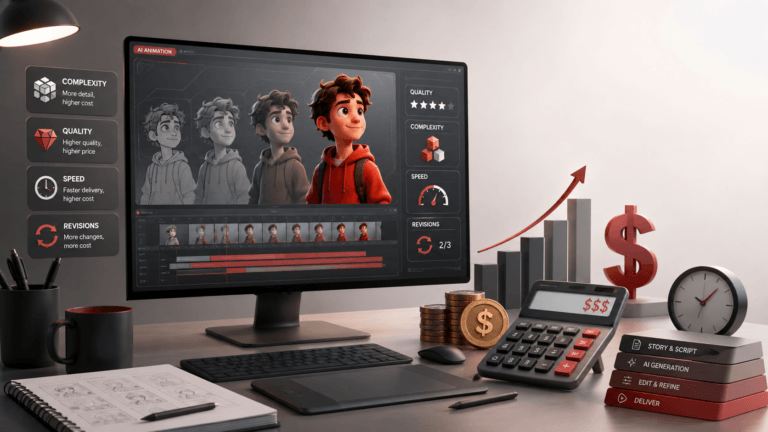
AI can reduce production time for certain parts of an animation project, but the total AI animation cost still depends on the creative scope. A simple short social advertisement may require significantly less production than a full campaign containing multiple characters, environments, product interactions, and deliverables.
Costs can be affected by:
- Number of shots
- Duration
- Character complexity
- Product integration
- 2D or 3D production
- AI generation and iteration
- Compositing
- Visual effects
- Sound design
- Number of campaign variations
The biggest potential advantage of AI animation is therefore not that every AI commercial is automatically inexpensive. Its value comes from allowing teams to explore and produce certain types of content faster.
Should You Use AI or Traditional Animation for Your Advertisement?
The answer depends on what the advertisement needs. AI can be a strong choice when the campaign requires unusual visuals, rapid experimentation, many creative concepts, or short-form content. Traditional animation may be more appropriate when the project requires highly precise character acting, accurate products, complex interactions, repeatable assets, or strict visual consistency. For many professional campaigns, the strongest solution is a combination. AI can handle exploration and selected production tasks while experienced artists and animators maintain creative direction and quality control.
The Future of AI Animation in Advertising
AI is likely to become increasingly integrated into animation production rather than simply replacing existing workflows. As generative models improve, they will provide greater control over characters, camera movement, environments, and continuity. At the same time, professional animation pipelines will continue to provide advantages in areas where precision and repeatability matter. The most valuable skill may therefore not be knowing how to generate a video from a prompt. It will be knowing when AI should be used, when it should not be used, and how to combine it with other production techniques. For advertising agencies and brands, this can lead to faster creative development and more ambitious visual concepts without sacrificing the strategic thinking behind the campaign.
Final Thoughts
AI animation gives advertisers a new way to explore ideas and produce visual content. Its greatest advantage is not simply generating videos faster. It is making previously expensive or difficult visual experimentation more accessible. However, great advertising still begins with a strong concept. The most effective AI animation campaigns combine the speed and flexibility of generative tools with the discipline of professional production. AI can generate possibilities, while experienced artists, animators, directors, and editors turn those possibilities into a coherent piece of advertising. For brands, the opportunity is not to choose between AI and animation. It is to determine where each approach creates the most value and build a production pipeline around that balance.

![1405,02,10 SnpLE[Cover HD] 1](https://pixune.com/wp-content/uploads/2026/08/14050210-SnpLECover-HD-1-768x431.jpg)