
The best VFX companies do far more than create impressive images. They help filmmakers solve production problems, decide what should be captured on set, develop digital assets, manage complex shot pipelines, and deliver consistent results across hundreds or even thousands of shots.
Industrial Light & Magic, Wētā FX, Framestore, and DNEG are regularly associated with major films and television series. However, famous credits alone do not make a visual effects company suitable for every project. A studio built for effects-heavy franchise films may not be the right production partner for a commercial, independent feature, music video, game cinematic, or limited episodic sequence.
Choosing a VFX studio requires a closer look at how the company works. Its artists matter, but so do its supervisors, producers, technical directors, internal tools, review process, available capacity, and ability to respond when a production changes.
The distinction between visual effects, CGI, animation, and post-production can also become unclear during vendor selection. Pixune’s guide to VFX in 3D animation explains how modelling, animation, simulation, lighting, rendering, and compositing contribute to a completed visual effects shot.
This guide examines ten of the most recognised VFX companies in the world, the strengths behind their reputations, and the practical factors clients should consider before hiring one.
Best VFX Companies in the World
The following companies are not arranged as a strict ranking. Each has developed a different combination of creative experience, technical specialisation, production capacity, and filmmaking relationships.
Some are particularly well suited to large feature films. Others have established strong positions in streaming series, advertising, digital characters, simulation, or virtual production.
Company ownership and operating structures can change, so producers should always verify which team, location, and legal entity will complete a new project.
1. Industrial Light & Magic / ILM
Industrial Light & Magic is one of the most influential VFX companies in modern filmmaking. Founded during the production of the original Star Wars, ILM helped develop techniques that shaped practical effects, miniature photography, digital compositing, computer-generated characters, and virtual production.
Its main advantage is not limited to technology. ILM has built a production culture in which technical development responds directly to filmmaking problems.
The company’s approach to visual effects production emphasises solving unfamiliar creative challenges while still considering the client’s schedule and budget. This balance is important. A tool or technique only becomes valuable when it works across a complete production rather than one controlled demonstration.
ILM has contributed to major franchises and effects-heavy films requiring digital creatures, environments, vehicles, destruction, animation, and invisible effects. Its StageCraft system has also made it a leading company in LED-based virtual production.
StageCraft combines real-time environments, tracked cameras, physical sets, and controlled lighting during photography. This can allow filmmakers to view a close representation of the finished environment while shooting rather than waiting until post-production.
ILM is best suited to productions that require extensive infrastructure, early VFX supervision, specialist departments, and large-scale delivery. Smaller projects may not benefit from the cost and organisational structure associated with a company of this size.
2. Wētā FX
Wētā FX is best known for digital creatures, performance-driven characters, large environments, and detailed worldbuilding. Its work on The Lord of the Rings, King Kong, Planet of the Apes, and the Avatar films helped establish its reputation.
What makes Wētā particularly effective is the depth of its approach. A digital creature is not treated as an isolated model. Its anatomy, muscles, skin, hair, facial performance, movement, lighting, and interaction with the environment must work as one system.
The studio’s public VFX research publications cover topics including rendering, simulation, geometry, denoising, distributed computing, and water effects. This research supports artists when existing software cannot deliver the required result efficiently.
Wētā also benefits from long-term collaboration with filmmakers. Complex productions often improve when the studio understands the director’s visual language and can develop assets, tools, and creative methods across several projects.
The company is a strong choice for feature films and premium series involving creatures, facial performance, large digital worlds, motion capture, and simulation.
Its scale and specialist infrastructure make the most sense when the production genuinely requires them. A smaller project that mainly needs compositing or a short CGI sequence may receive more suitable service from a focused studio.
3. Framestore
Framestore works across feature films, episodic production, advertising, immersive media, design, and virtual production. This range gives the company experience with several production models rather than one type of visual effects work.
Feature films may involve long development schedules and highly complex assets. Commercials often require a smaller number of polished shots within a compressed schedule. Episodic work demands consistency across several overlapping delivery dates.
Framestore’s strength lies in combining technical ability with visual storytelling. The company has developed a strong reputation in digital characters, creatures, animation, environments, invisible effects, and the integration of CGI with live-action photography.
Its experience in advertising also makes it relevant to brands that need closely controlled art direction. Commercial work often requires precise product surfaces, colours, camera movement, typography, and visual identity.
Framestore frequently becomes involved before post-production. Early VFX participation allows decisions about set construction, lenses, lighting, camera movement, and actor interaction to be made with the final image in mind.
This can prevent production choices that would otherwise become expensive to correct later.
Framestore is well suited to feature films, premium series, commercials, and immersive projects where design quality and storytelling are as important as technical execution.
4. DNEG
DNEG has built its reputation through large-scale visual effects and animation production. Its work includes feature films, streaming series, environments, creatures, simulations, digital characters, and invisible effects.
The company’s global structure allows different teams to handle separate sequences while working within a shared production system. This can provide access to specialist artists and greater capacity, but it also requires strong coordination.
Assets, colour decisions, review notes, and technical standards must remain consistent between locations. Without a reliable shared pipeline, distributing production can create delays rather than efficiency.
DNEG has invested heavily in production technology, real-time collaboration, review systems, and digital-character tools. Its Ziva technology, for example, supports anatomical simulation for muscles, skin, and tissue in digital creatures.
The company is particularly well suited to projects involving large shot volumes or several technically demanding sequences. Its structure allows separate client-facing teams to work on different production areas without completely isolating them from the wider pipeline.
DNEG also demonstrates why production relationships matter. Major directors often return to studios that understand their working methods and can anticipate the level of detail expected during reviews.
For clients, the relevant question is not simply whether DNEG has completed similar work. They should ask which office, supervisors, and production team will be assigned to their project.
5. Scanline VFX
Scanline VFX became widely recognised for complex simulation, particularly large bodies of water, destruction, fire, and natural phenomena. Its proprietary Flowline technology supported several demanding feature-film effects.
Simulation work is difficult because the result must appear physically convincing while remaining controllable. Directors may need a wave, explosion, or collapsing structure to follow a particular rhythm or reveal an important subject at a precise moment.
Scanline built its reputation by combining technical simulation with this type of artistic control. The company later expanded into creatures, environments, compositing, and large-scale episodic production.
Scanline no longer operates as a separate public-facing brand. Netflix combined Scanline VFX and Eyeline Studios under the Eyeline name in October 2025.
The current Eyeline structure combines Scanline’s visual effects experience with virtual production, volumetric capture, research, and newer production technologies.
For clients, this means Scanline’s historic specialisation remains relevant, but new enquiries should be evaluated through Eyeline’s current services and availability.
Eyeline may be particularly suitable for productions that need traditional visual effects and virtual-production services within one organisation. Producers should still confirm how resources are divided between internal Netflix projects and external client work.
6. Rodeo FX
Rodeo FX has developed a strong reputation in feature films, streaming series, advertising, environments, compositing, and invisible effects.
The company is especially effective at digital environments and cinematic worldbuilding. This work involves much more than placing a background behind photographed actors.
A believable environment must match the original camera, lens, perspective, lighting, atmosphere, movement, and image quality. It may also need to support crowds, vehicles, creatures, destruction, weather, or other digital effects.
Rodeo FX has worked on major feature and episodic productions while maintaining a more focused creative identity than some of the largest global vendors. This can provide a balance between substantial capacity and close creative collaboration.
Its expansion into animation has also widened the type of projects it can support. A studio with both VFX and animation capabilities may be useful when a production includes live-action integration alongside full-CG sequences.
Rodeo FX is particularly relevant for clients requiring environment work, set extensions, photoreal compositing, episodic delivery, or ownership of complete visual effects sequences.
Its structure occupies a useful middle ground. It can manage significant productions without necessarily using the same organisational model as the largest multinational studios.
7. Cinesite
Cinesite works across visual effects, feature animation, and immersive production. It operates through a wider group of studios that share technical resources and production infrastructure.
Its main strategic strength is the use of a connected global pipeline. This allows work to move between locations while maintaining compatible tools, asset structures, review systems, and technical standards.
A distributed model can help a studio increase capacity and access specialist talent. However, the production still needs clear creative ownership.
Clients should understand which location is leading the project, where final reviews take place, and who has authority over creative and technical decisions.
Cinesite is well suited to feature films, animation projects, episodic work, and productions that may benefit from distributed resources. Its experience across animation and VFX is also useful for projects that contain both photoreal and fully animated sequences.
The company demonstrates that size alone does not create scalability. Several offices only function as one production resource when artists and supervisors can exchange assets, shots, and feedback without unnecessary friction.
A client considering Cinesite should ask how the proposed work will be divided and whether it will remain within one studio or move between group locations.
8. Digital Domain
Digital Domain has a long history in feature-film effects, advertising, digital characters, virtual humans, and emerging media.
Its most distinctive specialisation is digital-human production. Creating a believable human face remains one of the most difficult challenges in CGI because viewers notice small errors in eye movement, skin response, expression timing, and facial anatomy.
Digital-human work combines several disciplines, including scanning, motion capture, facial capture, rigging, animation, machine learning, lighting, rendering, and compositing.
Digital Domain has invested in proprietary capture systems and facial technologies designed for both pre-rendered and real-time applications. This makes the company relevant beyond traditional feature films.
Its technology can support digital doubles, live events, interactive characters, games, virtual production, and other projects requiring realistic human performance.
Motion capture is only one part of this process. Captured data must be interpreted and refined by artists. A technically accurate performance can still feel wrong if expression timing, eye focus, or body language does not support the character.
Digital Domain is a strong choice for facial performance, digital doubles, character-led effects, virtual humans, and projects that move between linear and real-time media.
Best VFX Companies by Project Type
No single company is the best choice for every production. A studio that excels in digital creatures may not be the most efficient option for invisible compositing or a short commercial.
The following recommendations reflect the companies’ recognised strengths, but clients should still request relevant examples and confirm which production team would complete the work.
Best for Feature Films
ILM, Wētā FX, Framestore, and DNEG are among the strongest choices for large feature-film productions.
They can provide specialist departments, early VFX supervision, significant rendering capacity, and experience managing complex work over long schedules.
ILM is particularly valuable when a production requires technical development to be closely integrated with filmmaking. Wētā FX is a strong option for digital creatures, performance, simulation, and worldbuilding.
Framestore combines technical depth with character and design experience, while DNEG offers significant capacity through its global production structure.
Large films frequently divide work between several vendors. One studio may create hero creatures, another may handle destruction, and several supporting companies may deliver environments or compositing.
The best vendor strategy may involve assigning each sequence to the company most suited to it rather than placing the entire production with one studio.
Best for Streaming Series
Eyeline, Rodeo FX, DNEG, Framestore, and Cinesite are strong candidates for premium streaming work.
Episodic production requires more than feature-quality images. Teams must maintain consistency while several episodes move through different stages of production at the same time.
Assets may need to be reused across episodes, while lighting, environments, creatures, and effects must remain visually consistent.
Eyeline combines VFX and virtual-production capabilities. Rodeo FX has substantial experience with cinematic episodic work, while DNEG and Cinesite can allocate production across larger studio networks.
The most important questions concern scheduling and continuity. Clients should ask how the company will manage overlapping episodes, late editorial changes, reusable assets, and sequence-level approval.
Best for Commercials
Framestore, Digital Domain, and Rodeo FX have strong commercial experience. However, a boutique or mid-sized VFX studio may often be a better fit for advertising work.
Commercials usually involve fewer shots than feature films, but each shot receives close attention. Product surfaces, colours, reflections, camera movement, typography, and brand identity must be carefully controlled.
The approval process may involve the agency, production company, brand team, director, and legal department. This makes communication and version management particularly important.
A smaller company may offer more direct access to senior artists and faster creative revisions. The choice should depend on the style, schedule, and required level of finish rather than company size.
What Makes a VFX Company One of the Best?
A strong showreel may attract attention, but it does not reveal how reliably a studio can manage an entire production. The finished image is only one part of the result. Clients must also consider how the company plans its work, communicates with the production team, controls revisions, maintains visual consistency, and responds to technical problems.
The best VFX studios combine four broad qualities: relevant production experience, useful technical innovation, recognised creative achievement, and a pipeline that can scale without becoming disorganised.
Film and TV Credits
Film and television credits provide evidence that a company has worked under professional production conditions. They can indicate experience with demanding schedules, strict security requirements, large data volumes, and complex approval structures.
However, credits need context. A single film may involve dozens of visual effects vendors. One studio may design and build the hero creature, while another handles environment extensions, clean-up, digital crowds, or a particular action sequence. Both companies appear in the credits, but their responsibilities may be completely different.
Clients should therefore look beyond the title of the production and ask what the company actually delivered. Relevant questions include:
- Did the studio create the main digital assets?
- Was it responsible for full sequences or isolated shots?
- Did it provide on-set VFX supervision?
- How many shots did its team complete?
- Which departments contributed to the work?
- Did the company develop a new workflow for the production?
- Which studio location completed the work?
A company with experience that closely resembles the proposed project is usually more relevant than one with a more famous but unrelated showreel.
For example, a client commissioning a digital animal should review creature animation, grooming, anatomy, and interaction work. A producer planning invisible effects should look for set extensions, clean-up, crowd work, digital doubles, and photoreal compositing.
Credits are most useful when they demonstrate a repeatable production capability rather than a simple connection to a well-known title.
Technical Innovation
Technical innovation becomes valuable when it solves a production problem. A new tool might allow a studio to create more believable facial animation, simulate a larger body of water, review shots more quickly, or reduce repetitive technical work.
The most important developments are not always visible in the final image. Asset management, rendering optimisation, colour management, automated file validation, and review systems can have a major effect on production speed and reliability.
Open-source development also plays an important role in the industry. The Academy Software Foundation supports software projects and shared standards used across animation and visual effects production. These initiatives make it easier for studios to exchange data, maintain colour consistency, review shots, and build compatible production pipelines.
Large studios also develop proprietary tools around their specialist needs. A company known for digital humans may invest in facial capture, skin deformation, eye rendering, and performance transfer. A studio with a strong FX department may develop systems for water, smoke, fire, destruction, crowds, or natural phenomena.
Technology does not replace artistic judgement. A physically accurate simulation may still be wrong for the story. The timing, shape, scale, and visual emphasis must remain controllable by artists and supervisors.
The strongest VFX companies turn research into tools that can survive real production conditions. Those tools must remain useful when plates are imperfect, shots change, delivery dates move, or directors request a different creative direction.
Awards and Industry Recognition
Awards can provide evidence of sustained technical or artistic achievement. The Academy Award for Best Visual Effects recognises completed work in a film, while the Visual Effects Society Awards include more specialised categories for creatures, environments, simulation, compositing, and supporting effects.
Scientific and technical recognition is equally important because it reveals the systems behind the images. The Academy’s Scientific and Technical Awards have recognised developments in rendering, simulation, camera technology, animation, and digital production.
These awards can show that a company has contributed something valuable to the wider filmmaking process rather than producing one successful shot.
However, industry recognition should not become the only selection criterion. An award-winning studio may still be unsuitable for a client’s budget, schedule, working style, or project scale. Awards often recognise exceptional technical challenges, while many productions need reliable execution of less visible work.
A client should ask what was recognised and whether that capability is relevant to the current brief. An award for creature technology has limited value to a project that mainly requires product visualisation or clean-up compositing.

Pipeline Quality and Scalability
A VFX pipeline connects the creative and technical stages of production. It controls how footage, assets, versions, feedback, renders, and final files move between departments.
A typical VFX production pipeline may include plate preparation, matchmove, rotoscoping, modelling, texturing, rigging, animation, FX simulation, lighting, rendering, and compositing. Larger projects may also require previs, postvis, grooming, crowd work, virtual production, on-set data collection, and deep compositing.
A reliable pipeline should provide:
- Clear shot and asset ownership
- Consistent naming conventions
- Controlled file versions
- Automated technical checks
- Reliable colour management
- Secure file exchange
- Render monitoring
- Accurate review notes
- Defined approval stages
- Final delivery checks
Scalability means more than hiring additional artists. A studio must also increase its production management, supervision, storage, rendering, review capacity, and quality-control resources.
Adding artists to a poorly organised pipeline can make delivery slower. Files become difficult to track, outdated assets enter shots, feedback is applied to the wrong version, and supervisors spend more time resolving technical confusion.
Compositing is often where problems from earlier stages become visible. A compositor may need to combine live-action footage, CGI, atmospheric elements, matte paintings, grain, depth of field, lens distortion, and colour adjustments into a single image. Pixune’s guide to the role of a VFX compositor explains why digital compositing is both a creative discipline and a final technical checkpoint.
A good pipeline is rarely noticed by the client. Work arrives when expected, feedback is attached to the correct shot, and technical issues are resolved before delivery. That apparent simplicity usually reflects careful production design.
How to Choose the Right VFX Company
Selecting a VFX company is a production decision, not a popularity contest. Clients should compare the studio’s relevant experience, proposed team, pipeline, communication process, current capacity, and understanding of the brief.
The bidding stage often reveals how the company will behave during production. A reliable studio asks detailed questions, identifies missing information, and explains the assumptions behind its price.
Budget and Scope
The first step is to define what the studio is being asked to deliver.
A useful VFX brief should include:
- Approximate shot count
- Shot lengths
- Required techniques
- Delivery resolution
- Frame rate
- Production schedule
- Reference material
- Available plates and assets
- Editorial status
- Required source files
- Expected review stages
Shot count is not enough to estimate a project. Ten complex creature shots may require more work than one hundred clean-up shots.
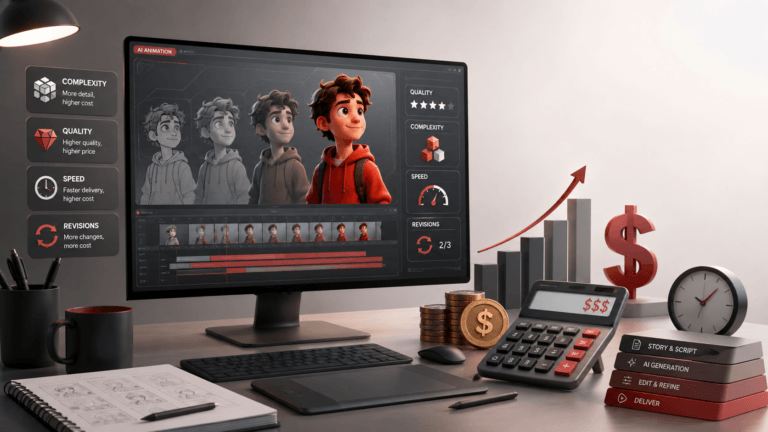
Pixune’s guide to VFX costs and pricing explains how asset creation, shot complexity, simulation, resolution, schedule, and revisions affect the budget.
Clients should also compare what each quotation includes. One studio may include matchmove, rotoscoping, rendering, and two review rounds, while another excludes them.
A lower bid may become more expensive if it is based on incomplete assumptions. Production risk should therefore be considered alongside the initial price.
Style and Technical Requirements
A studio’s previous work should match the project’s actual style and technical needs.
Photoreal compositing, stylised CGI, product rendering, creature animation, simulation, beauty work, and motion design require different teams and workflows.
Broad terms such as “cinematic” or “realistic” are not detailed enough. Clients should provide references that demonstrate the intended lighting, colour, texture, camera movement, atmosphere, and level of detail.
Understanding the different roles of VFX artists can help clients assess the proposed team.
A creature project may require modellers, texture artists, riggers, groom artists, animators, FX artists, lighters, and compositors. An invisible-effects project will need a different balance of skills.
Technical compatibility should also be discussed before work begins. The studio may need to follow a specific colour pipeline, use existing assets, exchange USD or Alembic files, deliver layered EXRs, or return editable source files.
These requirements can affect the schedule, software, staffing, and final cost.
Location and Tax Incentives
Location can affect tax eligibility, labour costs, time-zone overlap, legal agreements, access to talent, and the availability of on-set supervision.
Several major VFX centres developed around experienced crews, technical education, infrastructure, and public production incentives.
Tax incentives can reduce eligible spending, but they should not be treated as proof of quality. A lower-cost location may create additional management problems if the production lacks experienced supervisors or sufficient communication overlap.
Incentive programmes also change. Clients should verify rates, eligible costs, minimum spending, application procedures, and cultural requirements through official government or film-commission sources.
Time-zone differences can support continuous production, but they can also delay approvals. When the client and studio have little working-hour overlap, a simple question may hold up a shot for an entire day.
The company should explain how reviews, urgent decisions, and on-set support will be handled across locations.
Communication and Production Pipeline
Communication is part of production quality. Unclear feedback, missing files, delayed approvals, and undefined responsibilities directly affect the final result.
Clients should know who will manage the project. The VFX producer usually controls schedule, resources, and communication, while the VFX supervisor oversees creative and technical quality.
Smaller productions may combine some responsibilities, but ownership must remain clear.
The review process should establish:
- How often work will be presented
- Which stages require approval
- Where feedback will be recorded
- Who has final approval authority
- How additional revisions affect cost and schedule
Reviews should focus on the most important decisions first. Animation, camera movement, asset design, and simulation direction should normally be approved before expensive final rendering begins.
The studio should also explain dependencies. Late plates, editorial changes, missing camera data, and delayed feedback may affect delivery.
A reliable company identifies these risks before production rather than introducing them as excuses near the deadline.
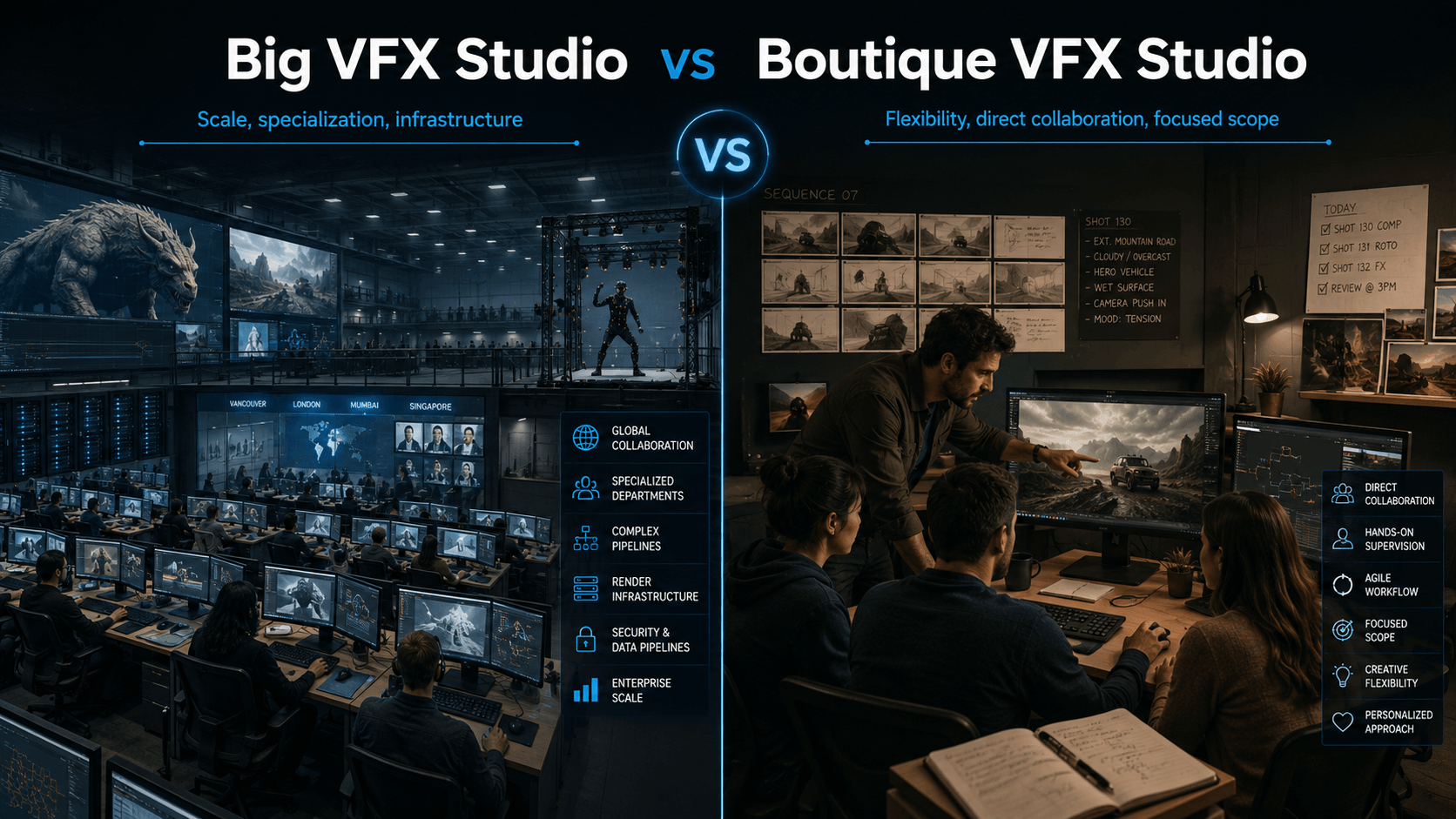
Big VFX Studio vs Boutique VFX Studio
A global VFX company and a boutique studio solve different production problems. Neither model is automatically better.
Large companies offer capacity, specialist departments, infrastructure, and experience with highly complex productions. Smaller studios often provide closer communication, flexible staffing, and a production structure better suited to limited scopes.
The right choice depends on the type of work and the amount of organisational support required.
When to Hire a Global VFX Company
A global company is often the stronger choice when the production requires:
- Hundreds or thousands of shots
- Several specialist departments
- Complex hero creatures
- Large simulations
- Extensive digital environments
- Motion or performance capture
- Significant rendering capacity
- Multi-location delivery
- On-set and virtual-production support
- Strict security infrastructure
Large studios can divide sequences between teams and assign specialists to narrow production areas. They may also have proprietary tools developed through years of similar work.
The trade-off is greater organisational complexity. Communication may pass through several layers, and smaller projects may receive limited access to senior supervisors.
Clients should ask which office will perform the work, whether assets will move between locations, and who will remain responsible for the final result.
When a Smaller VFX Studio Is Better
A boutique or mid-sized studio may be more suitable when the project requires close collaboration, direct supervision, or a team that can adapt quickly.
This model can be effective for:
- Commercials
- Independent films
- Music videos
- Game cinematics
- Selected feature sequences
- Episodic support
- Overflow production
- Clearly defined shot packages
Smaller studios may provide shorter approval chains, direct access to senior artists, more attention per shot, and lower organisational overhead.
They can also integrate more easily with a client’s existing production team when the scope is clearly divided.
Pixune’s 3D animation and CGI production services are structured for clients seeking flexible outsourced support without the full production overhead of a major global facility.
A smaller company still needs a reliable pipeline, realistic capacity planning, data security, and quality control. Boutique should not mean informal or unstructured.
The decision should ultimately be based on fit. A global studio may be appropriate for a large effects-heavy feature, while a smaller team may deliver a commercial or individual sequence more efficiently.
Final Thoughts on Choosing the Best VFX Company
The best VFX companies are not defined by famous credits alone. Their real value comes from the systems behind the work: experienced supervision, specialist artists, technical research, reliable pipelines, clear communication, and disciplined production management.
A studio should be evaluated according to the project it is being hired to complete. Relevant experience matters more than general prestige. Current capacity matters more than historic company size. A clear production plan matters more than an impressive but unrelated showreel.
Clients should examine what the company actually delivered on previous projects, who will supervise the new work, how feedback will be managed, and whether the proposed pipeline matches their technical requirements.
The best VFX company is not necessarily the largest or most awarded. It is the company that understands the creative brief, identifies production risks early, assembles the right team, and delivers consistent work within the project’s real schedule and budget.



![1405,02,10 SnpLE[Cover HD] 1](https://pixune.com/wp-content/uploads/2026/08/14050210-SnpLECover-HD-1-768x431.jpg)