
Video game graphics have changed dramatically since the earliest computer games. What began with simple lines, blocks, and limited colors has evolved into detailed 3D environments, realistic digital characters, physically based materials, dynamic lighting, and real-time ray tracing.
The evolution of video game graphics has never been only about making games look more realistic. Every generation of hardware and software has introduced new ways for developers and artists to represent characters, environments, lighting, movement, and entire worlds.
Early developers had to work within extremely limited memory and processing power. Modern developers can build enormous environments with millions of polygons, complex materials, advanced physics, and sophisticated lighting systems.
Understanding this evolution also means understanding how game art itself has changed, from pixel art and sprites to 3D modelling, physically based rendering, procedural generation, and increasingly sophisticated real-time graphics.
Let’s look at the major stages that shaped the way video games look today.
Evolution of Game Graphics
The evolution of game graphics can be understood as a progression from simple 2D representations to increasingly detailed and interactive 3D worlds. Each generation introduced new hardware capabilities, rendering techniques, and artistic possibilities that changed how developers created characters, environments, lighting, and visual effects.
From the limited pixels of early arcade games to today’s photorealistic environments and real-time ray tracing, game graphics have evolved through several major stages:
- Early 2D Graphics: Simple lines, shapes, and limited-color visuals defined the earliest games.
- Pixel Art and Sprites: Improved hardware allowed more detailed characters, environments, and animations.
- 16-Bit Graphics: More colors, larger sprites, and techniques such as parallax scrolling created richer 2D worlds.
- Early 3D Graphics: Polygon-based characters and environments introduced fully navigable three-dimensional spaces.
- Advanced 3D Graphics: Better hardware enabled higher polygon counts, detailed textures, improved lighting, and more complex animations.
- HD and Realistic Graphics: High-definition displays, sophisticated materials, and advanced character rendering pushed games toward greater realism.
- Physically Based Rendering: PBR created more consistent and realistic representations of materials such as metal, glass, fabric, and skin.
- Real-Time Ray Tracing: Ray-traced lighting improved reflections, shadows, and global illumination in supported games.
- Modern Game Graphics: Current engines combine advanced lighting, high-detail assets, visual effects, procedural techniques, and AI-assisted technologies.
1. The Early Days of Video Game Graphics
The earliest video games were extremely limited by the hardware available at the time. Early arcade and computer games often represented objects using simple lines, geometric shapes, or small collections of pixels. There was little room for detailed textures, complex characters, or realistic lighting.
The visual limitations were not necessarily a weakness. Developers learned to communicate information using extremely simple graphics. A few pixels could represent a character. A collection of rectangles could represent a building. A small number of colors could establish an entire environment.
This period established an important principle that continues to influence game art today: good game graphics are not necessarily about visual complexity; they are about communicating effectively within the limitations of the medium.
2. The Rise of Pixel Art
As home consoles became more capable, developers gained access to more colors, larger sprites, scrolling environments, and more sophisticated visual effects. The Nintendo Entertainment System, released in North America in 1985, became an important part of the recovery of the U.S. console market and helped establish characters such as Mario as enduring video game icons.
During this period, pixel art design services became one of the defining visual languages of video games. Pixel artists created characters and environments pixel by pixel, carefully deciding where every color should appear.
Because memory was limited, artists had to make efficient use of every available pixel. Characters were often recognizable through exaggerated silhouettes, strong color contrasts, and distinctive poses rather than detailed anatomy. Pixel art also established visual conventions that would later become an artistic style in its own right.
Why Pixel Art Worked?
Pixel art was not simply a consequence of weak hardware. It developed into a deliberate visual language. Limited resolution encouraged artists to simplify shapes and exaggerate important details. Animation also had to communicate movement with relatively few frames. These constraints encouraged a highly recognizable visual style that continues to influence modern indie games.

3. The 16-Bit Era and More Detailed 2D Graphics
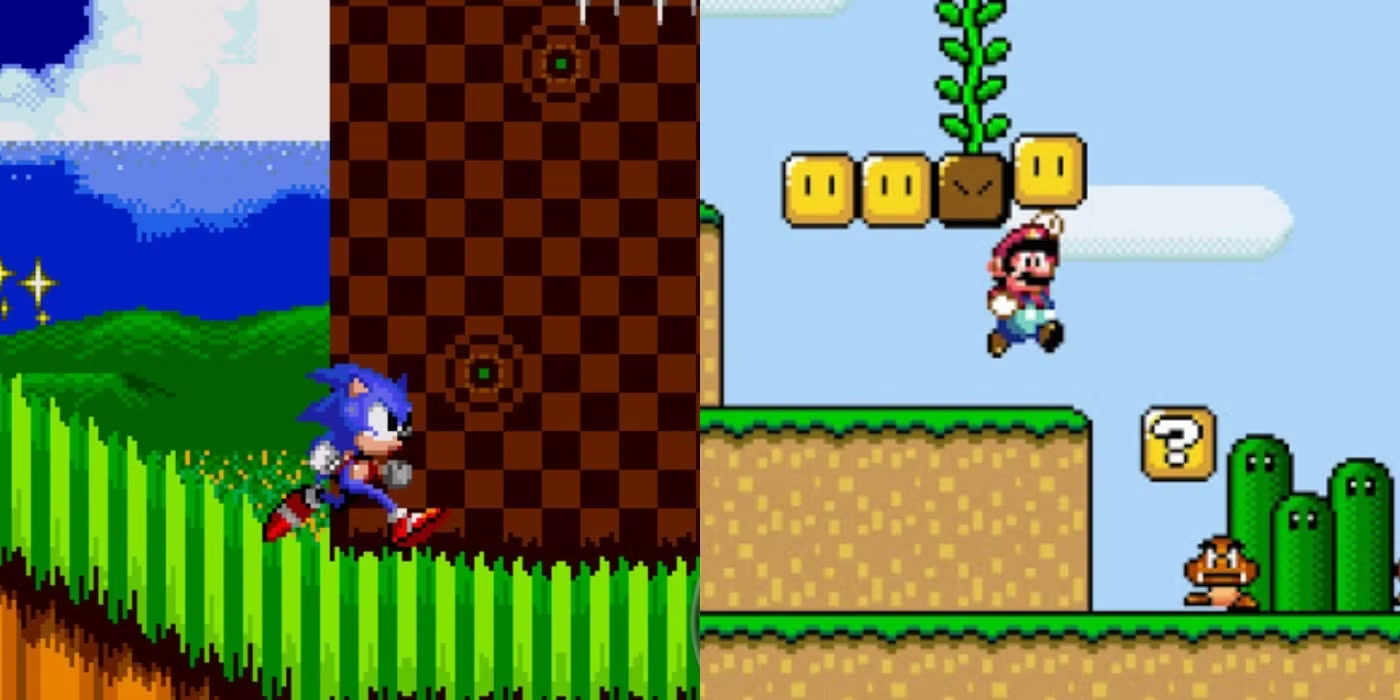
The transition to 16-bit consoles brought another major improvement. Systems such as the Super Nintendo Entertainment System and Sega Genesis could display more colors and more detailed sprites than earlier consoles.
Developers could create richer environments, more expressive characters, smoother animations, and more sophisticated visual effects. Games increasingly used techniques such as parallax scrolling to create the illusion of depth.
Instead of having every part of a scene move at the same speed, background layers could move more slowly than foreground elements. This created a greater sense of three-dimensional space while the game was still fundamentally built from 2D artwork. Game artists also gained more freedom to create detailed character designs, environmental artwork, and cinematic sequences.
The Transition From 2D to 3D
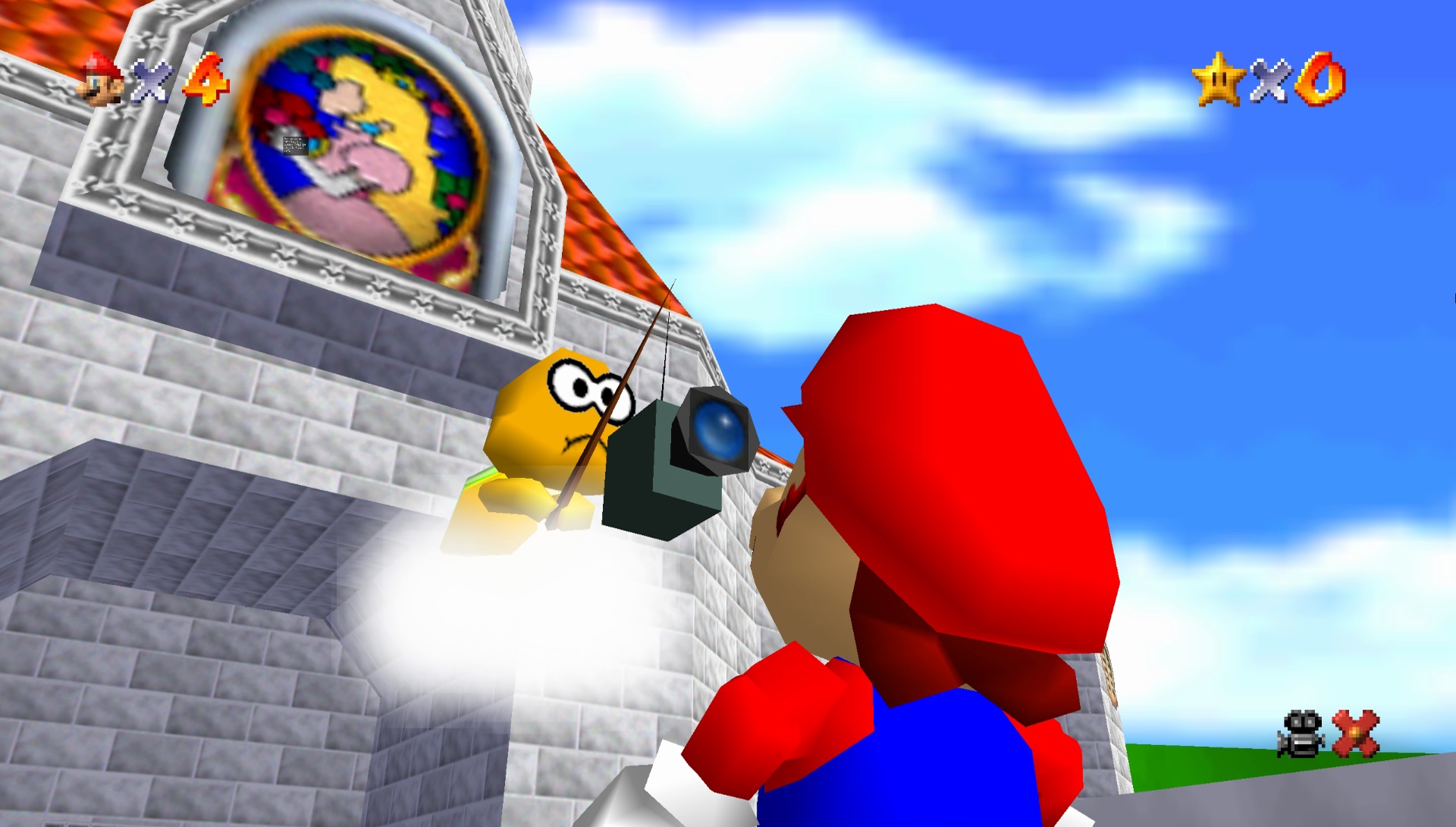
One of the biggest changes in video game graphics came when developers began moving from primarily 2D art styles to real-time 3D environments. Instead of representing a character as a flat sprite, developers could construct characters from polygons and move a camera through a three-dimensional world. This fundamentally changed game design.
Players could now explore spaces from different perspectives rather than viewing a fixed 2D scene. The PlayStation, launched in 1994, was designed with the ability to render multiple 3D computer-generated characters in real time, representing a major shift toward 3D console graphics. Games from this era often look primitive compared with modern titles, but they introduced video game ideas that became fundamental to modern game development.
4. Early 3D Game Graphics
Early 3D games had obvious limitations. Characters were often made from relatively small numbers of polygons. Textures were low resolution, lighting was simple, and environments were constructed from relatively basic geometric forms. Characters could have sharp or unnatural shapes because developers had to carefully manage polygon counts.
Yet these limitations also produced a distinctive visual style. The transition was important because developers were no longer simply drawing images. They were constructing interactive 3D spaces. That required new disciplines, including:
- 3D modelling
- UV mapping
- Texture creation
- Rigging
- 3D animation
- Lighting
- Camera systems
5. More Detailed 3D Worlds
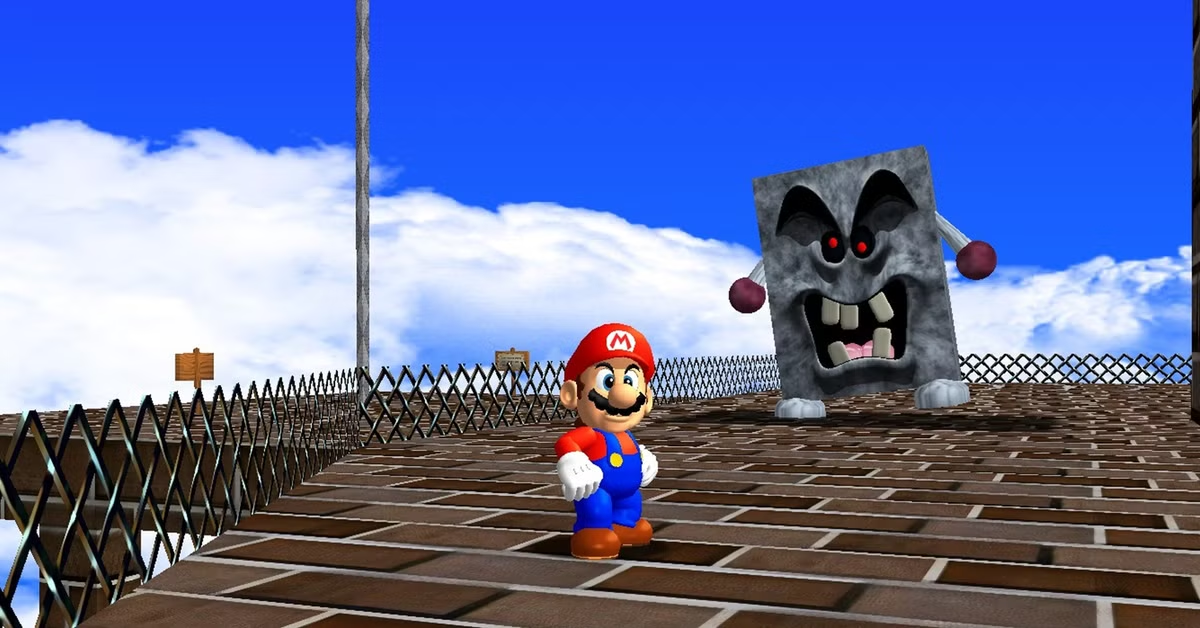
As hardware became more powerful, consoles such as the PlayStation 2, Xbox, and Nintendo GameCube allowed developers to dramatically increase the complexity of their environments and characters.
- Polygon counts increased.
- Textures became more detailed.
- Lighting became more sophisticated.
Developers could create larger environments and more convincing characters while maintaining real-time performance. The increase in processing power also allowed games to include more sophisticated physics, particle effects, facial animation, and environmental details. This was the period when 3D art styles became the dominant visual language for many major game genres.
6. The Rise of Realistic Game Graphics
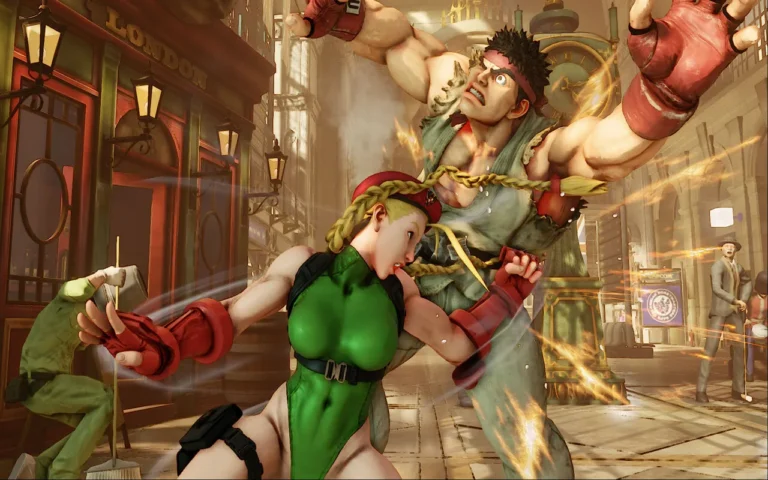
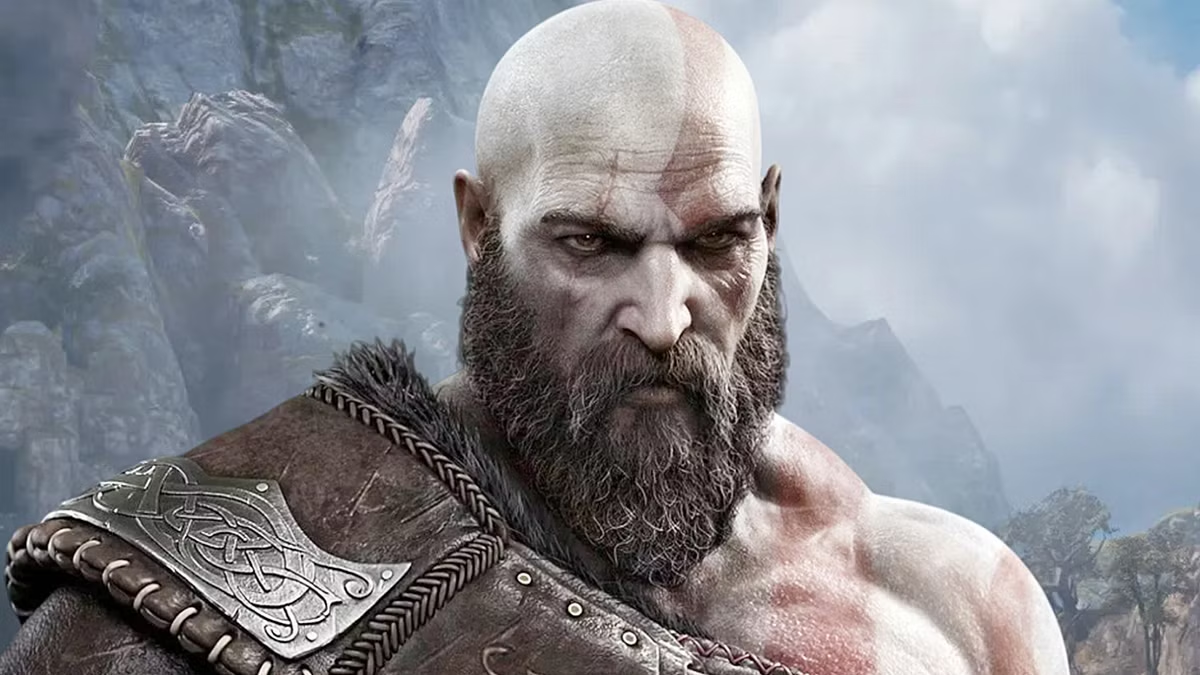
As hardware continued to improve, developers began pursuing increasingly realistic visuals. Textures became more detailed. Character models became more anatomically accurate. Materials began responding more convincingly to light. Water could look wet. Metal could reflect its environment. Skin could have subtle variations in color and roughness.
The goal was no longer simply to create recognizable objects. It was to reproduce the way real-world materials and environments behave. This led to major developments in rendering technology.
7. Physically Based Rendering
Physically based rendering, commonly known as PBR, changed the way many modern game assets are created. Instead of treating a texture simply as an image that determines an object’s color, PBR workflows describe material properties such as:
- Base color
- Roughness
- Metallic response
- Normal information
This allows materials to react to lighting in a more consistent and physically plausible way. PBR became particularly important as game engines developed more advanced lighting and rendering systems. The result was a significant improvement in the consistency and realism of game environments.

8. Real-Time Lighting Becomes More Advanced
Lighting technique has always been one of the most important elements of game graphics. Early games often relied on simple lighting models and baked effects.
Modern engines can simulate much more complex lighting conditions, including dynamic shadows, reflections, ambient lighting, and indirect illumination. This has allowed game designers to use lighting not only to make environments look realistic but also to establish mood and direct the player’s attention.

The HD Era
The arrival of high-definition displays and more powerful consoles pushed game graphics another step forward. Characters could contain significantly more detail, environments could be larger, and textures could be displayed at higher resolutions. Games increasingly began to resemble interactive experiences.
Facial animation also improved considerably. Characters could communicate emotion through more detailed facial rigs and animations rather than relying primarily on dialogue and simple body movement. This increased the importance of character artists, technical artists, animators, facial riggers, lighting artists, and other specialized roles.
9. Modern Game Engines
Game engines became increasingly important in the evolution of graphics. Engines such as Unreal Engine and Unity provide developers with sophisticated systems for rendering, lighting, materials, animation, physics, and visual effects.
Instead of building every rendering technology from scratch, developers can use 3D game engines as the foundation for their projects. Modern engines also make it possible to create real-time visuals that can approach cinematic quality. Unreal Engine, for example, provides physically based rasterized and ray-traced rendering, dynamic shadows, reflections, and advanced material tools for real-time content.
The Arrival of Real-Time Ray Tracing
One of the most significant recent developments in game graphics is real-time ray tracing. Traditional rasterization is extremely efficient and has powered real-time game graphics for decades. Ray tracing takes a different approach by tracing the paths of light to calculate how it interacts with objects.
This can produce more accurate reflections, shadows, ambient occlusion, refractions, and other lighting effects. Real-time ray tracing had traditionally been too computationally expensive for interactive applications.
That began changing significantly in 2018 with technologies including Microsoft’s DXR framework and NVIDIA’s RTX platform. Epic Games demonstrated real-time ray tracing in Unreal Engine through its Reflections demo at GDC 2018. The technology has since become increasingly accessible and is now supported across modern game engines and hardware.
Why Ray Tracing Matters for Game Art
Ray tracing is not simply about making games “more realistic.” It changes how artists approach lighting. Reflections can respond naturally to objects outside the camera’s immediate view. Shadows can react more naturally to light sources, and materials such as glass and polished metal can behave more convincingly.
For artists, this can reduce the need to manually fake certain lighting effects. At the same time, real-time ray tracing can be computationally expensive, so modern rendering pipelines often combine ray tracing with traditional rasterization and other techniques. This hybrid approach provides a balance between image quality and performance.
Current-Generation Game Graphics
Modern games combine many technologies rather than relying on one single breakthrough. A contemporary game may use:
- High-resolution 3D assets
- Physically based materials
- Real-time global illumination
- Ray-traced reflections
- Advanced particle systems
- Dynamic weather
- Detailed facial animation
- Procedural environments
- High-quality shadows
- Temporal reconstruction and upscaling
The result can be remarkably close to pre-rendered cinematic imagery while remaining interactive. Modern engines also support increasingly complex physics and visual effects. Unreal Engine’s current technology stack, for example, includes systems for destruction, cloth, hair, vehicles, rigid-body animation, and large-scale particle effects.
Photorealism Is Not the Only Direction
The evolution of video game graphics is sometimes described as a continuous journey toward photorealism. That is only part of the story.
Many successful high graphics games deliberately use stylized graphics rather than trying to reproduce reality. Cel-shaded characters, hand-painted environments, low-poly models, pixel art, comic-book aesthetics, and highly exaggerated designs can all create distinctive visual identities.
A game’s art style should support its gameplay, world, characters, and audience. In some cases, a stylized visual approach can remain more recognizable and memorable than photorealism.
The Return of Stylized and Retro Graphics
Interestingly, advances in technology have also encouraged renewed interest in older visual styles. Modern developers can intentionally recreate the limitations of earlier hardware through:
- Pixel art
- Low-resolution textures
- Low-poly modelling
- Limited color palettes
- Dithering
- Retro lighting
The difference is that modern developers are choosing these limitations rather than being forced to work within them. This has created a broad spectrum of game art styles, from highly realistic AAA graphics to intentionally retro indie games.
The Role of AI in Game Graphics
Artificial intelligence is beginning to influence game graphics as well. AI can assist with areas such as:
- Asset generation
- Texture creation
- Character development
- Animation
- Upscaling
- Image reconstruction
- Procedural content
- Voice and facial animation
The role of AI is likely to expand as game development tools become more integrated with generative and machine-learning technologies. However, AI does not eliminate the need for game artists. Someone still needs to establish the visual direction, evaluate assets, maintain consistency, and ensure that the artwork supports the game’s design.
From Graphics to Visual Experiences
The biggest change in game graphics is not simply that games look better. Games have become increasingly capable of creating interactive visual experiences. In an animated film, the production team controls the camera and every frame. In a game, the player can determine where to look, where to move, and what to interact with. This makes real-time graphics fundamentally different from traditional pre-rendered animation. Developers have to create systems capable of responding to unpredictable player behavior while maintaining visual quality and performance.
How Game Graphics May Evolve Next
The next stage of game graphics will likely involve improvements across several areas rather than one single technological breakthrough.
Real-time ray tracing and global illumination will continue to develop. AI-assisted asset creation tools and animation may become more integrated into production. Procedural techniques can help developers create increasingly detailed worlds, while advances in hardware will allow more complex scenes to run interactively.
Virtual and augmented reality may also influence graphics by requiring higher levels of visual fidelity and extremely responsive rendering. At the same time, stylized art will continue to evolve alongside realistic rendering.
The future of game graphics is therefore unlikely to have one universal visual style. Instead, developers will have access to a broader range of tools and techniques for creating the exact visual experience their game requires.
The Evolution of Game Art Production
The evolution of graphics has also transformed the people and game art pipeline behind games. Early games could sometimes be created by very small teams because the visual assets were relatively simple. Modern games can require a game art studio with a large team of specialized artists, including:
- Concept artists
- Character artists
- Environment artists
- 3D modellers
- Texture artists
- Technical artists
- Animators
- VFX artists
- Lighting artists
- UI artists
As graphics become more complex, collaboration between these disciplines becomes increasingly important. A realistic character, for example, is not the result of modelling alone. It may require concept design, sculpting, retopology, texturing, rigging, animation, hair, materials, lighting, and technical optimization.
Why the Evolution of Video Game Graphics Matters?
Better graphics have changed what developers can communicate visually.
A simple sprite can communicate the identity of a character. A detailed 3D model can communicate age, clothing, personality, and physical characteristics. Advanced lighting can establish mood. Realistic environments can make fictional worlds feel believable.
But technological advancement does not automatically produce better games. Some of the most influential games in history were created with extremely limited graphics. What matters is how effectively the visual style supports the game’s experience. Graphics are a tool for communication, immersion, visual storytelling, and gameplay, not an end in themselves.
Final Thoughts
The evolution of video game graphics is a story of increasing capability, but it is also a story of artistic adaptation.
Developers moved from pixels and simple sprites to detailed 3D worlds. Artists moved from manually constructing tiny images to building complex digital characters, environments, materials, and visual effects. Rendering evolved from simple real-time techniques to physically based workflows and increasingly sophisticated ray-traced lighting.
Yet the fundamental purpose of game art has remained the same: to create a world that players can understand, explore, and remember. The future will likely combine greater technical realism with more diverse artistic styles. AI, real-time rendering, advanced hardware, and increasingly capable game engines will give artists more tools, but the creative decisions behind those tools will continue to determine what makes a game’s visual identity successful.