
For decades, filmmakers have had to make important creative decisions before they could properly see the world they were creating.
An actor might perform against a green screen while imagining a landscape that would not exist until months later. A cinematographer could frame a shot knowing that half of the image still had to be built in post-production. Directors often relied on storyboards, previs, concept art, and experience to judge whether all those separate pieces would eventually work together.
Virtual production is changing that relationship. Digital environments, virtual cameras, real-time rendering, motion capture, and in-camera VFX can now enter the filmmaking process much earlier. Instead of waiting until post-production to see how a digital world interacts with a performance or camera, filmmakers can increasingly explore that world while they are still designing or shooting the scene.
That does not make traditional filmmaking or VFX obsolete. It changes when certain decisions can happen.
For storytelling, that distinction matters. A director who can walk through a virtual location before shooting can discover a better angle. A cinematographer who sees the environment while framing an actor can respond to its lighting and scale. A production designer can examine whether a digital set works from more than one carefully chosen concept-art view.
Virtual production brings more of the final image into the creative conversation while there is still time to change it.
Virtual production stage combining a physical film set with an LED virtual environment
What Is Virtual Production?
Virtual production is a broad approach to filmmaking that allows physical production and digital production to interact more directly.
It may involve previsualization, virtual scouting, real-time 3D environments, game engines, performance capture, camera tracking, virtual cameras, augmented-reality tools, or in-camera visual effects. An LED volume is one part of virtual production, but the two terms are not interchangeable.
Netflix describes virtual production as an umbrella for techniques including visualization, virtual cameras, performance capture, simulcam, world capture, and ICVFX. This broader definition is useful because many productions use virtual production without ever photographing actors in front of an LED wall.
The common thread is interaction. Digital elements that once lived mainly downstream in post-production become available earlier to the people making creative decisions.
This also explains why virtual production should be viewed as part of the wider VFX pipeline, rather than as a replacement for it.
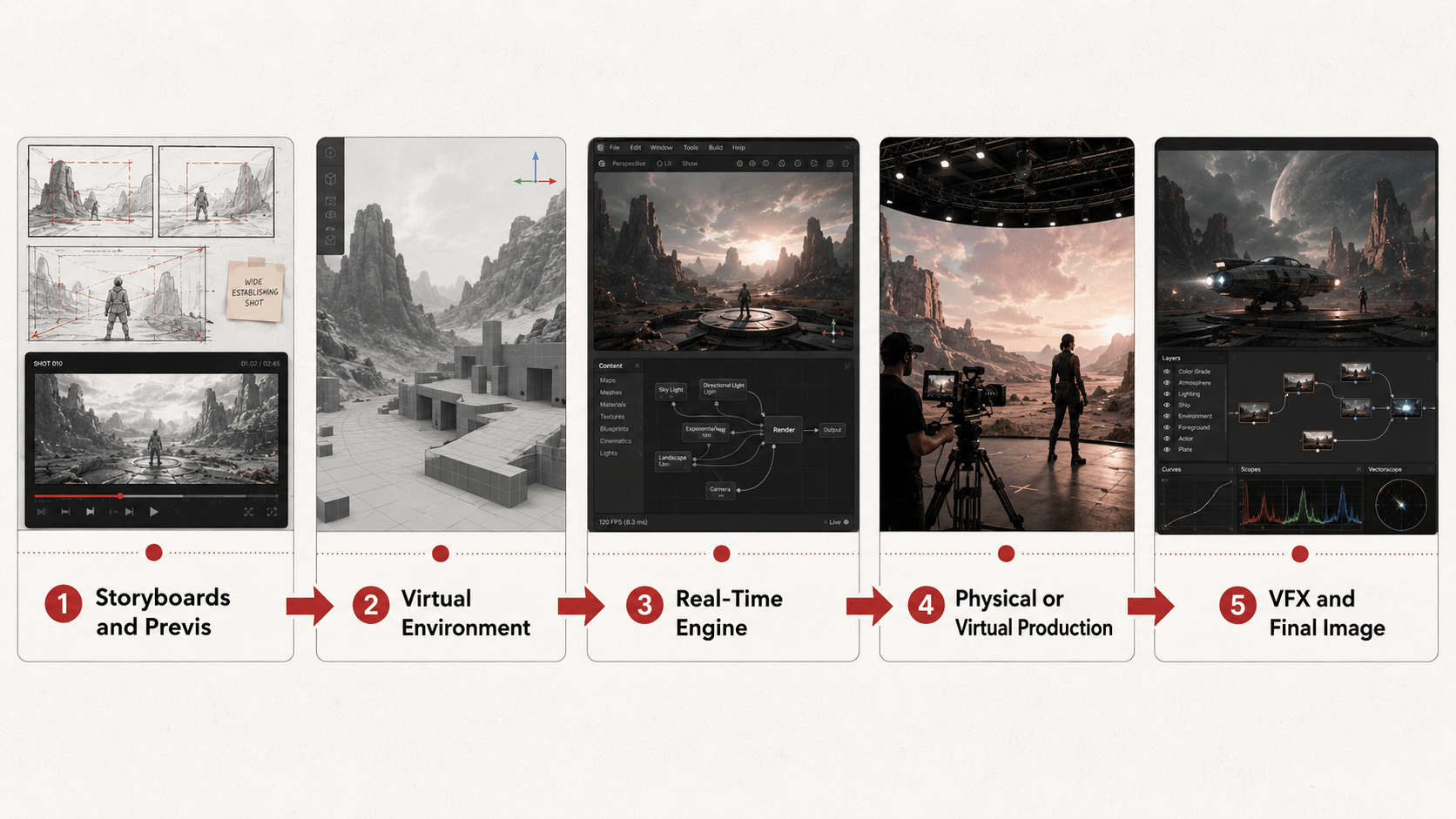
The easiest way to understand virtual production is to look at when the digital world becomes available to the crew.
Imagine a scene in which an actor is standing on another planet.
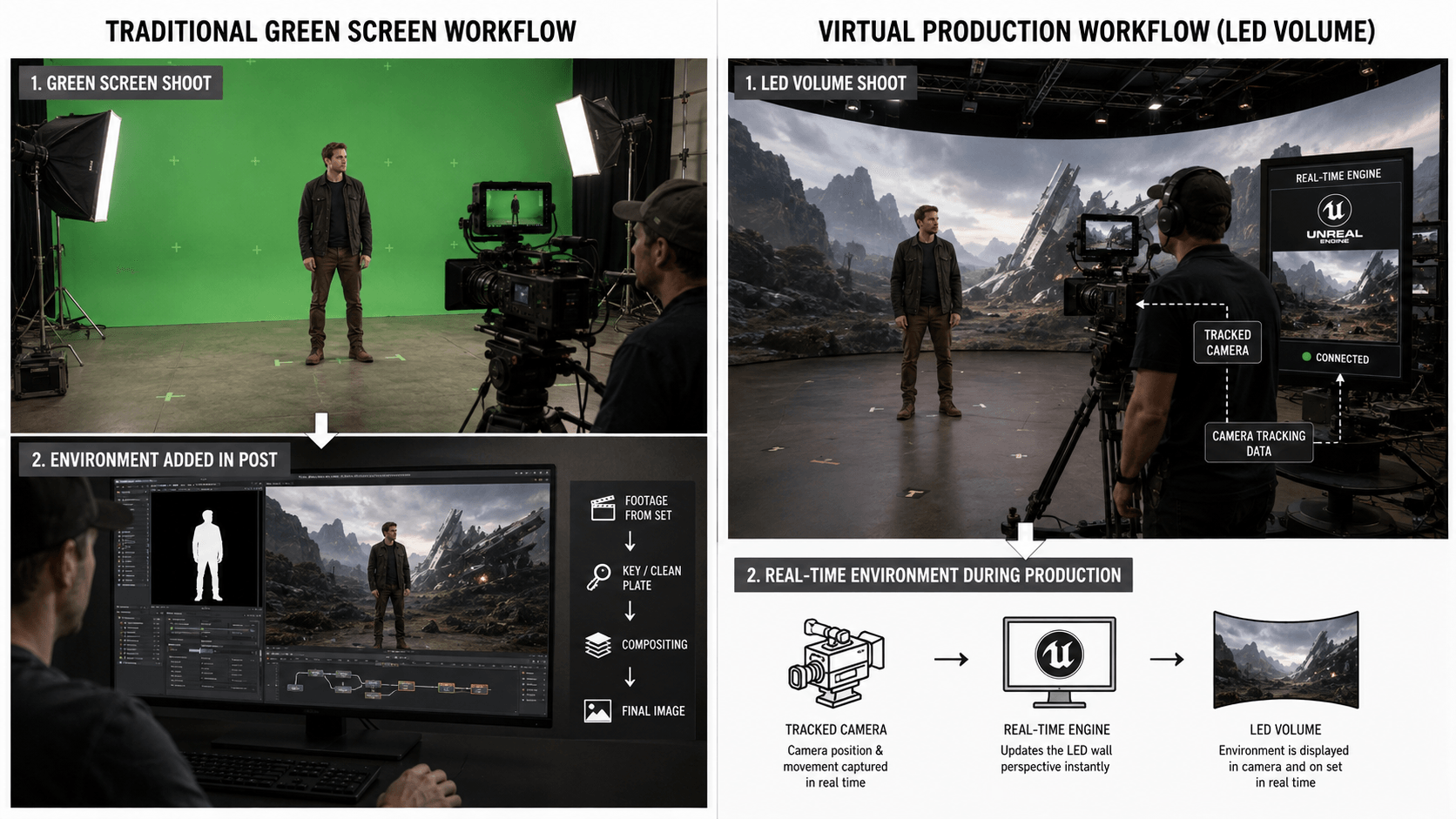
In a conventional VFX-heavy workflow, the production might construct a small foreground set and surround the actor with green screen. The camera records the performance, and a digital environment is later created, rendered, tracked, and composited into the shot.
There is nothing inherently wrong with that workflow. It has produced exceptional films for decades.
Virtual production offers another possibility.
The environment can be built earlier and used during previs. The director can explore it through a virtual camera. The cinematographer can test lenses and camera positions. If the production uses an LED volume, a real-time version of that environment can even appear behind the actor while the scene is being photographed.
The digital world is no longer something the crew only has to imagine.
This earlier visibility is one of the most important changes virtual production brings to storytelling. Questions about composition, scale, movement, and environment can be answered when the scene is still flexible instead of being postponed until post-production.
Virtual Production vs Traditional Production
Virtual production and traditional production should not be treated as competing systems where one has to replace the other.
Most ambitious productions are hybrids.
A physical set might be extended digitally. A performer might be photographed in front of an LED wall while a CG creature is added later. Another shot from the same sequence could be filmed on location and completed through conventional compositing.
The major difference lies in where certain decisions happen.
With traditional green-screen production, a large part of the final visual context is created after photography. With virtual production, some of that context can be visible before or during the shoot.
This can affect the actor as well as the camera crew. Looking toward a visible horizon or doorway is different from being told where one will eventually appear. Cinematographers can judge reflections and background composition while working. Directors can see whether blocking that looked good on paper still works inside the final environment.
However, virtual production shifts pressure toward pre-production. If an environment must appear on an LED wall during photography, it cannot remain an unfinished idea until post.
Assets need to reach production quality sooner.
Virtual Production Tools and Technologies
Virtual production does not rely on one piece of equipment or one software package.
It works when multiple systems exchange information quickly enough to create a useful production environment. A game engine may render the digital world. A tracking system reports where the physical camera is located. Motion-capture equipment can transfer an actor’s movement to a digital character. LED processors display imagery around a physical set.
When these systems are connected properly, filmmakers can interact with CG imagery more like they interact with physical production.
The technology is complex, but its purpose is practical. It is meant to reduce the distance between making a creative decision and seeing the result.
An LED volume is a stage built from large LED panels that display a digital environment around the performers and physical set.
What makes this different from putting an image on a giant screen is camera tracking.
In an in-camera VFX setup, the system knows where the physical camera is located. The real-time engine adjusts the perspective of the virtual environment according to that position, allowing the section of the LED wall visible through the camera to behave more like a window into a three-dimensional world.
Epic Games describes in-camera VFX as a combination of LED lighting, live camera tracking, real-time rendering, and off-axis projection.
The LED panels can also contribute light to the photographed scene.
If the virtual environment contains a large orange sunset, that colour can fall onto an actor’s skin or costume. A virtual neon sign may appear as a reflection on a practical vehicle. This can make certain surfaces much easier to integrate than shooting them against a uniformly green background.
The system still depends heavily on real-time rendering.
Unlike offline film rendering, where a computer can spend substantial time calculating each frame, an LED environment needs to respond quickly enough for camera movement and on-set adjustments. That creates a constant balance between image quality and performance.
The choice of rendering techniques also affects what can reasonably be displayed in real time. A scene designed for a slow offline render may require considerable optimization before it can maintain the performance expected on a virtual production stage.
Unreal Engine and Unity in Virtual Production
Game engines became useful to filmmakers for the same reason they transformed games. They can render interactive three-dimensional worlds continuously.
In a traditional CG workflow, moving a light or camera might lead to another render. In a real-time engine, the result can often be judged immediately.
That changes the rhythm of visual development.
A director can ask what happens if the camera moves behind a building. The environment artist can reposition elements. Lighting can be changed while the crew evaluates the shot. Different times of day can be tested without rebuilding the world.
Unreal Engine has become especially associated with LED virtual production and ICVFX, while Unity has also been used for product visualization services, virtual cinematography, interactive animated content, and production tools.
The choice between Unity and Unreal Engine still depends on the project, team, existing assets, technical requirements, and intended output.
For storytelling, the important change is not which logo appears when the software launches.
It is that a digital environment can behave like an explorable space rather than a fixed image waiting to be rendered.
Motion Capture and Virtual Cameras
Virtual production is not limited to environments.
Motion capture allows human movement to drive a digital character, sometimes while the performance is still happening. Depending on the setup, body movement, facial performance, or other data can be captured and transferred into the digital scene for animated storytelling.
Virtual cameras solve a different problem.
Filmmakers are trained to think through cameras and lenses. They understand how a wider lens changes spatial relationships, how animation camera height affects a character, and how physical movement changes the emotional quality of a shot.
Navigating a digital environment with a mouse does not feel the same.
A virtual camera can give filmmakers a physical device that controls a digital camera inside the scene. Instead of entering coordinates, the operator can move, pan, tilt, and search for compositions more intuitively.
This matters because good cinematography rarely comes from knowing exactly where the camera should be before looking through it.
Sometimes the shot is discovered by moving around.
[IMAGE 6 — MOTION CAPTURE AND VIRTUAL CAMERA]
Create one coherent behind-the-scenes scene. On the physical side, show a performer in a motion-capture suit and a filmmaker operating a handheld virtual-camera rig. On screens or within the digital side of the composition, show the corresponding CG character and the camera view inside a virtual environment.
Suggested alt text
Motion capture performer and virtual camera controlling a digital production scene
Benefits of Virtual Production for Storytelling
The most interesting benefits of virtual production are not purely technical, like the advantages of 3D visualization.
A faster render is useful. Avoiding a difficult location shoot can be valuable. Reducing certain post-production problems may save time and money. But none of these automatically produces a better scene.
The real potential of virtual production storytelling comes from allowing filmmakers to see more of the scene while their decisions can still influence it.
Art directors, cinematographers, production designers, VFX supervisors, and artists can work around a more complete version of the same visual problem.
That can lead to better decisions earlier.
Real-Time Visualization for Directors
Film production becomes expensive quickly once a large crew, cast, equipment, and location are involved.
Discovering during photography that a major camera angle does not work is inconvenient. Discovering it weeks later when the environment reaches post-production can be worse.
Visualization reduces some of that uncertainty.
Traditional storyboarding remains one of the most efficient ways to test composition, staging, and continuity before production. Previs extends those ideas into movement and time. Virtual production can push the process further by allowing filmmakers to explore the actual three-dimensional environment.
A director can move the camera before deciding whether a physical wall needs to be constructed. A wide shot can reveal which parts of the digital set need additional detail. Character blocking can be reconsidered when the size of the final environment becomes clear.
The value is not that every decision becomes perfect.
It is that more mistakes can happen while mistakes are still relatively cheap.
Physical locations impose conditions on the story.
The sun moves. Weather changes. Access may be restricted. Shooting permits end. Travelling between locations consumes time. A place that looks perfect from one direction may become unusable when the camera turns around.
A virtual environment is not free from limitations, but many of those limitations are different.
The sunset can remain for another take. A mountain can move if it destroys the composition. A building can be removed. A street can become longer. An environment that does not exist anywhere in the real world can still be explored spatially by the filmmaking team.
That changes the role of environment design.
A production-ready virtual environment cannot only look attractive from one hero angle. It may need to survive camera movement, different lenses, changing lighting, foreground interaction, reflections, and multiple shot sizes.
An environment artist working for virtual production therefore has to think partly like a filmmaker.
What is behind the camera?
What happens if the director suddenly wants a wider lens?
How close can the camera move to that building before its texture or geometry stops holding up?
These questions turn environment creation into part of shot design rather than a separate background task.
Faster Iteration and On-Set Collaboration
Real-time tools can also change the conversation between departments.
Imagine that the director wants the horizon lower in the frame.
That sounds simple, but in a conventional pipeline the request could involve several steps before everyone sees the result. In a prepared real-time environment, an artist may be able to adjust the scene while the cinematographer evaluates the new composition.
Lighting, environment, camera, and performance become more closely connected.
This is particularly useful when a problem crosses departmental boundaries. A background may be visually strong but create the wrong reflection on a costume. A camera move may work dramatically but reveal unfinished areas of an environment. A lighting choice may improve the actor while weakening the illusion on the LED wall.
Seeing these interactions earlier allows teams to solve them together.
There is a catch.
Real-time iteration should not become an excuse for weak preparation.
Making endless changes while an entire crew waits on set is still expensive. Virtual production works best when pre-production has already narrowed the possibilities and real-time tools are used to refine decisions rather than invent the whole scene from scratch.
Virtual Production Examples in Film and Games
Virtual production becomes easier to understand when different projects are compared.
There is no single virtual production workflow used across every film or game. Some productions rely heavily on LED volumes. Others use virtual cameras without shooting any final pixels from an LED wall. Games use many of the same real-time technologies for a completely different final experience.
The Mandalorian and The Lion King are useful examples precisely because their workflows were not the same.
The Mandalorian and LED Virtual Production
The first season of The Mandalorian became one of the defining examples of modern LED virtual production.
Industrial Light & Magic worked with collaborators including Epic Games to develop the StageCraft workflow used on the production. Instead of surrounding performers entirely with green screen, large LED panels could display real-time environments around practical scenery.
According to Industrial Light & Magic, Unreal Engine was used for more than 60 photoreal virtual environments during the first season.
What is equally revealing is what happened afterwards.
The same season still contained more than 4,000 traditional VFX shots completed in post-production.
That is a useful correction to one of the most common assumptions about virtual production.
Capturing more imagery in camera does not mean every VFX department disappears. CG characters, simulations, cleanup, extensions, compositing, animation, and other tasks can still be necessary depending on the shot. Pixune’s breakdown of VFX in 3D animation shows how many different disciplines may contribute to the final image even when a substantial part of the scene already exists in CG.
Virtual production changes the balance between those stages.
It does not remove them.
The 2019 production of The Lion King demonstrates another side of virtual production.
The film is computer-generated, yet the filmmakers deliberately brought techniques from physical cinematography into the digital world.
Cinematographer Caleb Deschanel and the production team could work with virtual cameras, virtual lenses, lighting, and camera movement rather than designing every shot through a conventional animation interface.
The American Society of Cinematographers documented how the production used traditional filmmaking ideas inside virtual space, with the virtual world processed through a custom system employing Unity.
This reveals something important about modern storytelling.
Computer graphics technically allow a camera to do almost anything.
It can accelerate instantly, move through solid objects, float without support, or use perspectives that no physical lens could reproduce.
But unlimited movement does not automatically produce meaningful cinematography.
Physical filmmaking developed a visual language partly because cameras have weight, lenses behave in particular ways, and operators move through real space. Bringing some of those familiar constraints into a digital world gives cinematographers a foundation from which they can make intentional choices.
Virtual production can use technology to make digital filmmaking feel more physical rather than less.
Virtual Production in Games and Interactive Storytelling
Games approached real-time storytelling from the opposite direction.
Game engines were already capable of rendering environments and characters for an interactive game art. The challenge was learning how to use those worlds cinematically.
Today, the same environment used for gameplay can also become a space for trailers, cutscenes, and narrative sequences.
Digital characters can perform inside it. Cameras can be animated or operated. Lighting can change specifically for a cinematic moment. Motion-capture data can feed performances into characters while game directors review the results in context.
This creates opportunities for more continuity between gameplay and visual storytelling.
Pixune’s game cinematic and trailer production already sits at this intersection. A cinematic may need to respect the visual identity of the game while using game camera setup, pacing, animation, and staging associated with filmmaking.
The more real-time and linear pipelines overlap, the less useful it becomes to think of games and film production as completely separate disciplines.
Virtual Production Challenges and Costs
Virtual production solves some filmmaking problems by introducing different ones.
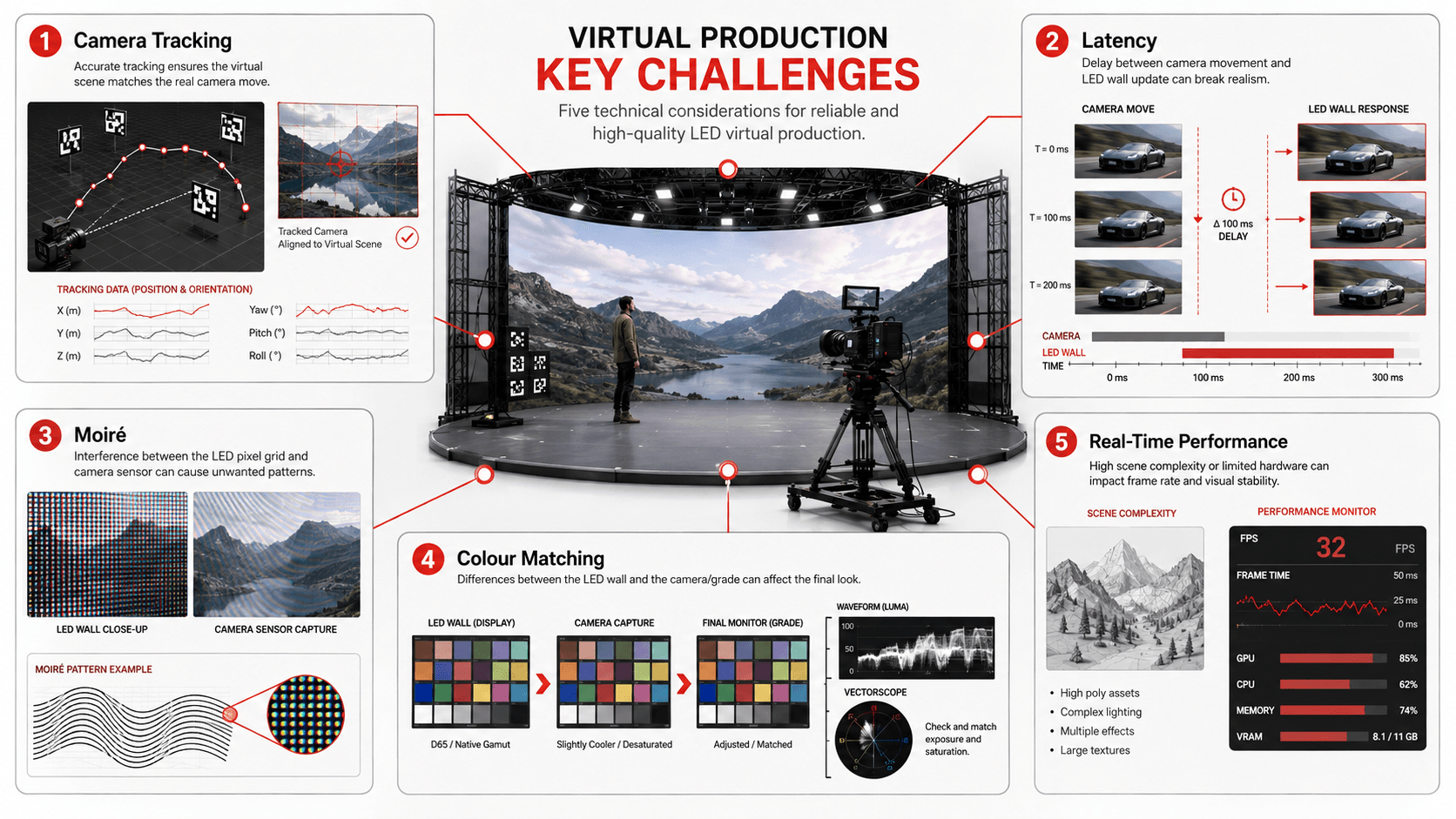
A difficult location may become unnecessary, but a complex real-time environment must now be built and tested. Green spill may disappear, but LED colour, moiré, tracking, synchronization, and screen performance become concerns. Some post-production work may decrease while more effort moves into pre-production.
This is why virtual production should not automatically be treated as a cheaper or easier way to make a film.
Its value depends on the shots being produced.
Technical Complexity and Production Costs
A professional LED virtual production stage brings together several systems that all need to perform reliably at the same time.
Depending on the setup, this can include LED panels, processors, tracking hardware, calibrated cameras and lenses, synchronization, render machines, networking, real-time software, physical lighting, colour management, and specialist operators.
A failure in one area can affect the photographed result.
Tracking errors can break perspective. Excessive latency may make the background lag behind camera movement. LED pixel structure can produce moiré under some camera conditions. An environment that is too heavy for the available hardware may struggle to maintain the required frame rate.
The cost argument deserves the same nuance.
Virtual production can potentially reduce travel, physical set construction, location restrictions, or certain post-production requirements. At the same time, a large LED stage, skilled crew, high-quality digital assets, and substantial technical preparation are not inexpensive.
The right comparison is therefore shot-specific.
The same principle applies when calculating VFX costs. A five-second cleanup shot and a five-second photoreal destruction shot have the same duration but completely different production requirements.
Virtual production should be budgeted around what it actually solves.
Virtual production also asks different departments to understand one another earlier.
A cinematographer does not need to become an Unreal Engine artist. An environment artist does not need to become a director of photography.
They do, however, need a shared language.
Environment artists should understand how camera distance and lenses affect asset requirements. Camera teams need to know enough about tracking and LED limitations to recognize when the technology is affecting the image. Production designers have to consider how physical foregrounds connect to virtual architecture.
VFX supervision also becomes valuable earlier.
A decision that would once have been solved in post may now determine how a scene is photographed. Waiting until the shoot is complete to involve the people responsible for digital integration can defeat some of the purpose of using virtual production in the first place.
The most effective teams are not simply collections of technical specialists.
They understand how one department’s decision changes another department’s work.
Integrating Virtual Production with the VFX Pipeline
Virtual production makes pipeline planning more important, not less.
Consider a virtual environment.
It might begin as concept art, become a rough previs environment, move into real-time production, appear on an LED stage, and later return to an offline renderer for final VFX work.
That environment has effectively travelled through several departments and several technical contexts.
Scale, cameras, materials, versions, naming, colour, geometry, and asset approval need to remain consistent enough for each stage to inherit useful work from the previous one.
A structured 3D animation pipeline helps prevent teams from rebuilding the same asset every time its purpose changes.
This is one of the less glamorous parts of virtual production, but it can determine whether the technology actually saves time.
A spectacular LED stage cannot fix a fragmented asset pipeline.
The Future of Virtual Production and Storytelling
The future of virtual production is unlikely to be a world where every film is shot inside an LED volume.
A more realistic direction is continued convergence.
Animation, VFX, live-action production, VR game development, and real-time rendering are increasingly sharing tools and assets. A virtual environment can exist during previs, photography, post-production, and interactive development. Camera language developed for physical production can operate inside entirely digital worlds.
That makes the boundary between production and post-production less rigid.
For storytellers, this means, in transmedia storytelling, the medium can be chosen around the scene rather than around one fixed pipeline.
Hybrid Filmmaking with Live Action and Virtual Environments
Hybrid production is already one of the most practical uses of virtual production.
A scene may combine a practical floor and props with an LED background. Another part of the environment may be extended in post. A CG character could be inserted later. Atmospheric FX might be simulated after photography.
The final image does not care which department created each pixel.
What matters is whether they work together.
This makes experience with environmental storytelling, CGI, animation, lighting, and VFX increasingly useful across production boundaries. Pixune’s 3D animation services cover many of the digital disciplines involved in building and finishing this kind of imagery, even when the wider production also includes physical filmmaking.
A virtual production workflow should therefore start by asking which elements benefit from real-time interaction and which are better left to conventional production or post.
Not every problem needs an LED wall.
Virtual Production for Games and Interactive Media
Real-time production also makes digital assets less tied to one final format.
A character built for a cinematic may later appear in interactive content. A virtual location can support a game trailer, a cinematic sequence, marketing imagery, or other real-time experiences if the assets are created with those uses in mind.
This does not mean every film asset can simply be dropped into a game.
Real-time assets have performance requirements. Offline assets may contain geometry, textures, simulations, or shading that would be impractical in an interactive environment. Reuse still requires technical planning.
But the opportunity is significant.
Production teams can increasingly think about digital assets as part of a broader content ecosystem instead of material that disappears after one final render.
That is particularly relevant for studios working across animation services, games, trailers, branded content, and other formats where the same visual world may need to support several outputs.
Making Virtual Production More Accessible
Much of the public conversation around virtual production focuses on enormous LED stages.
That can make the technology seem inaccessible to smaller productions.
But an LED wall is not required to benefit from every virtual production technique.
Independent filmmakers can use real-time previs. Directors can scout digital environments through VR. Virtual cameras can be used without photographing a final background from an LED screen. Game engines can help teams test camera movement, layout, lighting, and blocking before committing to expensive production.
These applications can be valuable even when the final scene is shot traditionally.
The real democratization of virtual production is therefore not that everyone can suddenly reproduce a major Hollywood volume.
It is that more filmmakers can interact with sophisticated digital environments earlier in their process.
High-quality imagery still requires skilled artists. Realistic environments still take time. Good cinematography still depends on judgment. Technology lowers some barriers, but it does not remove the craft behind the result.
Virtual Production Changes When Creative Decisions Happen
The most important thing virtual production changes may not be what appears on screen.
It changes when filmmakers can see it.
A director can explore a location before it exists physically. A cinematographer can frame shots inside a digital environment. An actor may perform with more visual context. Environment artists can see how their work behaves through the actual camera. VFX teams can influence production decisions before those decisions become locked into photographed footage.
That makes virtual production less about replacing green screens and more about connecting departments that once worked further apart.
It also explains why the technology works best when it serves a clear creative purpose.
Real-time rendering cannot decide whether a shot carries the right emotion. A virtual camera cannot decide where the audience should look. An LED wall can create a convincing horizon, but it cannot tell a director whether the horizon belongs in the composition.
Those decisions still belong to filmmakers and artists.
Virtual production simply gives them more information while they are making them.
For a production team, the useful question is therefore not whether virtual production is the newest or most advanced option.
The question is whether seeing and interacting with the digital side of the project earlier will make the story easier to design, shoot, or finish.
When the answer is yes, virtual production can turn digital filmmaking from something that happens after the camera stops into something that participates in the creative process from the beginning.
If your production involves virtual environments, CGI, animation, game cinematics, or VFX-heavy sequences, Pixune can help develop the digital assets and visual work that support the production pipeline. From environment design and 3D production to animation and VFX, the right preparation can determine how effectively those assets move from early visualization to the final image.
Talk to the Pixune team about your project’s visual requirements, production scope, and the digital assets needed before the pipeline is locked.
Conclusion
Virtual production is changing storytelling because it brings digital creation closer to the moment creative decisions are made.
Directors can explore environments earlier, cinematographers can frame shots inside digital worlds, and VFX teams can contribute before production choices become difficult to change. Tools such as LED volumes, real-time rendering, motion capture, and virtual cameras are valuable because they make those interactions possible, not because they replace traditional filmmaking.
The most effective productions will continue to combine physical sets, location work, CGI, animation, and post-production VFX according to what each scene actually needs. Virtual production simply gives filmmakers more options for connecting those elements.
For studios and production teams, that makes preparation especially important. Environments, assets, previs, camera planning, and VFX decisions increasingly need to work as parts of one connected pipeline rather than separate stages.
As these workflows become more accessible, virtual production will likely become less noticeable as a separate filmmaking technique and more familiar as another part of modern production. The technology will continue to change, but the goal remains the same: giving filmmakers better tools to turn an idea into a convincing final image.