
Limited animation is one of those animation terms that people often recognize without fully understanding. Many viewers have seen it in television cartoons, anime, motion comics, explainer videos, and digital shorts, but they may not know why it looks the way it does or why studios continue to use it.
At its core, limited animation is an approach that reduces the number of unique drawings and movements needed to create an animated scene. That does not automatically make it bad, lazy, or outdated. In fact, limited animation has been one of the most practical and influential techniques in animation history because it helped studios produce work faster, more affordably, and at scale.
To understand limited animation properly, it helps to look at both its technical side and its creative side. It is not simply “cheap animation.” It is a production strategy built around choosing where motion matters most and simplifying what can remain still, repeated, or implied.
What Is Limited Animation?
Limited animation is a cartoon style and production method in which only selected parts of a scene are animated, while other parts remain static or are reused. Instead of redrawing every element of a shot frame by frame, animators focus their effort on the most important movement.
That selective use of motion is what makes limited animation “limited.” The limitation usually refers to the number of drawings, the amount of movement, or the number of elements changing on screen at one time.
Definition and History
In practical terms, limited animation uses fewer unique drawings than full animation. Rather than animating every detail in every frame, the production may hold on a pose, reuse a walk cycle, move only a character’s mouth while the body stays still, or pan a camera across a static illustration.
This approach became especially important when animation moved into television. Studios could not always afford the time and labor required for highly fluid theatrical animation, so they looked for more efficient production methods. In the United States, studios such as UPA and later Hanna-Barbera became closely associated with this shift, helping define the visual language of TV animation. The Library of Congress overview of Hanna-Barbera’s television legacy offers helpful historical context for how television helped shape these production choices.
Limited animation also became deeply associated with anime production. Many anime works use held drawings, panning shots, mouth flaps, and selective movement, not because artists lack skill, but because productions need to allocate time and labor carefully. A shot with little movement can save resources for a later action cut that demands much more detailed animation.
How It Differs from Full Animation
The simplest distinction is that full animation uses more unique drawings and generally aims for more continuous, fluid motion, while limited animation uses fewer drawings and concentrates movement more selectively.
That said, the difference is not just about frame count. It is also about production philosophy.
Full animation usually tries to animate more of the character and scene more often. Limited animation decides what truly needs to move and simplifies the rest.
This is why limited animation can still look strong when the posing, timing, composition, and editing are handled well. It is not necessarily trying to achieve the same visual effect as full animation. It is often aiming for efficiency, stylization, and clarity.
If you want broader context on where limited animation sits among other visual approaches, Pixune’s guide to types of 2D animation is a useful companion read.
Characteristics of Limited Animation
Limited animation has several recurring characteristics that make it recognizable. These traits are not rigid rules, but they appear often enough that they help define the technique.
The main idea behind all of them is economy: reducing labor while still keeping the scene readable and engaging.
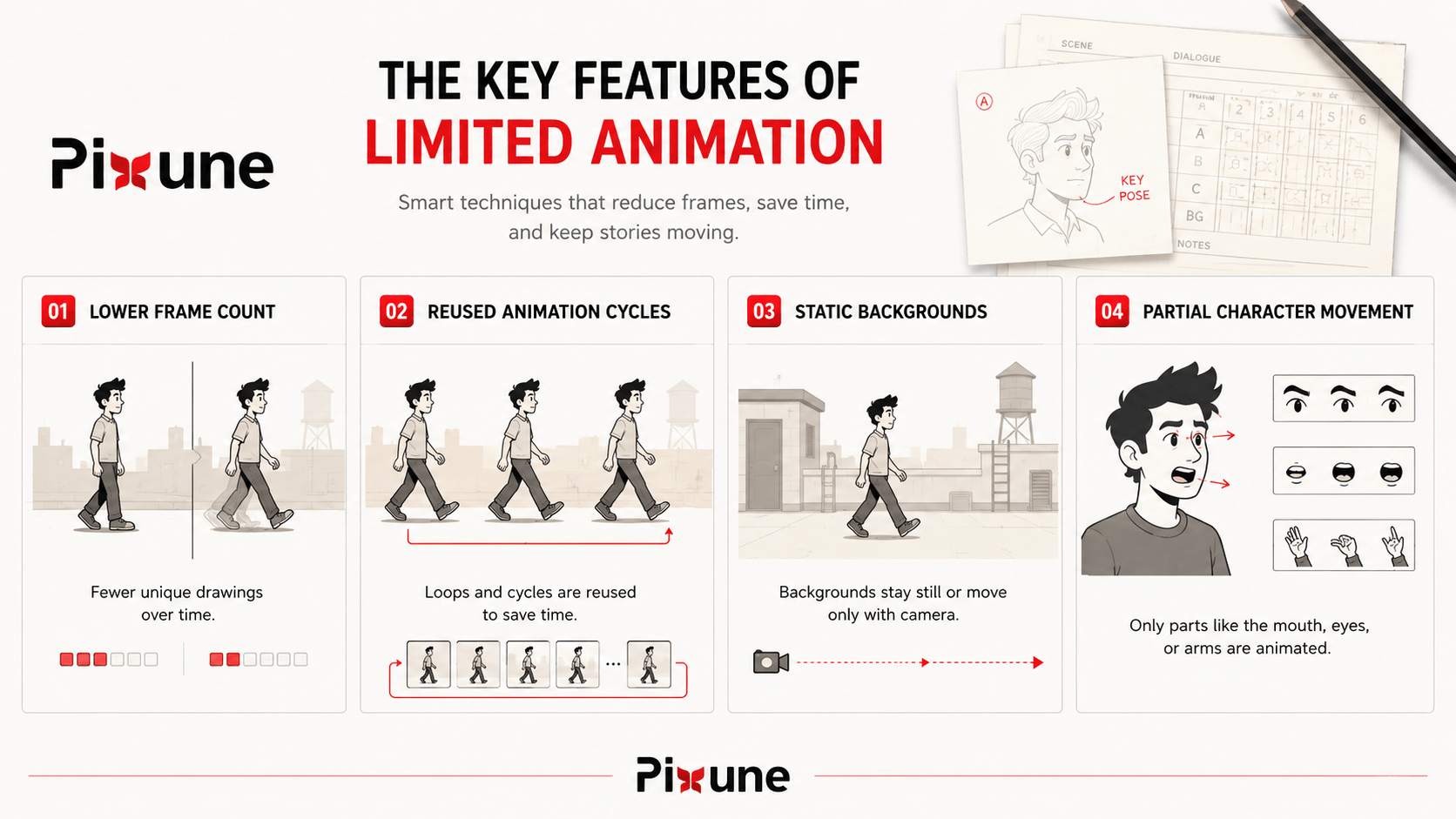
1. Lower Frame Count
One common characteristic of limited animation is a lower number of unique drawings over a given span of time. Instead of creating fresh artwork for every frame, animators may hold on drawings for longer or animate on fewer changes.
This does not always mean the final file literally runs at a lower playback frame rate. Often, the scene still plays back in a standard video format, but fewer unique poses are introduced within that playback.
That is why understanding animation frame rate can help when thinking about limited animation. The key issue is not only how many frames are displayed per second, but how many of those frames actually contain new movement.
Lower drawing counts reduce production time, but they also shape the visual rhythm of the work. When used well, this can create a deliberate, graphic style rather than simply making the animation feel sparse.
2. Reused Animation Cycles
Reusing cycles is another hallmark of limited animation. A walk, blink, run, or looped gesture can be animated once and then reused whenever needed.
This is especially useful in television, web content, and game-adjacent animation, where scenes may need to be produced quickly and repeatedly. Cycles save time and maintain consistency.
Repetition can become a weakness if it is overused carelessly, but when it is handled well, it becomes part of the visual design rather than a flaw. Many productions rely on repeated cycles because they allow the team to save effort for more important shots.
3. Static Backgrounds
Limited animation often relies on static or minimally changing backgrounds. Instead of redrawing the entire environment continuously, the background may remain fixed while the character moves in front of it.
Sometimes the background itself does not move at all. In other cases, the illusion of movement comes from a camera pan across a larger painted background.
This is one reason limited animation can still look visually rich even when movement is reduced. A strong background painting can carry atmosphere and design value without requiring expensive frame-by-frame animation.
4. Partial Character Movement
One of the clearest signs of limited animation is that only part of a character moves while the rest remains still.
For example, the mouth may move while the head and body hold. An arm may gesture while the torso remains static. The eyes may blink, but everything else stays locked in place.
This selective movement is central to the technique. It allows animators to direct attention toward the most important element of a shot without spending production time animating every part of the figure.
In many cases, this approach is supported by strong key poses. If the pose is expressive enough, only a small amount of movement is needed to make the scene feel alive. Pixune’s article on what keyframe animation is helps explain why those major poses matter so much in any animation workflow.
Common Techniques Used in Limited Animation
Limited animation is not one single trick. It is a collection of production techniques that reduce workload while preserving the illusion of motion and storytelling.
Some of these methods come from traditional cel workflows, while others continue today in digital cutout and compositing-based animation.
1. Hold Frames
A hold frame is exactly what it sounds like: a drawing or pose is held on screen instead of being replaced immediately with another one.
This is one of the simplest and most effective techniques in limited animation. If the pose is clear and the dialogue, sound, or camera treatment supports it, a hold can feel intentional rather than static.
Holds are especially common in dialogue scenes, reaction shots, and moments where emotional emphasis matters more than continuous body motion.
2. Cycle Animation
Cycle animation reuses a short sequence of movement, such as a walk, run, or repeated gesture. Rather than drawing the motion from scratch every time, the same sequence loops.
This technique is highly efficient and remains common in many forms of animation, especially when characters need repeated or background movement.
The success of a cycle depends on how well it is designed. A strong cycle feels purposeful and clean. A weak one feels mechanical and repetitive.
3. Mouth Flaps
Mouth flaps are one of the most familiar limited-animation devices. A character speaks while only the mouth changes shape, often with little or no movement in the rest of the head and body.
This is a practical way to handle dialogue-heavy scenes without animating a full performance every frame.
In some productions, mouth flaps are extremely simple. In others, they are combined with blinks, eyebrow movement, slight head turns, or camera changes to make the performance feel more alive.
4. Camera Pans and Zooms
Instead of animating every element in the frame, 2D animators can move the camera across still artwork. A pan across a background, a zoom into a character, or a push across a painted scene can create motion without requiring constant redrawing.
This technique is common in documentary-style animation, anime, motion comics, and stylized TV work. It helps the scene feel active while keeping the production efficient.
It also allows artwork to do more of the storytelling work. A strong composition can support a camera move even when the character animation is minimal.
5. Cutout and Puppet Animation
Cutout and puppet-based methods are closely related to limited animation because they break a character into separate movable parts rather than redrawing the whole figure repeatedly.
A head, torso, upper arm, forearm, hand, pelvis, and legs may each exist as separate pieces that can be posed and reused. This makes production faster and often more controllable, especially in television, explainer content, and digital series.
That is why cutout animation remains one of the most practical forms of limited animation in modern workflows. Pixune’s piece on the cut-out animator gives a closer look at the people and process behind this approach.
For a broader visual breakdown of limited-animation methods, this video is worth placing in the article here:
Advantages and Disadvantages
Limited animation has survived for decades because it solves real production problems. At the same time, it comes with trade-offs that every animation studio or creator needs to understand.
Its value depends on the goals of the project, not on a universal rule that says more movement is always better.
Lower Production Costs
The most obvious advantage of limited animation is cost efficiency. Fewer unique drawings, simpler movement, reusable cycles, and held frames all reduce the amount of labor required.
That can make animation possible for projects that would otherwise be too expensive. Television series, web shorts, indie productions, educational content, and social media projects often benefit from this.
Lower cost does not mean no artistry. It means the artistry is being focused more selectively.
Faster Production
Limited animation also supports faster schedules. A team can produce more footage in less time when it does not need to fully animate every second at the same level of detail.
This is especially important in serialized work, where delivery schedules are tight and consistency matters.
It also helps in modern pipelines that involve several stages of production. If you look at Pixune’s 2D animation pipeline, you can see how every stage depends on time, coordination, and available resources. Limited animation helps reduce the pressure on those stages by keeping the production manageable.
Creative Limitations
The drawback is that limited animation can feel stiff or repetitive if it is poorly designed. Weak posing, overused cycles, lifeless mouth flaps, or awkward stillness can make the work feel cheap rather than stylized.
It also gives the animator less room for fluid acting and nuanced body performance unless the production carefully chooses where to spend its effort.
That is why limited animation works best when the team understands its strengths. It should be treated as a design and staging choice, not merely a way to cut corners.
Examples of Limited Animation
Limited animation appears in several major corners of the animation world, although it does not look exactly the same in every context.
Its appearance changes depending on the medium, the audience, and the production goals.
TV Cartoons
Television cartoons are one of the clearest historical homes of limited animation. Once studios had to deliver episodes regularly and at lower budgets than theatrical shorts, limited methods became essential.
Held poses, repeating cycles, simple walk loops, reusable backgrounds, and talking-head dialogue scenes all helped television animation become economically sustainable.
This is one reason so many classic TV cartoons share a recognizable visual rhythm. They were designed not only as stories, but as productions that had to be made repeatedly on schedule.
Anime Production
Anime-style video should be discussed carefully here, because it is often misunderstood.
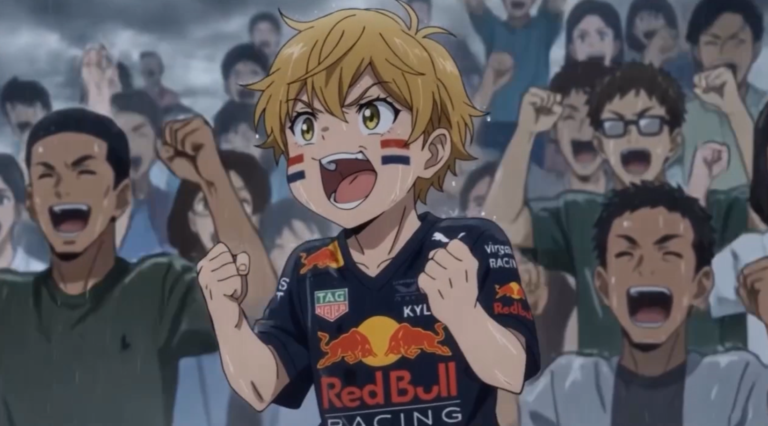
A lot of anime art styles use limited-animation techniques, but that does not mean anime is simply “cheap animation.” In many productions, stillness and selective movement are used strategically. A show may hold on a powerful drawing, pan across a detailed illustration, or animate only certain elements in a scene, then suddenly spend much more effort on a key emotional or action moment.
That balance is part of the craft.
Good anime direction often proves that strong composition, careful timing, and selective movement can create impact without constant full-body animation. This is one of the reasons limited animation remains such an important part of anime language.
This second video can sit naturally here because it helps illustrate how limited animation shows up in practice and how viewers often recognize it in animated works:
Motion Comics
Motion comics are another clear example of limited animation at work. Instead of fully animating characters frame by frame, they often animate panels, pans, zooms, layered cutouts, and selected facial or body movements.
This format depends heavily on the strengths of limited animation. It creates motion and pacing without requiring a full traditional or full-animation workflow.
That makes motion comics useful for adaptation, animated digital storytelling, branded content, and stylized promotional pieces.
Limited Animation vs Full Animation
Comparing limited animation with full animation can be helpful, as long as the comparison stays fair. One is not automatically superior in every situation.
They simply solve different production problems.
Visual Quality
Full animation usually offers more fluid motion, more frequent drawing changes, and often more complex body performance. This can create a richer sense of movement and detail.
Limited animation, by contrast, often relies more heavily on graphic design, staging, strong poses, and editing.
Visual quality, therefore, should not be judged only by how much moves. A beautifully directed limited scene can feel more effective than a fully animated scene with weak composition or poor acting choices.
Production Time
Full animation generally takes more time because more drawings, more inbetweens, and more changing elements need to be produced.
Limited animation speeds production by reducing the number of unique assets and changes required per shot.
That makes it especially valuable when time is a major constraint, such as in TV production, social content, or multi-episode work.
Budget Comparison
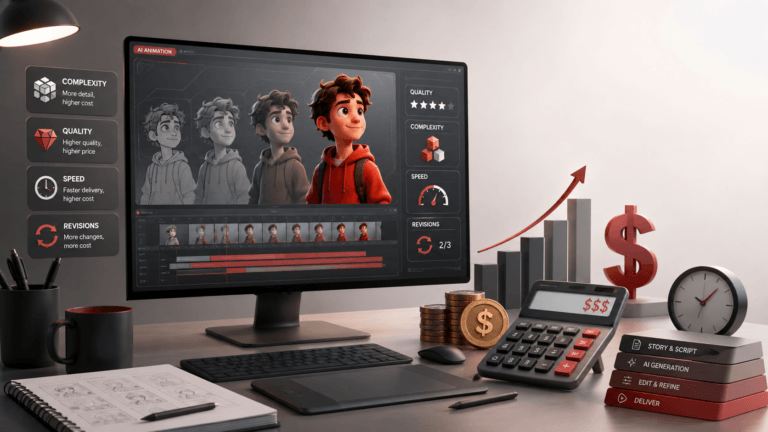
Budget differences follow from the labor difference. More drawings and more complex motion usually mean more production hours, more revisions, and more cost.
Limited animation lowers that cost by simplifying what must be animated. You can also read more about 2D vs. 3D animation production costs.
Still, the better question is not which method is cheaper in the abstract. The real question is which method is appropriate for the project. A stylized streaming series, an explainer video, or a motion comic may gain very little from fully animating every moment. In those cases, limited animation may simply be the smarter choice.
This third video fits well in this comparison section because it helps reinforce the practical distinction between animation approaches and why reduced movement does not automatically equal poor craft:
Is Limited Animation Still Relevant Today?
Limited animation is absolutely still relevant. In fact, in many parts of the industry, it is more relevant than ever.
Modern frame-by-frame animation tools have changed the workflow, but they have not removed the need for efficiency.
Streaming and Television
Streaming platforms and television still rely on schedules, budgets, and repeatable production systems. Even when the visual finish improves, the logic behind limited animation often remains.
Studios still need to decide where to spend time and where to simplify. That makes limited animation not just a historical technique, but an ongoing production solution.
Indie Games and Mobile Games
Indie games and mobile projects often face budget and team-size limits similar to television. They need expressive visuals, but they may not have the resources for full character animation in every scene.
Limited animation techniques such as cutout rigs, cycle reuse, held poses, and selective movement make these productions possible without stripping away all personality.
Digital Content and Social Media
Digital and social media content has become one of the strongest modern homes for limited animation. Explainer videos, social media clips, animated ads, motion comics, and stylized shorts often rely on exactly the same ideas: move what matters, hold what does not, and build rhythm through editing and design.
This is one reason the topic also connects naturally to the broader animation pipeline. Even as tools evolve, production still depends on balancing quality, time, and budget.
Conclusion
Limited animation is best understood as a selective approach to motion. It reduces the number of unique drawings and animated elements in order to save time, lower cost, and make production practical, especially for television, anime, motion comics, and digital content.
But that is only half the story.
At its best, limited animation is not a compromise that ruins quality. It is a creative discipline that asks a smarter question: what actually needs to move for the scene to work?
When the answer is handled with good design, strong posing, clear staging, and thoughtful timing, limited animation can be expressive, memorable, and highly effective. That is why it remains such a major part of animation history and such a relevant production method today.


![1405,02,10 SnpLE[Cover HD] 1](https://pixune.com/wp-content/uploads/2026/08/14050210-SnpLECover-HD-1-768x431.jpg)